Twitter?

twitter.jpg

What’s wrong with this picture? As it turns out, a lot. At the October 6th Target First Saturday, we decided to experiment with Twitter and this post will take you through the first wave of our experience. As with all new web ventures, we like to keep things as simple as possible until we get a feel for the requirements. When starting with Twitter, we decided to simply give updates at the event and not complicate the issue with the Twitter API, so I updated our feed manually throughout the evening.

Problem #1 came during testing. Although it’s a fairly simple process to sign people up on the spot, it requires 5 text messages to do so. To join our feed from the event:

  • Visitor texts “follow username” to 40404
  • They get a message back “Now you’ll know what’s going on with username. But, what are you doing? Reply w your answer.”
  • They respond with something.
  • Then they get another message “Thanks! Reply w your name so you can tell friends how to follow you!”
  • They respond with their name, so the account can be identified.

Umm, wow. That’s a lot to get someone signed up and a bit confusing if folks don’t know the social aspects of Twitter, right? When you’ve got thousands of people coming through the door it’s impossible to explain all this. We made an attempt in our signage (above), but it makes the sign text heavy and that’s not good.

Problem #2 cropped up with our signage. Take a look at the photo above. We had about 10 of these tabletop signs on the visitor desk and other locations, but they were small and text heavy. With thousands of people streaming through the doors, this type of signage gets buried. As I was watching all of this during the event, I remembered something. Back in the Spring, I attended the Web 2.0 Expo in San Francisco and look what they did:

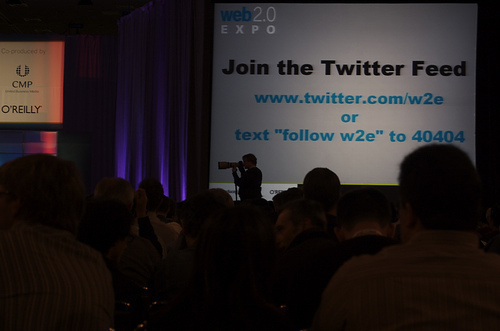
464909118_7c97c60e7f.jpg 462197807_c0690bdfa5.jpg
(photos L to R: emilychang, MichaelBee)

There were giant displays with all the Twitter activity right as you went into the conference halls. In the auditorium, they had slides encouraging people to sign up. I wish I could put these displays right where our lines form for tickets, but there’s no budget for this…..at least not in the early stages. What really got me at the Expo, was the spectacle of it all. When you see a display like this, you instantly get the social nature of the application and you don’t get buried in too many words. It’s a very visual thing and it works very well.

Problem #3 concerned use. At a conference like Web 2.0 Expo, Twitter makes a lot of sense. Many participants come alone and need to make connections with each other. At Target First Saturday, most people come in groups and are socializing already, so I’m not sure it works as well in this context. In addition, Twitter is great for people with unlimited sms plans, but for people who have limited plans or pay-as-you-go txting, it’s a lot of messages: 5 to get started + announcements from us + txting what you are doing = do I really want to do this?

Is the use of Twitter at live events over at the Brooklyn Museum? Well, I’m not totally sure. This application may not be right for us or it may just require more experimenting to find the right use. Many of us have read this blog post, and we’ve been thinking along these lines. It might work really well if:

  • The sign up process could be simplified. It would be really great if Twitter had an “event mode” to bypass some if the back and forth.
  • Signage is adjusted.
  • We did something really special with Twitter, so that visitors are engaged and want to participate.
  • Perhaps we stage a Twitter event, so that people already using Twitter are the participants instead of trying to recruit a new audience.

We learned a lot here and all of it is valuable as we move forward. Many thanks to Biz and Alex at Twitter for helping with support issues and questions. I have to say, it’s really fantastic to be able to talk to a founder and a developer directly and was a tremendous help in this first go round.

Author profile

About Shelley Bernstein

Shelley is the Chief of Technology at the Brooklyn Museum where she works to further the Museum's community-oriented mission through projects including free public wireless access, web-enabled comment books, projects for mobile devices and putting the Brooklyn Museum collection online. She is the initiator and community manager of the Museum's initiatives on the social web, she co-created 1stfans: a socially networked museum membership, organized Click! A Crowd-Curated Exhibition and Split Second: Indian Paintings. In 2010, Shelley was named one of the 40 Under 40 in Crain's New York Business and she's been featured in the New York Times. She can be found biking to work or driving '74 VW Super Beetle in Red Hook, Brooklyn with her dog Teddy. ::contact::
Filed under: Technology
Tagged:
Bookmark the permalink

8 Responses to Twitter?

  1. Nate Solas says:

    Thanks for posting your experience with Twitter in this new environment. Too often I think museums only post about their successes, and while this doesn’t sound at all like a failure, it was great to read about the issues you ran into and ideas you have for next time. Hopefully you or whoever tackles this next can learn from this project and avoid some of the same mistakes.

    … although I do think it will have to be something “extra cool” to really get people to want to buy in. Otherwise it is almost too much at once. Keep us posted!

  2. Matt Morgan says:

    Shelley, thanks, this is great. Lots of museums, I think, can learn from your willingness to experiment & push to get these things to work right, while being totally realistic about the possibilities for success. Too often we nix the imperfect ideas before we’ve really considered them carefully.

  3. Bravo for experimenting!! I hope you try it again, if you can tweak the issues you mentioned. I look forward to reading how it works out.

  4. Thanks for this! I too have found Twitter to be very labor intensive and easy to forget about. I love the idea of an “event mode” for Twitter. It seems like something that may actually make Twitter more useful (in my mind). I for one tend to make my twitter-like updates on Facebook, which also allows texting from cell phones and which I know gets to all my friends, even those without Twitter accounts, and is more connected to other social activities within FB.

  5. Nina Simon says:

    Shelley,

    This is excellent–I’ll blog it soon. I’m now working with a museum on a project to solicit exhibit ideas from people all over the world (and visitors), and I’m looking for a twitter-like application where people can submit short, wild ideas. The goal would be that anyone could post their idea to this application, and it would all show up as in a twitter timeline–but without forcing anyone to log in. Functionally, I’m looking for an open group twitter. I know one option is a super pared-down blog, but I’m curious if anyone out there has other suggestions so we can use this as a way to keep up a stream of energetic submissions from individuals at home, at the museum, and potentially have some of the twitter benefits of following it with the platform that works best for you.

    Any ideas out there?

  6. Hi Nina,

    I wonder about Jaiku (http://jaiku.com/). I can’t tell if it is easier to sign up or not direct via mobile, but they have an API and it looks like it may have some potential.

  7. Robert Duffy says:

    Hey all.. Thanks for writing this.. I started a Twitter account for the Wexner Center that we’re playing around with internally right now…

    One thing that seems different than this blog post (and maybe it’s new to how they do things) is there seems to only be two calls of action to sign up:

    1. Sent the 40404 text
    2. Confirm with your name.

    The language around the third “so what are you up to” seems optional and is definitely not required..

    Like I said, maybe this is new to how people subscribe…

    And I don’t think the two texts are that big of a deal, considering that the people who live in txt message world are used to sending 2.3 million a day. :)

    Thanks again for the report, it was helpful!

  8. This is good news. Back when we were doing this project, the Twitter team I was working with said they were really close to simplifying the process a bit, so maybe they made some progress here. The language around “what are you up to” has always been optional, but it’s not that clear. We had folks totally confused at that point and then I was standing there saying “no, you don’t have to do that part” which was impossible to convey in signage.

Leave a Reply

Your email address will not be published. Required fields are marked *

*

You may use these HTML tags and attributes: <a href="" title=""> <abbr title=""> <acronym title=""> <b> <blockquote cite=""> <cite> <code> <del datetime=""> <em> <i> <q cite=""> <strike> <strong>

9 Reactions

  1. Pingback: BrandingFire Blog » Brooklyn Museum Tests Twitter

  2. Pingback: New Media Initiatives Blog » WebWalker 2.1

  3. Pingback: iPodly » WebWalker 2.1

  4. Pingback: Twitter for Museum 2.0 « UK eInformation Group

  5. Pingback: We Are All Twits : Robert HC’s PonderBlog

  6. Pingback: düğümküme » Click: Sadece Bir Başka Sergileme Deneyi mi?

  7. Pingback: Serie Web 2.0 im Kulturmarketing: Twitter für Kulturangebote? | Kulturmarketing Blog

  8. Pingback: Serie Web 2.0 im Kulturbereich - Basiswissen: Web 2.0 in der Kulturvermittlung | stART Conference 2009 |stARTconference

  9. Pingback: Twitter et les musées plus qu’une présence une vrai relation « Museonet2.0