Elizabeth Blackwell
(b. 1821, Bristol, England; d. 1910, Sussex, England)
Born in England, Blackwell emigrated with her family to the United States in 1832, and lived in New York City. Privately tutored both in England and in America, she began her professional career as a teacher to aid her family economically after her father's death. At the time Blackwell decided on a medical career, there were no academically trained female physicians in the United States, making her acceptance to medical school unlikely. Admission to medical school also required previous experience, which as a schoolteacher, Blackwell did not have. Undeterred, she used her teaching skills to her advantage, moving to Asheville, North Carolina, to be a music teacher for the daughters of Dr. John Dickenson. There, Blackwell bolstered her medical résumé through his tutelage, and by observing his practice and using his medical library.
The admission of a female student into an American medical school was unprecedented. Some doctors Blackwell knew encouraged her to apply as a man, while others discouraged her altogether. She was rejected by almost all of nearly thirty schools to which she applied. She was accepted at Geneva Medical College in Geneva, New York where she began her studies in 1847. Despite being snubbed by the local community, referred to by the dean of faculty as an "inconvenience" to male students, and asked not to attend lectures on the male reproductive system, Blackwell persevered. She excelled in all of her studies, from anatomy to material medica, or the study of the origin, preparation, dosage, and administration of drugs. In January 1849, Blackwell graduated first in her class, after which the college closed its doors to women.
After medical school Blackwell faced additional difficulties. The dean never wrote the recommendation letters he once promised her. She was refused jobs in numerous hospitals; she had difficulty finding patients who would be treated by a female doctor and consequently she had trouble establishing her own practice. With the help of a cousin, in 1850, Blackwell began studying under Sir James Paget at St. Bartholomew's Hospital in London. She started a friendship with activists Baroness Anne Isabella Noel Byron (Lady Byron), and Barbara Leigh Smith, and also met Florence Nightingale, who was fighting for medial reform in England. Blackwell returned to the U.S. in 1851 to open a private practice with her sister Emily, who was studying to become a doctor in Chicago and facing opposition due to the controversy caused by Elizabeth's accomplishments.
Blackwell soon became an advocate and lecturer for the benefits of preventative medicine and physical hygiene. At the same time, she urged other women to pursue medical careers and pushed to make medical education available to more women. In order to address her biggest concerns—improving access to medical care and providing a place for women to work in the medical field—Blackwell founded the New York Infirmary for Indigent Women and Children in 1857, which still exists as part of the New York University Downtown Hospital.
Although she preferred that women study alongside men in the same medical schools, Blackwell realized the obstacles to co-ed education. In 1868, she established the Woman's Medical College of the New York Infirmary and served as its professor of hygiene. In 1869, Blackwell returned to England, where she continued her medical advocacy. Leaving her sister to run the infirmary and college, Blackwell lived out the remainder of her life in England, continuing her work as a lecturer and advocate for medical causes. She published her autobiography, Pioneer Work in Opening the Medical Profession to Women, in 1895.
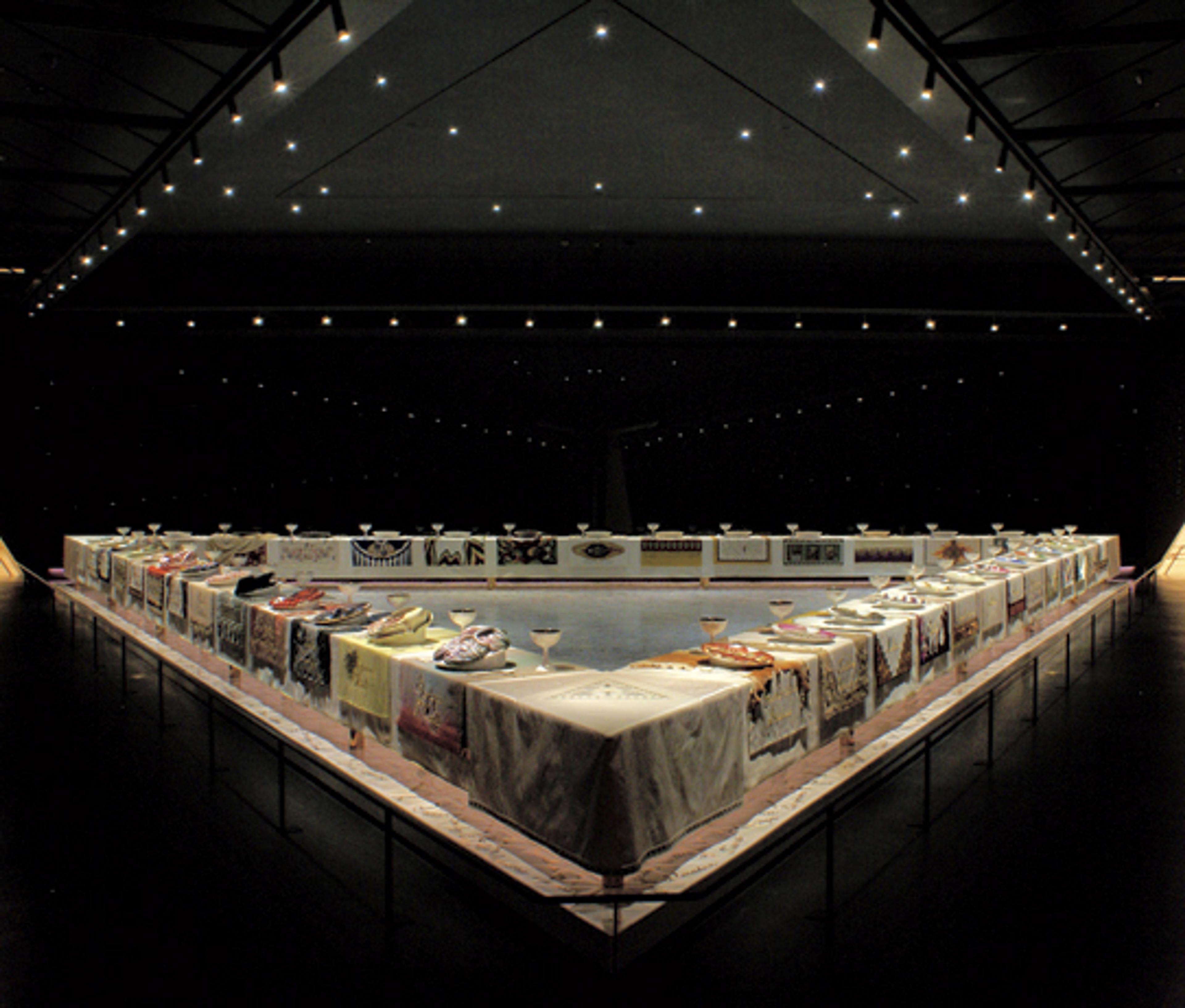
Elizabeth Blackwell at The Dinner Party
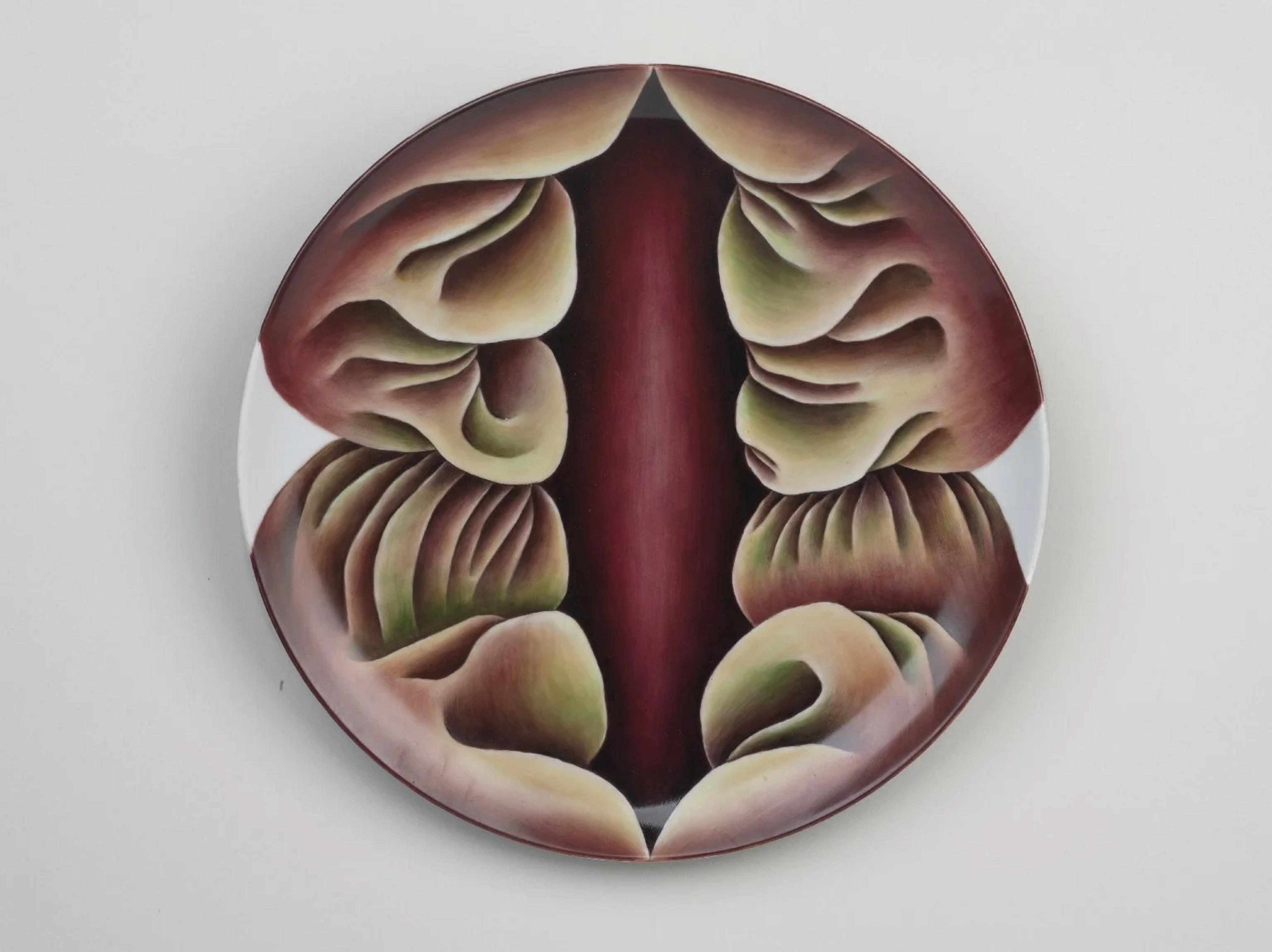
The plate's bright palette is repeated through the rainbow colors of the runner, an abstract butterfly shape with scalloped edges resembling wings. The butterfly is a symbol repeatedly used in The Dinner Party to represent women's freedom. In this setting, it can be interpreted as a celebration of Blackwell's landmark achievements in medicine. The swirling motion depicted in the plate and runner also symbolizes the shift in thinking that allowed for more opportunities for women. The brilliant colors of the runner, however, are veiled in a thin gray chiffon, suggesting the difficulties Blackwell and other women pursuing careers in male-dominated fields still had to endure. The technique used to create the runner's form, reversed appliqué, or the cutting away of layers of fabric, is also a metaphor for the "obstacles faced by women wishing to break into various professions" (Chicago, The Dinner Party, 131).
The illuminated letter "E" on the front of the runner is embroidered as a stethoscope, a medical symbol referencing Elizabeth Blackwell as the first female doctor in the U.S.
Related Heritage Floor Entries
Elizabeth Anderson
Clara Barton
Marianne Beth
Emily Blackwell
Sophie Blanchard
Marie Bovin
Edith Cavell
Marie Curie
Babe Didrikson
Marie Duges
Marie Durocher
Amelia Earhart
Emily Faithful
Althea Gibson
Charlotte Guest
Salomée Halpir
Jane Harrison
Sophia Heath
Marie Heim-Vögtlin
Sonja Henie
Kate Campbell Hurd-Mead
Irene Joliot-Curie
Elin Kallio
Betsy Kjelsberg
Sofia Kovalevskaya
Marie la Chapelle
Rebecca Lee
Belva Lockwood
Madame A. Milliat
Margaret Murray
Florence Nightingale
Emmy Noether
Susan la Flesche Piccotte
Marie Popelin
Clemence Royer
Anna Schabanoff
Emilie Snethlage
Miranda Stuart
Amelia Villa
Dorothea von Rodde
Mary Walker
Nathalie Zand
Primary Sources
The Laws of Life, With Special Reference to the Physical Education of Girls. New York: G. P. Putnam, 1852.
Counsel to Parents on the Moral Education of Their Children, In Relation to Sex. 1878; 2nd ed., London: Hatchards, 1879.
The Human Element in Sex: Being a Medical Enquiry Into the Relation of Sexual Physiology to Christian Morality. London: J. & A. Churchill, 1884.
Purchase of Women: The Great Economic Blunder. London: John Kensit, 1887.
The Religion of Health. 1871; 3rd ed., London: Moral Reform Union, 1889.
Why Hygienic Congresses Fail: Lessons Taught by the International Congress of 1891. London: Bell & Sons, 1892.
Pioneer Work in Opening the Medical Profession to Women: Autobiographical Sketches. London: Longmans, 1895.
Scientific Method in Biology. London: Elliot Stock, 1898.
Essays in Medical Sociology. 2 vols. London: Ernest Bell, 1902.
Translations, Editions, and Secondary Sources
Bashford, Alison. Purity and Pollution: Gender, Embodiment, and Victorian Medicine. Basingstoke: Macmillan, 1998.
Bix, Amy Sue. Introduction to Pioneer Work in Opening the Medical Profession to Women: Autobiographical Sketches, by Elizabeth Blackwell. Amherst, N.Y.: Humanity Press, 2005.
Boyd, Julia. The Excellent Doctor Blackwell: The Life of the First Woman Physician. Stroud, England: Sutton, 2005.
Kline, Nancy. Elizabeth Blackwell: A Doctor's Triumph. Berkeley: Conari Press, 1997.
Sabin, Francine. Elizabeth Blackwell. New York: Troll Associates, 1982.
Sahli, Nancy Ann. Elizabeth Blackwell, M.D. (1821–1910): A Biography. 1974; 2nd ed., New York: Arno Press, 1982.
Walsh, Mary Roth. Introduction to Pioneer Work in Opening the Medical Profession to Women: Autobiographical Sketches, by Elizabeth Blackwell. New York: Schocken Books, 1977.
Wright, Mary. Elizabeth Blackwell of Bristol: The First Woman Doctor. Bristol, England: Bristol Branch of the Historical Association, 1995.
Web Resources
National Library of Medicine—National Institutes of Health : Elizabeth Blackwell Photo Gallery
National Library of Medicine—National Institutes of Health : "That Girl There is Doctor in Medicine: Elizabeth Blackwell, America's First Woman M.D."
The British Library : Showcases - Landmarks in Printing: Elizabeth Blackwell's "A Curious Herbal"
FAQ

Eastern Parkway/Brooklyn Museum