Theodora
(b. 500, Crete or Syria, exact location unknown; d. 548, Constantinople)
She grew up on the outskirts of the Byzantine Empire with a father who was an animal trainer. After his death, Theodora took the stage as an actress to support the family. During this time, the profession was considered scandalous—being an actress was synonymous with being a prostitute—but Theodora took every opportunity to move up in a very rigid class system. In 516, at the age of sixteen, she traveled to Alexandria, Egypt, where she discovered and adopted Monophysitism, the belief that Jesus Christ was wholly divine. Theodora converted, renouncing her former career and lifestyle.
Theodora met Justinian I in 522, who was at that time heir to the throne. Justinian wanted to wed immediately, but as heir, he was forbidden to marry an actress, even one who had reformed. Justinian had this law repealed the following year, and the two were married in 525.
Theodora and Justinian were known for ruling as intellectual and political equals, and Theodora was responsible for much of the reformation of Byzantium. In 528, construction began on the Basilica of San Vitale in Ravenna, Italy, built as an imperial church on the outskirts of the Byzantine Empire. The basilica's mosaic, completed in 548, depicts both the emperor and the empress participating in an imperial procession, signifying her equal role and importance in ruling the empire.
In 532, religious unrest plagued the region. A conflict between two political and religious groups, the Blues and the Greens, began during a chariot race at the Hippodrome and quickly grew into what is now known as the Nika Revolt. This revolt destroyed much of Constantinople, and many saw this as a chance to overthrow Justinian, who wished to flee. Instead, Theodora spoke out, preferring to die a ruler than to be removed from power, and her courage prompted Justinian to send in troops to calm the rebels. After quelling the revolt, Theodora and Justinian confronted the destruction of important monuments in Constantinople, including the original Hagia Sophia. The couple rebuilt the basilica, which was rededicated in 537. It was the largest church of the period and later became one of the greatest examples of Byzantine architecture.
During her time as empress, Theodora fought for the persecuted. She attended to the rights of prostitutes in particular by closing brothels, creating protective safe houses, and passing laws to prohibit forced prostitution. In addition, she passed laws that expanded the rights of women in divorce cases and abolished a law that had allowed women to be killed for committing adultery. Finally, she strove to protect the persecuted Monophysites, building houses of worship that served as refuges.
Theodora died in 548, but her influence was apparent in Justinian's subsequent rule. He sought to maintain the same level of freedom for women, setting a precedent for women's equality. He also fought for the Monophysites, despite his own conflicting orthodox beliefs.
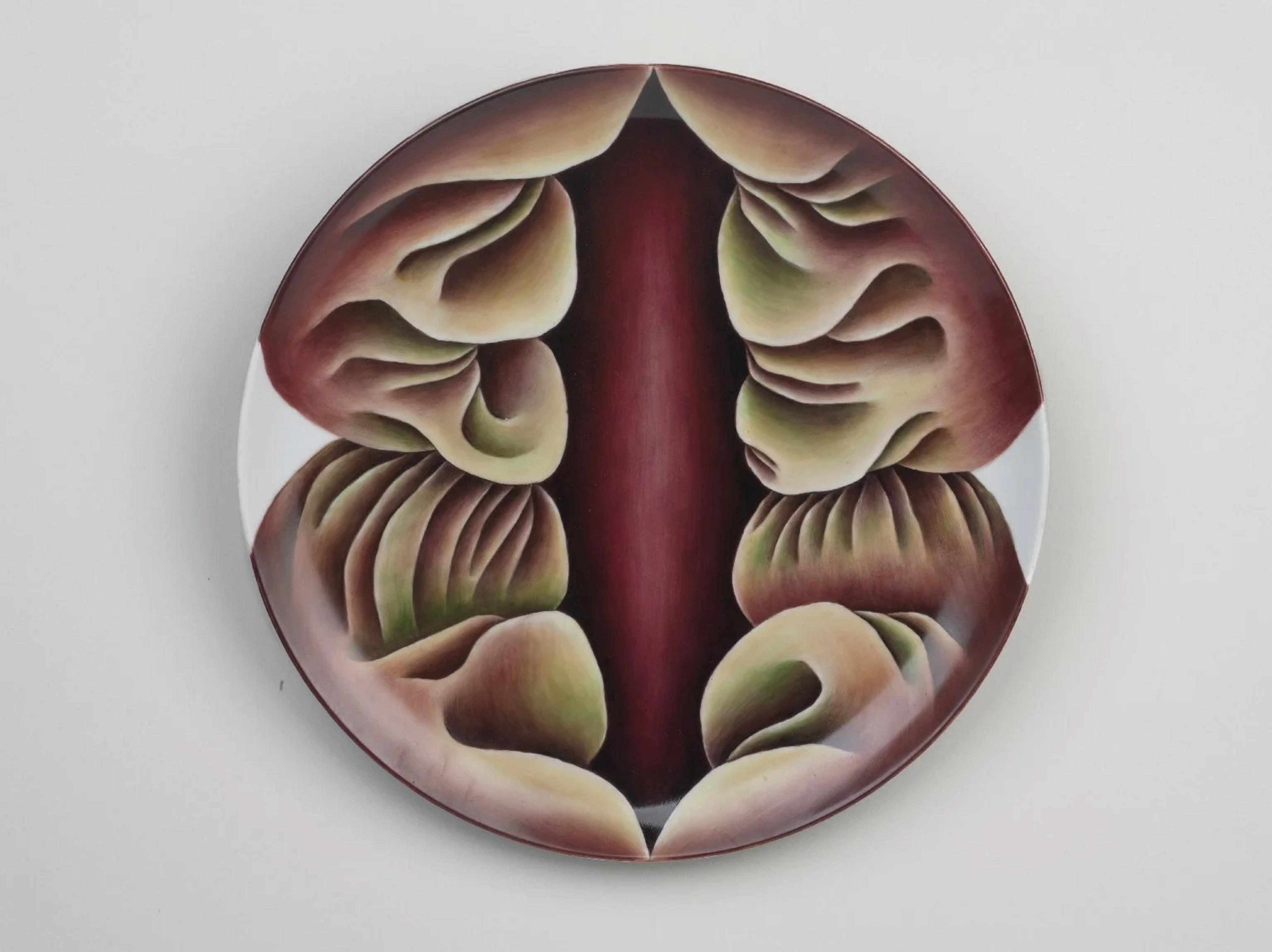
Theodora's plate was painted to resemble mosaic tiles. The imagery is a symmetrical abstract butterfly form, each wing stretching to the edge of the plate. The extended wings represent Theodora's ability to expand her own role in Byzantium and to create freedoms for women during her time. The symmetry of the image echoes a basilica plan, with a colonnade of Roman arches in the upper quadrants of the wings.
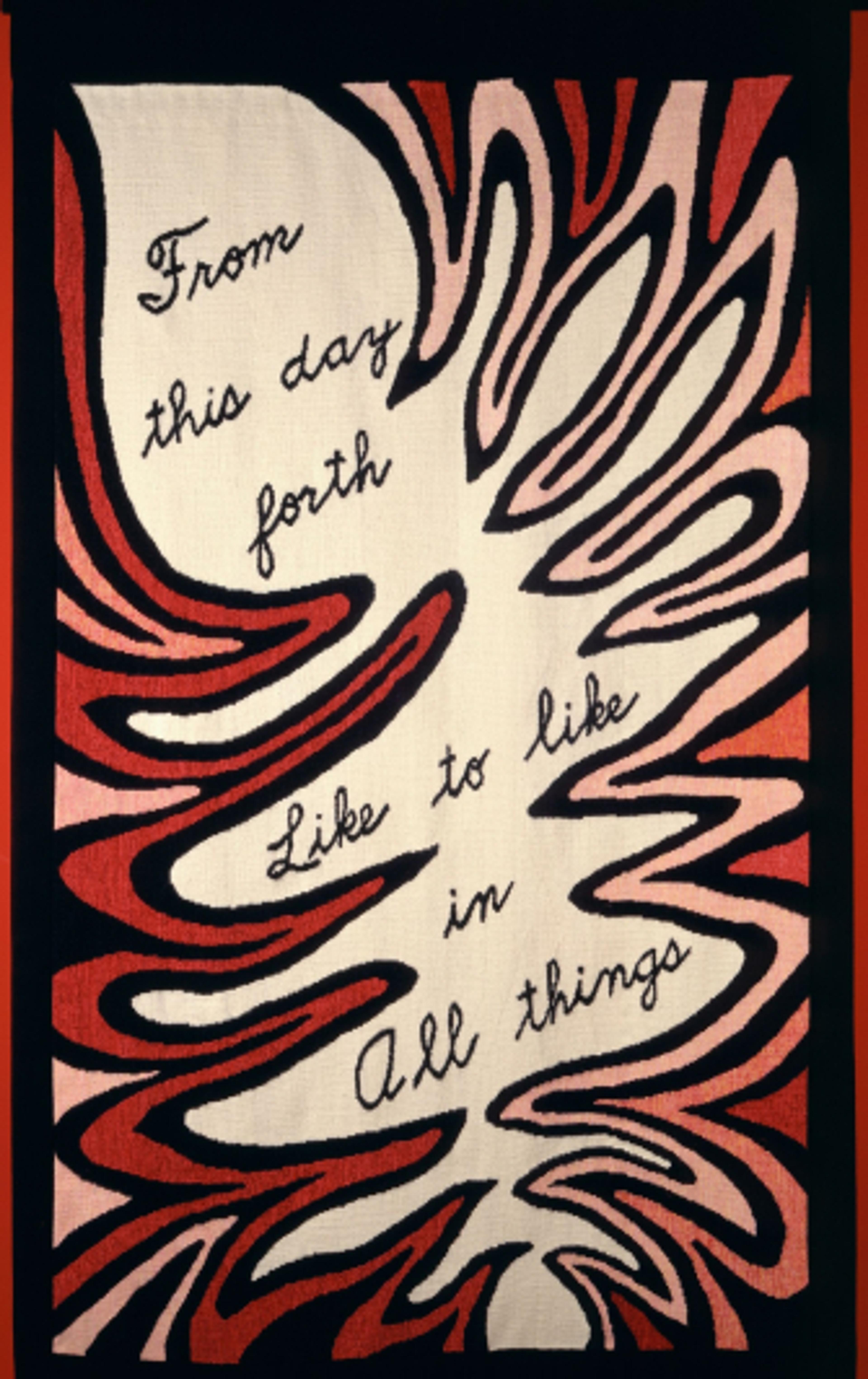
A mosaic-like halo is embroidered on the runner, the plate resting in its center, which references the halo in the Ravenna mosaic and associates Theodora with both her imperial reign and her religious work. Embroidered on the illuminated capital "T" is the dome from one of the most celebrated architectural monuments of Theodora's reign, Hagia Sophia, built in 530. The back of the runner is finished with a half-shell design, referencing the imperial collars worn during Theodora's reign.
Related Heritage Floor Entries
Adelaide
Aethelburg
Aethelflaed
Balthilde
Bertha of England
Brunhilde
Clotilda
Anna Comnena
Anna Dalassena Comnena
Damelis
Engleberga
Eudocia
Eudoxia
Fredegund
Irene
Leoparda
Maude
Olga
Olympia
Pulcheria
Radegund
Theodelinda
Theodora II
Theodora III
Wanda
Zoé
Primary Sources
Translations, Editions, and Secondary Sources
Bridge, Antony. Theodora: Portrait in a Byzantine Landscape. London: Cassell, 1978.
Browning, Robert. Justinian and Theodora. 1971; 2nd. ed., New York: Thames and Hudson, 1987.
Cameron, Averil. Procopius and the Sixth Century. Berkeley: University of California Press, 1985.
Connor, Carolyn L. Women of Byzantium. New Haven: Yale University Press, 2004.
Evans, James Allan Stewart. The Age of Justinian: The Circumstances of Imperial Power. London and New York: Routledge, 1996.
---. The Empress Theodora: Partner of Justinian. Austin: University of Texas Press, 2002.
Garland, Lynda. Byzantine Empresses: Women and Power in Byzantium AD 527–1204. London and New York: Routledge, 1999.
Garlick, Barbara, Suzanne Dixon, and Pauline Allen, eds. Stereotypes of Women in Power: Historical Perspectives and Revisionist Views. New York: Greenwood Press, 1992.
Herrin, Judith. Women in Purple: Rulers of Medieval Byzantium. Princeton: Princeton University Press, 2001.
Procopius. The Anecdota of Secret History, translated by H.B. Dewing. Cambridge, Mass.: Harvard University Press, 1935.
Web Resources
FAQ

Eastern Parkway/Brooklyn Museum