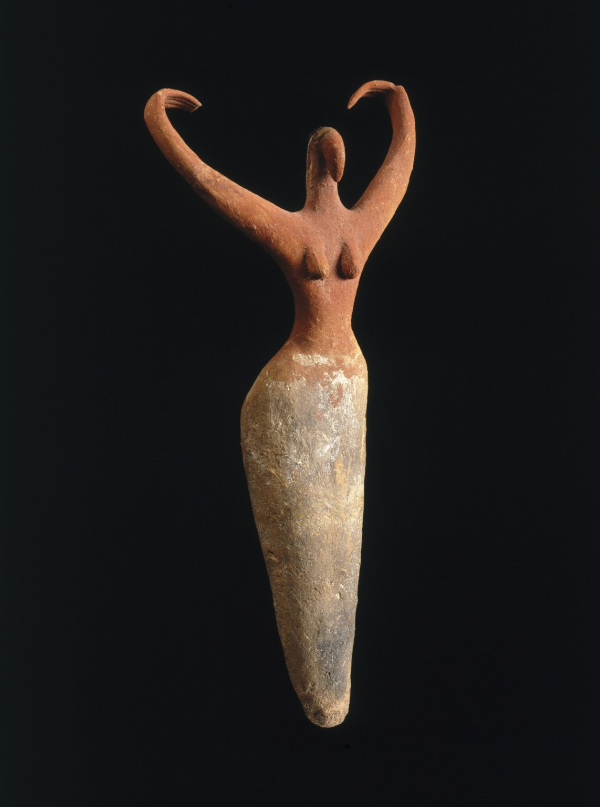
Female Figurine. Egypt, from Ma’mariya. Predynastic Period, Naqada II, circa 3500–3400 B.C.E. Terracotta, painted, 111⁄2 x 51⁄2 x 21⁄4 in. (29.2 × 14 × 5.7 cm). Brooklyn Museum, Charles Edwin Wilbour Fund, 07.447.505
Female Figurine. Egypt, from Ma’mariya. Predynastic Period, Naqada II, circa 3500–3400 B.C.E. Terracotta, painted, 111⁄2 x 51⁄2 x 21⁄4 in. (29.2 × 14 × 5.7 cm). Brooklyn Museum, Charles Edwin Wilbour Fund, 07.447.505

Statue of Nykara and His Family. Egypt, provenance not known. Old Kingdom, late Dynasty 5, circa 2455–2350 B.C.E. Limestone, painted, 225⁄8 x 141⁄2 x 10⁷⁄8 in. (57.5 × 36.8 × 27.7 cm). Brooklyn Museum, Charles Edwin Wilbour Fund, 49.215
This family statue depicts Nykara, who was a scribe of the granary, seated between the standing figures of his son, Ankhmara, and his wife, Khuen-nub. Beneath the central part of Khuen-nub’s short wig, her natural hair is indicated by horizontal lines and a row of stylized curls. The boy’s nakedness, sidelock of hair, and finger-to-mouth gesture indicate that he is very young, but he is depicted as the same height as his mother. And, if Nykara were shown standing, he would tower over his two companions. Although Old Kingdom group statues often show the man on a larger scale, this particular composition seems also to reflect the sculptor’s desire to show all three heads in a row.

Kneeling Statue of Senenmut. Egypt, from Armant. New Kingdom, Dynasty 18, joint reign of Hatshepsut and Thutmose III, 1478–1458 B.C.E. Granite, 189⁄16 x 67⁄8 in. (47.2 × 17.4 cm), base: 63⁄4 x 215⁄16 x 119⁄16 in. (17.2 × 7.5 × 29.3 cm). Brooklyn Museum, Charles Edwin Wilbour Fund, 67.68
Senenmut, a powerful official of the female pharaoh Hatshepsut, commissioned at least twenty-five statues of himself. This innovative statue type, which shows him holding a divine symbol, was offered to Montu, the god of Armant, in petition for Hatshepsut’s well-being and his own eternal reward. The image, which depicts a cobra resting on a pair of upraised arms and crowned with a cow’s horns and a sun disk, is identified in the inscription as Renenutet, a goddess of harvest and nourishment. However, it can also be read as a cryptogram for Maatkara, Hatshepsut’s throne name—a visual pun made possible by the close relationship between Egyptian hieroglyphic writing and art.

The Brooklyn Black Head. Egypt, provenance unknown, reportedly from Memphis. Ptolemaic Period, circa 50 B.C.E. Diorite, 165⁄8 in. (42.2 cm). Brooklyn Museum, Charles Edwin Wilbour Fund, 58.30
During the Ptolemaic Period (332–30 B.C.E.), when Egypt was ruled by a family of Greek descent named Ptolemy, large numbers of Greeks moved to Egypt, where many served as government officials. We cannot know, therefore, whether this striking head, from an over-life-size statue, represented a Greek or a native Egyptian, especially since its striking features are a blend of Egyptian and Greek styles. The short curls, for example, are a simplified rendering of a Greek hairdo, and the large, deep-set eyes derive from images of Alexander the Great. But the facial modeling, with its folds and furrows, has many precedents in Egyptian art, as does the narrow, sharply outlined mouth. We may see here the beginning of a mixed Greco-Egyptian style, which was soon to disappear when the Romans conquered Egypt.

Cartonnage of Nespanetjerenpere. Egypt, probably from Thebes. Third Intermediate Period, Dynasty 22 to early Dynasty 25, circa 945–718 B.C.E. Linen or papyrus mixed with plaster, pigment, glass, lapis lazuli, height: 6911⁄16 in. (177 cm). Brooklyn Museum, Charles Edwin Wilbour Fund, 35.1265
Cartonnage, a substance made of cloth or papyrus mixed with plaster and water, was used during the Third Intermediate Period to make an innermost case for the mummified body. The mummy was inserted and the covering was then painted with funerary scenes and inscriptions and placed in one or more coffins, which had been decorated in much the same way. The decoration here was chosen to associate its occupant, the priest Nespanetjerenpere, with divine resurrection. The ram-headed falcon on his chest represents the sun god’s nightly journey through the land of the dead. The small figures on the front represent deities aligned with various parts of his body, as described in the funerary Book of the Dead.

The Wilbour Plaque. Egypt, probably from Akhetaten (“Horizon of the Aten”), modern Amarna. New Kingdom, Dynasty 18, reign of Akhenaten, probably late in his reign, circa 1352–1336 B.C.E. Limestone, 63⁄16 x 811⁄16 x 15⁄8 in. (15.7 × 22.1 × 4.1 cm). Brooklyn Museum, Gift of Evangeline Wilbour Blashfield, Theodora Wilbour, and Victor Wilbour honoring the wishes of their mother, Charlotte Beebe Wilbour, as a memorial to their father, Charles Edwin Wilbour, 16.48
The Wilbour Plaque is named for the early American Egyptologist Charles Edwin Wilbour (1833–1896), who acquired it in Egypt in 1881. The small slab is not part of a larger scene but complete as it was made. It was intended as a sculptor’s model, to be studied and imitated by students and beginning artists. With the hole at the top, it could be hung on a workshop wall. On the left is the head of a king, most probably a representation of Akhenaten, who wears the baglike khat headdress with a royal uraeus. Opposite him is the head of a queen wearing the ovoid cap crown often worn by Nefertiti, also with a uraeus. Both heads have ear holes for earrings. The carving is a splendid example of the elegant royal style that developed toward the end of the Amarna Period.

Statuette of Queen Ankhnes-meryre II and Her Son, Pepy II. Egypt, probably from Upper Egypt. Old Kingdom, Dynasty 6, reign of Pepy II, circa 2288–2224/2194 B.C.E. Egyptian alabaster, 157⁄16 x 913⁄16 in. (39.2 × 24.9 cm). Brooklyn Museum, Charles Edwin Wilbour Fund, 39.119
Pepy, who became king at about the age of six, had one of the longest reigns in world history. During his childhood his mother, Queen Ankhnes-meryre II, acted as his regent, and she appears to be the primary subject of this statue. Over her striated wig she wears the queenly headdress of a vulture with outspread wings; the bird’s head was made separately in metal or stone and inserted in the hole at the front. Pepy’s small size indicates his extreme youth, but his costume, including the nemes headdress with a uraeus cobra, is that of a full-fledged king. He sits facing toward his mother’s right, almost as if he were a separate statue; but in a most unusual gesture, he acknowledges their relationship by placing his right hand on hers.

Ritual Knife. Egypt, from Abu Zaidan, Burial 32. Predynastic Period, Naqada III Period, circa 3300–3100 B.C.E. Flint, elephant ivory, 23⁄8 x 13⁄16 x 91⁄8 in. (6 × 2.1 × 23.2 cm). Brooklyn Museum, Charles Edwin Wilbour Fund, 09.889.118
This is the best-preserved and most detailed example of a type of late Predynastic knife with rows of animals on both sides of the handle. There are 227 animals of 19 species covering this handle, and even the sides of its thumb rest (which is placed to be held by a right-handed person). The purpose of such knives and the significance of their decoration are not known. Most known examples seem to have belonged to men of the highest rank, but this example has the added mystery of having been found in an otherwise modest grave.

Pair Statue of Nebsen and Nebet-ta. Egypt, possibly from Dahamsha. New Kingdom, Dynasty 18, early in the reign of Amunhotep III, circa 1400–1352 B.C.E. Limestone, painted, 153⁄4 x 89⁄16 x 91⁄4 in. (40 × 21.8 × 23.5 cm). Brooklyn Museum, Charles Edwin Wilbour Fund, 40.523
To express the physical and spiritual bond between two individuals, sculptors devised a form called the pair statue. The most common variety showed the subjects—a husband and wife, a mother and child, or a king and a divinity, for example—seated together on a chair or bench. The earliest documented examples date to the reign of King Djoser in the Third Dynasty (circa 2675–2625 B.C.E.).
This New Kingdom pair statue represents a married couple. The inscription tells us that the man is Nebsen, a scribe in the royal treasury, and the woman is Nebet-ta, a singer in the temple of the goddess Isis. They each pass one arm behind the other, a symbol of closeness. In order to convey this sentiment and to create a harmonious design, the sculptor extended the arms to unnatural lengths.

Senwosret III. Egypt, from Hierakonpolis. Middle Kingdom, Dynasty 12, reign of Senwosret III, circa 1836–1818 B.C.E. Granite, 217⁄16 x 71⁄2 x 1311⁄16 in. (54.5 × 19 × 34.7 cm). Brooklyn Museum, Charles Edwin Wilbour Fund, 52.1
Senwosret III, one of the most powerful kings of the Twelfth Dynasty, ruled Egypt with absolute authority during a time of great power and prosperity. He is shown wearing the traditional royal regalia: the nemes headcloth with a cobra at the front, the pleated shendyt kilt, and the bull’s tail, visible between his legs. Beneath his feet are nine bows, symbolizing Egypt’s traditional enemies under his power. Unlike his predecessors, who were shown with idealized facial features, Senwosret has heavily lidded eyes, lined and haggard cheeks, and pursed lips. The reason for this change is not known, but imitations of his features by later kings and private individuals suggest that Senwosret’s features were intended to convey his virtuous qualities.

Bust of the Goddess Sakhmet. Egypt, from Thebes. New Kingdom, Dynasty 18, reign of Amunhotep III, circa 1390–1352 B.C.E. Granodiorite, 39 × 197⁄8 x 159⁄16 in. (99 × 50.5 × 39.5 cm). Brooklyn Museum, Gift of Dr. and Mrs. W. Benson Harer, Jr. in honor of Richard Fazzini and the excavations of the Temple of Mut in South Karnak; the Mary Smith Dorward Fund; and the Charles Edwin Wilbour Fund, 1991.311
This bust from a life-size statue of the goddess Sakhmet shows her in her usual form, with the head, ears, and ruff of a lioness and the body of a woman. She wears a female wig and necklace and a dress with rosettes on the straps. Sakhmet’s name meant “the Powerful One”; the sun disk (now damaged) and the cobra on her head invoke her manifestation as the Eye of Re, the sun god. Sakhmet was a protector of Egypt and its king, but if not placated she could become dangerous. Amunhotep III commissioned many Sakhmet statues at Thebes to elicit the goddess’s beneficence. This bust comes from one of these statues.

Head from a Female Sphinx. Found in Italy, said to have been in the ruins of Emperor Hadrian’s villa at Tivoli, outside Rome; originally from Egypt, probably Heliopolis. Middle Kingdom, Dynasty 12, reign of Amunemhat II, circa 1876–1842 B.C.E. Chlorite, 155⁄16 x 131⁄8 x 1315⁄16 in. (38.9 × 33.3 × 35.4 cm). Brooklyn Museum, Charles Edwin Wilbour Fund, 56.85
This sculpture representing a queen or daughter of King Amunemhat II has long fascinated collectors. The Roman emperor Hadrian (117–138 C.E.) brought it to Italy from Egypt in 130 C.E. to be displayed alongside other Egyptian antiquities at his villa in Tivoli, near Rome. There the statue decorated The Canopus, a pool meant to represent a canal in Egypt connecting the towns of Canopus and Alexandria. The sculpture next belonged to Cardinal Alessandro Albani (1692–1779), who displayed his large antiquities collection in a private art museum in the Villa Albani where the statue was admired by Johan J. Winckelmann (1717–1768), known as the father of classical archaeology. In 1772, the Scottish painter Gavin Hamilton purchased the statue in Rome for William Petty (1735–1805), the first Marquis of Lansdowne, second Earl of Shelburne, and the British Prime Minister who conceded American independence in a treaty with Benjamin Franklin. Lord Shelburne’s descendents kept the statue on a fireplace in their London house until 1929. In 1956 the statue came on the market and the Brooklyn Museum purchased it, making it available to the public for the first time in nearly two thousand years.

Block Statue of Senwosret-senebnefny. Egypt, exact provenance not known. Middle Kingdom, late Dynasty 12, circa 1836–1759 B.C.E. Quartzite, 267⁄8 x 165⁄16 x 181⁄8 in. (68.3 × 41.5 × 46 cm). Brooklyn Museum, Charles Edwin Wilbour Fund, 39.602
Created between 1878 and 1814 B.C.E., this statue is one of seven that left Egypt in 1799 C.E. with Napoleon. He presented it to his wife, Josephine, as a souvenir of the French invasion of Egypt. Josephine displayed the statue at Malmaison, her fashionable chateau outside Paris. By 1841, the statue belonged to Count James-Alessandre Pourtalès-Gorgier (1775–1855), who exhibited it in his home in Paris. His family sold the statue in 1865 to Lord Amherst of Hackney, whose Egyptian collection was on view at Didlington Hall in Norfolk, England. It was here that the young Howard Carter—who later discovered Tutankhamun’s tomb—first saw Egyptian art. In 1915, the Amherst family sold the statue to the American publishing tycoon William Randolph Hearst. The Brooklyn Museum acquired the statue in 1939.
Egypt Reborn: Art for Eternity
April 12, 2003–November 27, 2015
In April, 2003, we completed the reinstallation of our world-famous Egyptian collection, a process that took ten years. Three new galleries joined the four existing ones that had been completed in 1993 to tell the story of Egyptian art from its earliest known origins (circa 3500 B.C.E.) until the period when the Romans incorporated Egypt into their empire (30 B.C.E.–395 C.E.). Additional exhibits illustrate important themes about Egyptian culture, including women’s roles, permanence and change in Egyptian art, temples and tombs, technology and materials, art and communication, and Egypt and its relationship to the rest of Africa. More than 1,200 objects—comprising sculpture, relief, paintings, pottery, and papyri—are now on view, including such treasures as an exquisite chlorite head of a Middle Kingdom princess, an early stone deity from 2650 B.C.E., a relief from the tomb of a man named Akhty-hotep, and a highly abstract female terracotta statuette created over five thousand years ago.
The title of the installation refers to a central theme of Egyptian life and to the rebirth of Egyptian art here at the Museum. The ancient Egyptians created many of the objects now on view to assist in the process of rebirth from this world to the next. This unifying idea led to an artistic conservatism in Egyptian culture that disguises stylistic changes. The balance between permanence and change is a theme that resonates throughout the installation’s seven galleries.
The 2003 phase of Egypt Reborn was made possible by the National Endowment for the Humanities, with additional major support from the National Endowment for the Arts, the Marilyn M. Simpson Charitable Trusts and the Museum’s Charles Edwin Wilbour Fund. The 1993 phase was made possible through major grants from the National Endowment for the Humanities and the National Endowment for the Arts; the Booth Ferris Foundation; and the J. M. Kaplan Fund. Generous support was provided by Jack A. Josephson; Christos G. Bastis; and Samuel and Edwin Merrin. Additional funding was provided by the New York State Council on the Arts; Antiquarium Fine Arts Gallery, Ltd.; the Ernest Erickson Foundation, Inc.; Louis D. Fontana; Sotheby’s; a donor in memory of Frederick and Helen Nunes, and the Museum’s Charles Edwin Wilbour Fund. Research and planning for the 1993 phase were made possible in part, by a generous grant from the Andrew W. Mellon Foundation.
Shop
Media