Collections: Arts of the Islamic World

  • 1st Floor
    Arts of Africa, Steinberg Family Sculpture Garden
  • 2nd Floor
    Arts of Asia and the Islamic World
  • 3rd Floor
    Egyptian Art, European Paintings
  • 4th Floor
    Contemporary Art, Decorative Arts, Elizabeth A. Sackler Center for Feminist Art
  • 5th Floor
    Luce Center for American Art

On View: Paddle Doll

So-called paddle dolls are flat, schematic representations of naked, legless female figures on which jewelry, belts, and other details have ...

Hiroshige's One Hundred Famous Views of Edo

Hiroshige's 118 woodblock landscape and genre scenes of mid-nineteenth-century Tokyo, is one of the greatest achievements of Japanese art.

    On View: Tile

    Ceramics have a long-standing tradition in the southwestern pueblos dating from 7500 B.C.E. to the present day. Originally all pottery produ...


    Login to play

    Login with Google ID

    Forgot your password?

    Not a Posse member? Register

    Brooklyn Museum Posse:
    Exploring the collection

    When you join the posse, your tags comments and favorites will display with your attribution and save to your profile.

     
    Battle of KarbalaManuscript of the Hadiqat al-Su`ada (Garden of the Blessed) of FuzuliSpherical Hanging OrnamentHunter on Horseback Attacked by a LionBowl with Peacock MotifBowl of ReflectionsFolio of Poetry From the Divan of Sultan Husayn MirzaKhusraw Discovers Shirin Bathing, From Pictorial Cycle of Eight Poetic SubjectsFragment of a Bowl Depicting a Mounted WarriorMirror CaseRosebushes, Bees, and a DragonflyJug (Mashraba) with Human-Headed Inscription and Zodiac SignsTiraz Fragment of Caliph Marwan IIHaft Rang (Seven-Color) Ware Bowl"Bahram Gur at the Home of Baraham the Jew," Page from an Illustrated Manuscript of the Second Small Shahnama of Firdawsi (d. 1020)Prince YahyaMedallion Ushak CarpetBowl with Kufic InscriptionFolio from the "Blue" QuranHunter on Horseback Attacked by a Mythical BeastTop Section of a Water JugVelvet PanelBowl with Kufic CalligraphyMirror CaseMirror Case with Portrait of the Eunuch Manuchihr Khan Mu`tamid al-DawlaMolded TileHexagonal TileBowl with Kufic InscriptionSultan Sanjar and the Old WomanBottlePanel of TilesBird in a MedallionCarpet with Garden DesignDish Depicting a Coiled DragonChihil Kilid (Forty Keys) Divination Bowl with Inscriptions, Zodiac Signs, and Four PlaquettesAmulet BoxBottle Depicting a Hunting SceneFragments of Light 2Girl Adorned in Silver JewelryAlbum Folio with CalligraphyYoung Woman Offering Wine to a SageHunters at a StreamRustam Lassoes the Khagan of China, Folio from a Manuscript of the Shah-Nama of FirdausiCrouching Youth Restrains a Bucking Ram in a Landscape"Job Lying Under a Tree," Page from an Illustrated Manuscript of the Majma` al-tavarikh (Collection of Chronicles) of Hafiz Abru (d. 1430)Seated Qajar PrincePortrait of Fath Ali Shah QajarMan Holding a PomegranateBlue IrisStar Ushak CarpetCupJugRoseBorder Drawings and Page from a Manuscript of "Yusuf and Zulaykha" by Jami (d. 1492)Bowl Depicting Bahram Gur and Azada

    Collection – Showing objects 1 - 55 of 1462

    View All
     

    Othoniel’s Sculptures and Glass from the Islamic World

    Jean-Michel Othoniel: My Way just closed here in Brooklyn a few days ago, but The Secret Happy End (2008) is still on view in the first-floor lobby and we are always thinking of ways to draw connections between among our collections.

    As Lisa mentioned, Othoniel’s work gives us a chance to explore the medium of glass across our diverse collections. While his work is unlike glass from the Islamic world in function and meaning, Othoniel has collaborated with workshops located in centers of glass production that hold particular importance to the medieval Islamic world. Beads in his glass sculptures were produced in Murano, Italy, home of the Venetian glass industry since the late 13th century. Trade between Venice and the Islamic world, including the transfer of glass objects and technology, has been extensively documented. The glass bricks that form Othoniel’s The Precious Stonewall (2010) were manufactured in Firozabad, India, a center of glass production since the 15th century that was founded by a Muslim ruler of the Delhi Sultanate.

    Mosque Lamp 21.484

    Mosque Lamp. Egypt or Syria, 13th–14th century. Glass; free blown, applied, enameled, and gilded; tooled on the pontil. Bequest of William H. Herriman, 21.484.

    Glassmaking technologies spread across the former Roman Empire, and some methods existed continuously into the Byzantine and early Islamic periods. Things we can sometimes see—a vessel’s shape, decoration, mold marks, imperfections, and pontil scars (left by a glassblowing tool)—can help us figure out how, and perhaps when or where, it was made. This excellent video produced by the Corning Museum of Glass demonstrates the process of free-blown glass, a basic technique used by glassmakers from antiquity to the present. Many of the glass beads and organic forms that make up Othoniel’s sculptures are also free-blown.

    This mosque lamp, now on view on the second floor, is one of my favorite examples of a free-blown glass object in our Arts of the Islamic World collection for its enamel decoration. The Mamluk period (1250-1517 C.E.) in Egypt and Syria produced many fine examples of such glass lamps that were commissioned for mosques and charitable foundations. The illuminated glow of the lamp symbolized divine light, and mosque lamps were often inscribed with the well-known Sura of Light from the Qur’an. The inscription that encircles the body of the Brooklyn Museum example, however, repeats the phrase “the learned” in Arabic. Lamps of this type—characterized by a flared neck, a rounded body with handles, and a wide foot—hung from a mosque’s ceiling by chains. After the shape was set, enamel (made from finely crushed glass and an oily medium) was applied with a brush or reed pen, and the vessel was fired. The bottom of the Brooklyn Museum lamp was ground down and a flared pedestal was added at another point, but its intact wick is unusual among extant examples of Mamluk lamps.

    Four Bowls 1994.41.1- 4

    Four Bowls. Iran, 11th–12th century. Glass; mold blown. Gift of The Roebling Society, 1991.41.1-.4

    Aside from free blowing, another basic glassblowing technique involves blowing molten glass into a mold. These straight-sided round glass bowls in our Arts of the Islamic World collection date to the Saljuq period (1081-1307 C.E.) in Iran. While the four bowls are mold-blown, the transparent and aubergine (1994.41.1, above far left) and cobalt (1994.41.2, above far right and below) bowls were blown into a patterned mold to create a honeycomb pattern on the surface and bottom with a rosette in the center of the bowl.

    Bowl. 1994.41.2

    Bowl. Iran, 11th–12th century. Glass; mold blown. Gift of The Roebling Society, 1991.41.2

    The Romans had developed mold-blown glass centuries earlier, and the technique was employed across the Islamic world. These four bowls were probably formed from so-called full-size molds because it appears that their basic shape was not modified after removal from the mold. Molten glass on the end of a blowpipe was blown into a hinged full-size mold, so the pattern of the mold appeared in relief on the glass. The vessel was removed from the mold and finishing touches, such as a rim or handle, were added. The iridescent film now present on surface of these bowls is due to decomposition and previous burial. An acidic environment would cause the certain elements of the glass to undergo a chemical reaction in which the glass would separate into layers, forming a thick iridescent outermost layer subject to flaking.

    Free- and mold-blowing are basic techniques for forming glass objects, and both are still in use across the globe today. Even though glass from the Islamic world and Othoniel’s glass sculptures hail from very different moments in time, they were made from the same material and with similar basic techniques.

    Author profile

    About Caitlin McKenna

    Caitlin McKenna joined the Brooklyn Museum in 2011 as Curatorial Assistant for the Arts of Asia, Africa, and the Islamic World. She holds an M.A. in the History of Art and Archaeology from the Institute of Fine Arts at New York University, where she studied Islamic art and architecture.
    Filed under: Arts of the Islamic World
    Tagged:
    Bookmark the permalink

    Go to the original blog post

    Exhibiting Architecture in a Salon

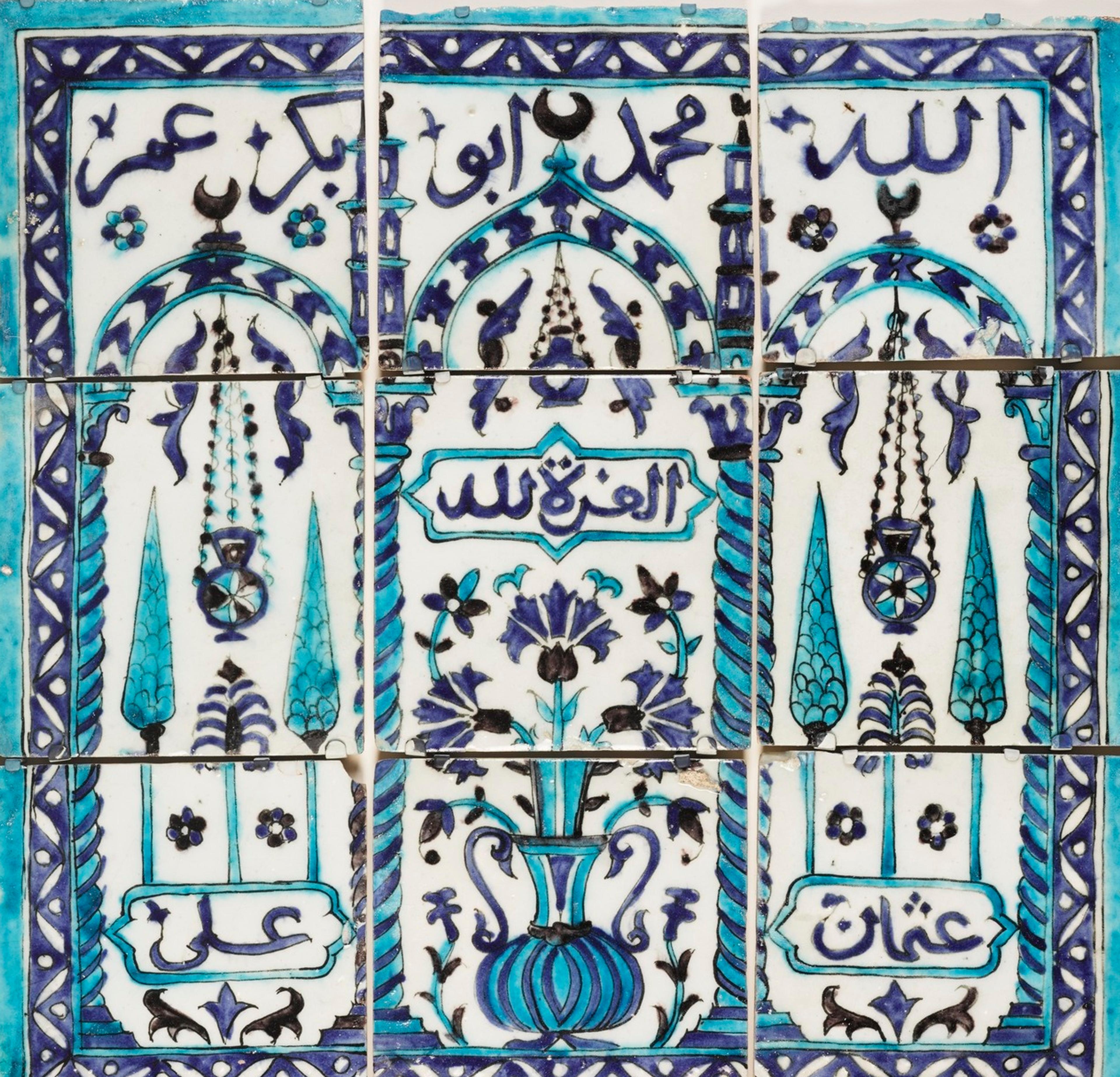
    Yesterday conservator Kerith Koss introduced readers to a late 16th- or early 17th-century Ottoman tile panel (39.407.1-.54), is currently on view in Connecting Cultures: A World in Brooklyn, and today I’ll discuss the panel from a curatorial perspective.

    Connecting Cultures Installation View

    Installation view of tile panel in Connecting Cultures: A World in Brooklyn.

    The tiles in the panel were likely made in Damascus, Syria, an important provincial capital after its conquest by the Ottomans in 1516. Damascene ceramics workshops were influenced by a style of vegetal decoration associated with Iznik, Turkey, a center for ceramic production in the Ottoman Empire, but they adapted color schemes to include cobalt-blue, turquoise, green, and purple. (For an example of Iznik decoration, see this ornament in our Arts of the Islamic World gallery.) Motifs and brushwork on ceramics from Damascus at this time are generally more relaxed than on Iznik examples, where imagery was court-controlled.

    We do not know in which building the tiles now at the Brooklyn Museum initially hung. Many buildings from the same period, such as the Darwish Pasha Mosque built by the Ottoman governor, and other museum collections (i.e., The Met and the V&A) include examples of similar tile work.

    Darwish Pasha Mosque

    Darwish Pasha Mosque, Damascus, Syria, 1574, detail of portico showing two tile panels to the west of the entrance (©Michael Greenhalgh, image via Archnet.org)

    As Kerith mentioned, the tiles were assembled into a panel upon arrival to the Museum in 1939. Such reconstructions were commonplace during the early 20th century. Numbers on the tiles and breaks in the decorative scheme suggest a larger original. (Can you spot breaks? It took me awhile at first.) Perhaps damaged tiles were removed and existing ones rearranged, or perhaps the panel includes tiles from various sources. We only know that the tiles came from multiple firing batches due to differences in glazing.

    Connecting Cultures Installation View

    Installation view of “Connecting Places” wall in Connecting Cultures: A World in Brooklyn.

    You might assume that all museum objects look now as they did upon creation, but this is often untrue following subsequent interventions. This composite panel is a piece of architecture from Syria that now—approximately 400 years later—functions as a standalone art object on another continent. The reuse of architectural elements has been common throughout Islamic architecture, but they undergo further changes when removed from buildings altogether. Pieces entered European and American collections and museums in the twentieth century, and adjustments occurred for various reasons by those possibly unfamiliar with their original use.

    In Connecting Cultures, works are hung in a collage-like formation or “salon hanging.” You get a sense of the panel as an art object conversing with surrounding objects. It appears six feet above the floor on the wall devoted to the theme “Connecting Place”—a completely different placement and environment than in the Darwish Pasha Mosque. In Brooklyn the panel is surrounded by a 17th-century sandstone panel from Mughal India, aTunisian Roman-periodmosaic, and paintings depicting places as diverse as Niagara Falls, Cairo, and Europe.

    While these tiles now hang differently than originally intended in a museum far from Damascus, I hope that their inclusion in Connecting Cultures, particularly in relation to the theme of “place,” encourages you to consider the interesting conversation provoked by their proximity to other representations of “place” as well as the significant effects of places—Ottoman Syria, private collection(s), and the Brooklyn Museum—and human agents upon these tiles.

    Author profile

    About Caitlin McKenna

    Caitlin McKenna joined the Brooklyn Museum in 2011 as Curatorial Assistant for the Arts of Asia, Africa, and the Islamic World. She holds an M.A. in the History of Art and Archaeology from the Institute of Fine Arts at New York University, where she studied Islamic art and architecture.
    Filed under: Arts of the Islamic World
    Tagged:
    Bookmark the permalink

    Go to the original blog post

    Connecting with Conservation

    If you’ve been through Connecting Cultures, you’ve probably wondered at the number of diverse objects.  You may not be aware, however, of the planning and activity that goes into an installation of this depth.  And if conservators have done our jobs, you hopefully won’t even know that we’ve been there—yet our work can have a dramatic effect on how artwork is presented.

    An Islamic tile panel from Damascus, Syria (39.407.1-54) underwent extensive conservation for the installation.  Previously the tiles had been assembled, set into concrete, and put into the wall of the Islamic Galleries.   Losses and cracks were filled with plaster and painted a flat, medium brown.  A common restoration for the early 20th century, this resulted in a panel that weighed over 800 pounds!

    After Treatment, Panel of Tiles

    After Treatment, Panel of Tiles, 16th-17th c, Damascus, Syria, Gift of Alan Devereux, 37.409.1-.54

    Since this structure was so cumbersome, the tiles were removed from the cement backing.  We used a power saw to cut them apart along the grout lines, carefully avoiding the tiles, and then cleaved them from their backings.

    removing tile

    Tiles were separated from the backing by inserting a chisel into air pockets between the tile and the cement after the tiles were cut out of the panel with a power saw (39.407.27)

    After all of the old restorations were removed, we examined the tiles. Variations in technical characteristics between tiles indicated they could be from different sources.  Many were broken and a few had smaller fragments of similar tiles inserted into losses.  Several numbering systems were on the backs of the tiles and some were higher than the 48 tiles that existed in our construction, suggesting that the panel may originally have been larger.

    These observations made us consider how the tiles should be displayed.   Rearranging, cutting, and inserting fragments of mismatched tiles to make the pattern continuous had been widespread techniques for reconstructing tile panels, but was the current condition an accurate reflection of how the panel would have originally looked?  Would leaving it fragmentary with missing tiles ruin the aesthetic?

    inserted fragment

    In a previous restoration, fragments were inserted into trimmed tiles to create a complete tile. Here, the pattern is the same, but doesn’t quite match (39.407.46, .50)

    We decided that all the tiles and fragments would be included in the new display. Tiles would be individually mounted without grout or restorations.  The effect was that they would be separate objects, but each an integral part of a larger collection.  This also allowed for changes that cement and mortar does not—tiles can be removed, displayed and examined separately without having to disturb the entire panel.

    installation

    Art handlers perform a test hanging of the tiles before installing them in the galleries.

    In creating this new mount, we were faced with another challenge:  the panel would be installed over 6 feet above the floor.  The mount would need to be easy and safe for installation, but satisfy concerns about the appearance.  The tiles were mounted in columns on to backing boards, so that eight tiles could be installed at a time.  When the boards were pushed together, they created the entire panel.

    The newly conserved Islamic tile panel is in the “Connecting Places” section of Connecting Cultures.  Tell us what you think! Were we successful in presenting a complete object?  Do you miss the cement and grout of a traditional tile panel? Can you see the inserted fragments?  Do the losses detract from the overall appearance?

    Look for conservators and other Museum staff serving as “connectors” in the gallery to find out more about the objects in the installation.

    Author profile

    About Kerith Koss

    Kerith Koss is the Andrew W. Mellon Fellow in Objects Conservation at the Brooklyn Museum. She received her Master's Degree in Art History and Conservation from the Conservation Center of the Institute of Fine Arts at New York University. Before joining the Brooklyn Museum in 2008, she was a Smithsonian Post-Graduate Fellow at the Freer Gallery of Art in Washington, DC. Over the course of her conservation training, she has completed internships at the Metropolitan Museum of Art, the Field Museum in Chicago and the Shelburne Museum in Vermont and has assisted in hurricane recovery efforts at several local museums on the Gulf Coast of Mississippi.
    Filed under: Arts of the Islamic World, Conservation
    Tagged:
    Bookmark the permalink

    Go to the original blog post

    Sufi-Inspired Artist Books

    One of the great feelings I experience at the Brooklyn Museum is when I see a true connection between the Library and art collections here. This connection was felt recently at a public program showcasing the work of the widely-admired translator Zahra Partovi and the Brooklyn-based artist Kelly Driscoll. Kelly and Zahra’s work Fragments of Light II is now on view in the exhibition Light of the Sufis: The Mystical Arts of Islam and several other books published by Vincent FitzGerald & Co. are on view in the Library display cases on the second floor. The conversation included Zahra, Kelly, Ladan Akbarnia, Hagop Kevorkian Associate Curator of Islamic Art, and me, with a large audience made up of artists and artisans who have collaborated with Vincent Fitzgerald over the years. We had a lively conversation and the opportunity to view some remarkable books.

    This panel discussion, held Saturday June 13, 2009 at the Brooklyn Museum, addressed the production, collection, and display of Sufi-inspired artist books. Zahra Partovi, whose artist book Fragments of Light II is featured in the special exhibition Light of the Sufis, discussed her art in conversation with collaborating book artist Kelly Driscoll, Hagop Kevorkian Associate Curator of Islamic Art Ladan Akbarnia, and Principal Librarian Deirdre Lawrence.

    Vincent has been the primary leader in the overall conception, design and production of these books, pulling together incredibly talented artists and artisans to create them. The books, all inspired by the Sufi poetry of Rumi as translated by Zahra Partovi, are a jewel in the crown of our artists’ book collection and remain wonderful examples of how contemporary art can carry on the essence of traditional art.

    How did these wonderful books come into the Brooklyn Museum collection?

    Back in October 1998 the Brooklyn Museum held an exhibition entitled Royal Persian Paintings, The Qajar Epoch, 1785-1925 curated by Dr. Layla Diba. This exhibition was one of several that Brooklyn has featured over the years and an example of the Museum’s long standing interest in Islamic art. The Library collection is also rich in this area due to a series of grants from the Hagop Kevorkian Fund and donations such as the personal library of noted Islamic scholar Charles K. Wilkinson whose selected acquisitions are on view in the newly reinstalled Islamic Art galleries.The Library has a collection of artists’ books, ranging from multiples to limited editions to unique works, many of which relate to the cultures represented by the Museum’s object collections. Many of the books published by Vincent FitzGerald & Co. fall into this latter category as they resonate so well with the Islamic collections here.

    I first met Vincent FitzGerald and Zahra Partovi in the Dieu Donne Galleries in 1999 at an exhibition entitled Dialogues in Collaboration: the publications of Vincent FitzGerald & Co. I remember being swept off my feet by the books on view and wanted to bring some of these books into the Brooklyn Museum collection.  Both Vincent and Zahra recognized the Museum’s longstanding interest in Islamic art and knew their books would fit in well with our collections.

    Through the generosity of anonymous donors and guidance from Vincent we were given nine books created by Vincent FitzGerald & Co. The books demonstrate in a beautiful way that thirteenth-century Persian poetry can be made intellectually accessible to a present-day audience. Since we acquired these books we have featured them in exhibitions such as Working in Brooklyn: Artists Books in 2000 and they have been a favorite of visiting teachers, students and artists in the Library Reading Room. Both visually challenging and intellectually stimulating, these books speak to the future of the book as a vibrant tool for communication while being works of art in themselves. The Fragments of Light series is the most recent example of innovative ways Vincent and his collaborators challenge the definition of the book.

    Come visit and see these great books in person!

    Author profile

    About Deirdre Lawrence

    Deirdre Lawrence has been the Principal Librarian at the Brooklyn Museum since late 1983. Before coming to the Brooklyn Museum, she was Associate Librarian at the Museum of Fine Arts in Boston. She received her M. L. S. from Pratt Institute in 1979 and has studied art history on the graduate level. At the Brooklyn Museum she has established the Museum Archives and implemented many projects to preserve and make accessible the research collections. Deirdre has overseen a major renovation project, implementation of an online catalog and several collaborative projects with other libraries. She has written articles on the collections and lectured frequently on the research collections held in the Libraries and Archives as well as Brooklyn Museum history. Deirdre has curated several exhibitions at the Brooklyn Museum and elsewhere. She is a visiting professor at Pratt’s School of Information and Library Science and serves as a board member at the Center for Book Arts in New York.
    Filed under: Arts of the Islamic World, Libraries & Archives
    Tagged: ,
    Bookmark the permalink

    Go to the original blog post

    Reinstalling the Arts of the Islamic World

    For those of you who have been missing the arts of the Islamic world (or wondering what it is you’ve been missing), we are almost finished with our reinstallation of the past several weeks. The galleries had been a sandy beige for some 2-3 decades, so the new dark color will probably be the first thing you notice on your next visit. When I came to the Museum in early 2007, I knew that it would be a few years before we would be making any big structural changes to the second floor, where the Islamic galleries are located. But I really wanted to do something in the meantime to bring some attention to the arts of the Islamic world, which are a constant reminder of the positive and beautiful aspects of Islamic culture. I wanted the objects to “pop out,” for the focus to be on the art rather than the space in which the art is exhibited. I thought a dark, grayish or charcoal blue would be a nice change of scenery and a great backdrop for the objects of various media in rich cobalt blues, turquoises, deep reds, and purples found in the arts of a territory spanning from Spain to China and Southeast Asia, and even the contemporary diaspora. Golds and silvers also look great against this blue, whether on metalwork or paper; luster ceramics now feel like they sparkle!

    To give the designer, Lance Singletary, a sense of what I imagined, I picked up a couple of paint swatches from the hardware store and he took it from there. I can’t stress enough how important these conversations with the designer are, because if Lance didn’t “get” what kind of vision I had for the space, it would have ended up looking a lot different than what you’re about to see in this video. He will explain how he came up with the subtle details that make for an extraordinary change on a relatively modest budget. It’s been an intense project that came together in an incredibly short period of time, thanks to the help of a whole team of people— curatorial staff, conservators, editors, designers, painters, electricians, art handlers, maintenance staff, technology staff, the security staff who kept an eye on me on many a late night at the museum, and more (I really hope I haven’t overlooked anyone here!). Ultimately, though, you will have to come see for yourself when the galleries open to the public on June 5, 2009—in the meantime, check out this “behind-the-scenes” video of some of the reinstallation:

    Author profile

    About Ladan Akbarnia

    A specialist on the art of Iran and Central Asia, Ladan Akbarnia joined the Brooklyn Museum in 2007. Previously, she held teaching positions at Smith and Wheaton Colleges in Massachusetts, and interned or worked at the Harvard Art Museum, the Metropolitan Museum of Art, and the National Museum of Iran. She has also served as a consultant to the Aga Khan Museum Collection and to the virtual museum, artsoftheislamicworld.org. Dr. Akbarnia received her B.A. from Vassar College and her M.A. and Ph.D. from Harvard University, where she co-curated the exhibition The Tablet and the Pen: Drawings from the Islamic World. At the Brooklyn Museum, she has organized several installations in the Islamic galleries. A renovation of the Islamic galleries is planned for 2009, along with an exhibition on Sufism in the arts of the Islamic world.
    Filed under: Arts of the Islamic World
    Tagged: ,
    Bookmark the permalink

    Go to the original blog post

    Recent Blog Posts

    Othoniel’s Sculptures and Glass from the Islamic World
    Jean-Michel Othoniel: My Way just closed here in Brooklyn a few days ago, but The Secret Happy End (2008) is still on view in the first-floor... read more.

    Exhibiting Architecture in a Salon
    Yesterday conservator Kerith Koss introduced readers to a late 16th- or early 17th-century Ottoman tile panel (39.407.1-.54), is currently on view... read more.

    Connecting with Conservation
    If you’ve been through Connecting Cultures, you’ve probably wondered at the number of diverse objects.  You may not be aware, however... read more.

    Sufi-Inspired Artist Books
    One of the great feelings I experience at the Brooklyn Museum is when I see a true connection between the Library and art collections here. This... read more.

    Reinstalling the Arts of the Islamic World
    For those of you who have been missing the arts of the Islamic world (or wondering what it is you've been missing), we are almost finished... read more.

    Read all Arts of the Islamic World blog posts

    advanced 99,475 records currently online.

    Recent Comments

    "the roses are in fullness the bees are busy and the dragonfly hovers and is about its life; life beckons and sings and all creatures are active and so should we too come then, gather the tools of our trade and let us go now and let’s make what is good for the world "
    By RajArumugam

    "IN PRAISE of the SIMURGH the world has been through cycles and beings have come and gone and the Simurgh has lived through them all What is it that the Simurgh has not seen? There is nothing the Simurgh has not seen It has seen all Ages of the world and is cognizant of all wisdom of the Ages O Simurgh - fly again over earth and over water and land for you are the mediator between earth and sky and we shall follow you like the hare on land as you glide beautiful and mysterious in the air – and truly we have great need of you "
    By RajArumugam

    "O listen all you that live and feel in this garden: walk with me Sheikh Muslih-uddin Sa’di Shirzai whom many may call Saadi O listen all who desire peace and harmony: I have traveled far and wide in this world that is ours this earth of ours that is but a garden and all I have found is charm at the feet of the peaceful, and beauty and depth in all of our earth that is our garden Fill your hearts with radiance and grace and fill your beings O all that live and feel with stillness justice and humility and contentment - and let there be love first and last and always let there be love O listen all you that live and feel in this garden: walk with me Sheikh Muslih-uddin Sa’di Shirzai whom many may call Saadi "
    By RajArumugam

    Join the posse or log in to work with our collections. Your tags, comments and favorites will display with your attribution.