Collections: Egyptian, Classical, Ancient Near Eastern Art

  • 1st Floor
    Arts of Africa, Steinberg Family Sculpture Garden
  • 2nd Floor
    Arts of Asia and the Islamic World
  • 3rd Floor
    Egyptian Art, European Paintings
  • 4th Floor
    Contemporary Art, Decorative Arts, Elizabeth A. Sackler Center for Feminist Art
  • 5th Floor
    Luce Center for American Art

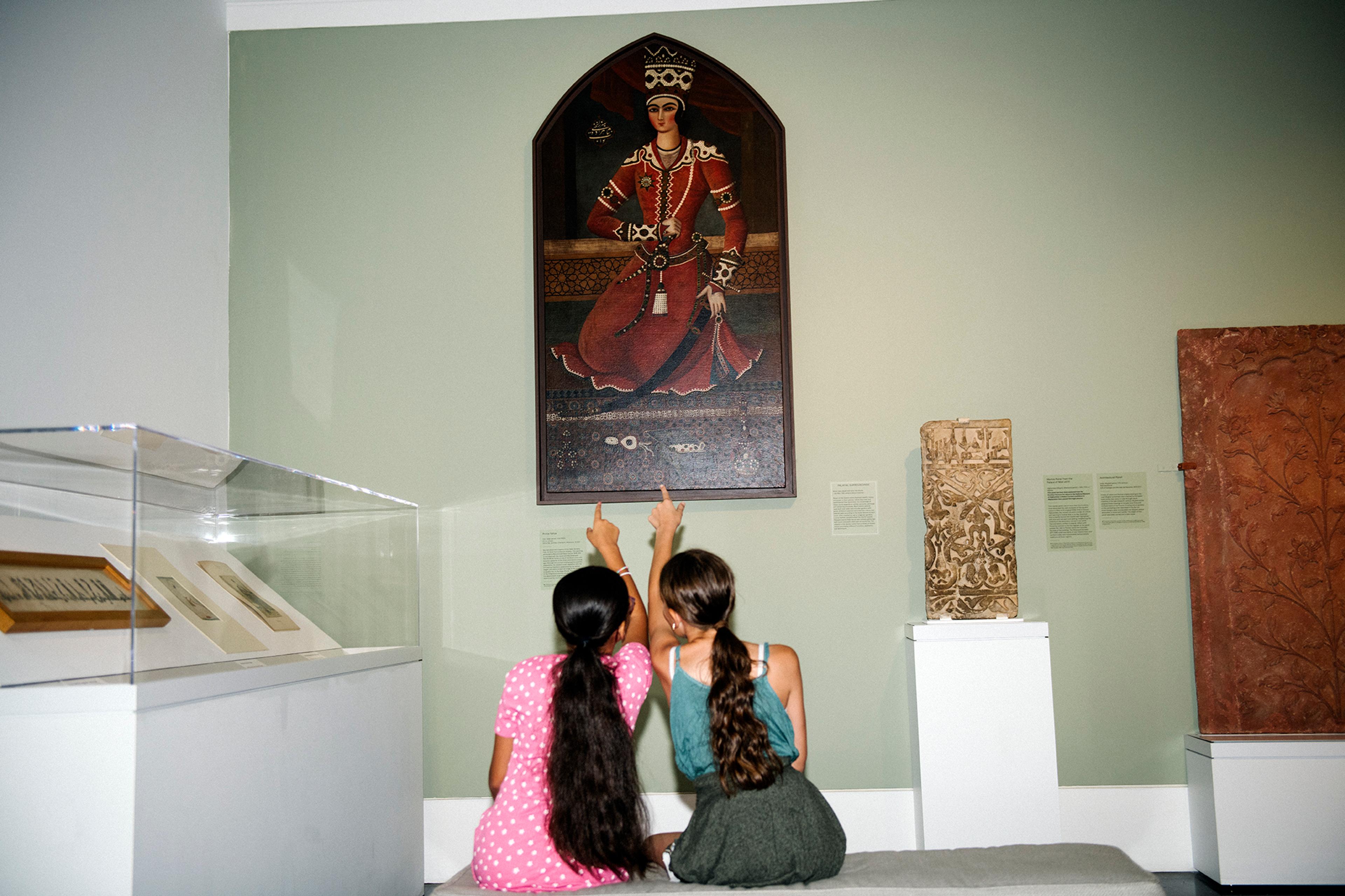
On View: Sultan Sanjar and the Old Woman

The lyrical paintings of this poetic cycle depict love stories from the classic works of celebrated Iranian poets, biblical and Qur’anic episodes, and hunting vignettes

Hiroshige's One Hundred Famous Views of Edo

Hiroshige's 118 woodblock landscape and genre scenes of mid-nineteenth-century Tokyo, is one of the greatest achievements of Japanese art.

On View: The Fallen Angel, or Illusions Received by the Earth (La Chute d'un ange, ou Les Illusions reçues par la Terre)

This piece exemplifies Rodin’s signature modeling, in which his sculpted figures seem to emerge organically from the unworked clay. Kneebone’s nearby Descent also mines sculpture’s ability to represent metamorphosis through the exuberant explosions of limbs and body parts

Login to play

Login with Google ID

Forgot your password?

Not a Posse member? Register

Brooklyn Museum Posse:
Exploring the collection

When you join the posse, your tags comments and favorites will display with your attribution and save to your profile.

 
Relief of Sandaled Feet of a Royal WomanRelief of Mourning WomenStatue of Ity-senTorso of ZiharptoMummy and Cartonnage of HorThe Kings Scribe Si-ese, Grinding GrainRelief Blocks from the Tomb of the Vizier NespeqashutyRoyal Statues in ProcessionFalse-Door Stela of a WomanAnthropoid Coffin of ThothirdesRelief of Mourners Before a TombFragment of Inscribed Door LintelHeadrest with Two Images of the God BesScribe Statue of Amunhotep, Son of NebirySeated Statue of the Superintendent of the Granary IrukaptahSeated Statuette of SekhemkaRelief of Montuhotep IIIRelief of a FowlerDetail of a Row of ForeignersNefertitiRelief of Amunhotep IHead of a Ptolemaic QueenBoundary Stela of Sety ISwamp SceneDonation Stela with a CurseBlock Statue of PadimahesRelief with Desert AnimalsRelief of Princess Khekeret-nebtyJewelry Box (?) with LidFemale Ancestral BustRelief Depicting Akenhaten and His Daughter Offering to the AtenRelief of Queen Nefertiti Kissing One of Her DaughtersTear Drop Shaped Vase with Painted Designs of Maidens, Cows, Swamp Plants, etc.Statue of IpepyDoorjamb of ThaasetimuGoddess SeshatShabty Box of AmunemhatStatue of MetjetjiBase for Votive Model of a Temple GatewayFigure of Monkey Seated on Ovoid BaseFalcon Head Terminal from NecklacePrincess Sobeknakht Suckling a PrinceKneeling Statuette of Pepy IStatuette of Queen Ankhnes-meryre II and her Son, Pepy IIHistorical Papyrus in Five PiecesCartonnage of NespanetjerenpereHead of a KingHead and Chest From a SarcophagusElaborately Painted Shroud of Neferhotep, Son of HerrotiouFootcase of a Mummy with Images of Defeated Enemies Under the FeetSunk Relief Representation of Ptolemy IIMummy Mask of a ManFemale Offering BearerStela of PakhaasStela of Djefi and Ankh[en]es-ites

Collection – Showing objects 1 - 55 of 8536

View All
 

What drew you to the Egyptian Galleries?

One morning in late September, I went to Lan Tuazon’s studio in Bushwick with Pierce Jackson, who is making the videos for Raw/Cooked. Lan was talking us through her sculptural combines, which are now on view in the Museum’s 3rd Floor Egyptian Galleries, seamlessly placed in the same cases as ancient objects.

Raw/Cooked: Lan Tuazon

Part of Lan's installation includes seven “sculptural combines” created to be displayed alongside artifacts within the third-floor Egyptian galleries.

As she held this small wooden carving of a pair of arms (pictured at left), she began to animatedly recount a myth about Rhampsinitis, a thief, and disembodied arms. I was impressed; she had clearly been reading a lot about Ancient Egyptian culture and seemed to have become immersed in it.  I wondered and wanted to ask her: What drew you to the Egyptian Galleries?

Here’s what Lan had to say:

I wanted to learn from the Egyptians.  I wanted to see what types of ritual practices they established that distinguished their culture.  More selfishly, I wanted to think like an Egyptian sculptor so I could “read” our historical present differently and make artifacts for rituals that don’t yet exist for our time.

Raw/Cooked: Lan Tuazon

Fragments of feet, including Lan's installation, in the Body Parts exhibition on the third floor.

My attention was caught by a small fragment of a foot in the Body Parts Gallery.  It was made in wood and perhaps because it was both a fragment and a miniature, it was simply perfect.  I imagined making sculptures that could somehow sit next to these artifacts.  My thoughts were arrested too, with the image of lifting the glass cases and inserting a contemporary sculpture in this frozen moment.  It was a Duchampian move on my part to make this simple gesture – moving one thing outside into the preserved space of the cases.  It meant moving back in the time that these artifacts were made, a willful art historical amnesia when objects had a lived experience and psychic capacity.

Author profile

About Tessa Hite

Tessa Hite is the Project Coordinator for Raw/Cooked, a series of five consecutive exhibitions, featuring under-the-radar Brooklyn Artists. Tessa joined the Contemporary Department in June, before which she was the Curatorial Assistant in the Exhibitions Division since 2008. She received a BA from the University of Pennsylvania.
Filed under: Contemporary Art, Egyptian Art
Tagged: ,
Bookmark the permalink

Go to the original blog post

Repairing the Book of the Dead

Repairing papyrus can be a little like putting a jigsaw puzzle together. In order to make sense of the many small pieces at hand, we take advantage of the various examination techniques we have here in the lab.

Detail of Book of the Dead of Sobekmose

Detail of Book of the Dead of Sobekmose, #37.1777E, transmitted light.

One method of examination we use is the use of transmitted light, which is light which passes through a transparent material from one side to the other.  Transmitted light is very useful in understanding how a sheet of papyrus is made and therefore, how it fits back together.

Use of the microscope is another instrument which makes our work easier.  Under magnification, and in combination with transmitted light, we can see clearly what we are doing and this makes our repairs and placing of loose fragments more precise.  It’s important to make as few and as small repairs as possible in order to stabilize the piece so that as much as possible of the original papyrus is visible.

Some of the clues we look for when reattaching fragments include looking at the contour of the fragment.  It’s shape is more easily visible with transmitted light, and we can see where the edges of the fragment may fit in place.  In transmitted light one can also easily see the vertical and horizontal lines of the papyrus plant’s fiber bundles (these bring water and nutrients up to the top of stalk) which create a characteristic crisscross pattern when viewing the sheet. The orientation of these lines on a fragment tell us in which orientation the fragment should be placed—horizontal or vertical, since all fibers on one side of a roll will be in the same direction.

Detached fragment from Book of the Dead of Sobekmose

Detached fragment from Book of the Dead of Sobekmose, #37.1777E, transmitted light.

Fragment in place from Book of the Dead of Sobekmose

Fragment in place from Book of the Dead of Sobekmose, #37.1777E, transmitted light.

Most importantly with magnification and transmitted light we can use these lines to place fragments.  At every join, there is a “fingerprint” pattern of lines which tells us if the fragment fits there and if so, exactly where.  If all the fibers on that particular fragment do not line up perfectly, it does not fit.

To join fragments, or make repairs, we use a kozo-fibered Japanese paper which we tint with acrylics or watercolors to the color the papyrus so that the repairs are visible but blend in.

Toned Japanese paper mend

Toned Japanese paper mend

Wheat starch paste is used to adhere the mends to the papyrus.  The paper is cut into small rectangles with a scissors.  (Normally the Japanese paper is torn so that the strength of its fibers are utilized; here we do not want the Japanese paper fibers to pull on the papyrus fibers if we need to remove the mend.)  Wheat starch paste is used because it does not change the papyrus and is reversible over time.

Pasting up a piece of Japanese paper

Pasting up a piece of Japanese paper with wheat starch paste and a small brush.

After we place the mend on the papyrus, we place a blotter on top of it to dry it out and a small weight to keep it flat while drying.

See brass weight over white blotter.

See brass weight over white blotter.

As a comparison, these two photographs show how a fragment will fit in place, viewed in normal light.

Detached fragment, Book of the Dead of Sobekmose

Detached fragment, Book of the Dead of Sobekmose, #37.1777E, normal light

Fragment in place, Book of the Dead of Sobekmose

Fragment in place, Book of the Dead of Sobekmose, #37.1777E, normal light.

Sometimes we see mends to the papyrus that were made in ancient times.  We’ll talk more about those cases in the next blog.

This post is part of a series by Conservators and Curators on papyrus and in particular theBook of the Dead of the Goldworker of Amun, Sebekmose, a 24 foot long papyrus in the Brooklyn Museum’s collection. This unique papyrus currently in 8 large sections has never been exhibited due to condition. Thanks to a generous grant from the Leon Levy Foundation, the entire papyrus is now undergoing conservation treatment. The conservation work is expected to last until fall 2011 when all 8 sections will be exhibited together for the first time in the Mummy Chamber. As each section is conserved, it will join those already on exhibition until eventually the public will see the Book of the Dead in its entirety.

Author profile

About Rachel Danzing

Rachel Danzing is a Conservator of Paper at the Brooklyn Museum where she has worked since 1992. Rachel has worked at the National Gallery in Washington, and has completed internships at institutions including the Metropolitan Museum of Art, and the Library of Congress. She received her M.A. in Art History and a Diploma in Conservation from the Institute of Fine Arts, New York University.
Filed under: Conservation, Egyptian Art
Tagged: , , ,
Bookmark the permalink

Go to the original blog post

35 Animal Mummies meet Twitter and Instagr.am

If you read Lisa’s post on the animal mummy field trip to the Animal Medical Center and got as excited as we did, follow us on Twitter and Instagr.am because we are going to accompany the conservators and curators and cover the process live this Friday, June 17.

Instagram

We're going to utilize Instagr.am for photo sharing across social networks during live coverage of 35 animal mummies going to the Animal Medical Center for CT scanning.

As many blog readers and followers on our social networks know, we do a lot of live coverage when we’ve got something special going on.  From human mummies visiting the hospital for CT scanning to the re-wrapping of an anonymous man to the installation of a 26′ Blackfeet tipi in our Rotunda—the hope is we can take our visitors behind the scenes during complicated installations and highlight some of the interesting work that our staff do here on a daily basis.

What you may not know is how difficult it can be to cover these events.  During the last run to the hospital for mummy CT scanning we had three point and shoot cameras, a laptop, a video camera and several staffers and interns running back and forth capturing the spectacle.  Once materials were in hand, we were posting to several social networks at the same time, which proved to be a more difficult task than one would expect.

This time around, we are going to simplify a bit and concentrate on two platforms for most of the live coverage: Twitter and Instagr.am.  Luckily, Instagr.am can share images across networks easily, so you’ll see images popping up on Flickr, Facebook and Twitter utilizing our Instagr.am account and we’ll cover almost the entire trip using my iPhone.  Video and better photos will be posted after the fact, but for the live coverage we are going to keep it simple and streamlined.

Many of these field trips have yielded tons of surprises and you just never know where the journey will take us.  We hope you can join us online Friday—come with questions and we’ll work to get you answers!

Author profile

About Shelley Bernstein

Shelley is the Chief of Technology at the Brooklyn Museum where she works to further the Museum's community-oriented mission through projects including free public wireless access, web-enabled comment books, projects for mobile devices and putting the Brooklyn Museum collection online. She is the initiator and community manager of the Museum's initiatives on the social web, she co-created 1stfans: a socially networked museum membership, organized Click! A Crowd-Curated Exhibition and Split Second: Indian Paintings. In 2010, Shelley was named one of the 40 Under 40 in Crain's New York Business and she's been featured in the New York Times. She can be found biking to work or driving '74 VW Super Beetle in Red Hook, Brooklyn with her dog Teddy. ::contact::
Filed under: Conservation, Egyptian Art, Technology
Tagged: , , ,
Bookmark the permalink

Go to the original blog post

Animal Mummies – X-radiography, and coming soon – CT scans!

These past few weeks we have been steadily packing and preparing to transport a group of animal mummies to the Animal Medical Center (AMC) for CT scanning with radiologist Anthony Fischetti, DVM, MS. In earlier blog posts we described the CT scanning of Brooklyn’s human mummies, but we have yet to CT scan our animals.

Falcon X-rayAs you may remember from an earlier post, Dr. Fischetti and a colleague came out to the Conservation Lab to look at a group of x-rays of animal mummies. It was at that time that we discussed the possibility of CT scanning the animal mummies. While x-radiographs are very useful for showing the interior of the mummy bundles, they will not give a three dimensional image that can be manipulated. With CT scans it is often possible to discern what might be inside the animal as opposed to lying within the linen wrapping of the mummy bundle. X-radiographs of the animals will aid in the CT scanning as it will give a kind of road map and some indication of areas we would like to focus on in the scanning process. Colleagues at other institutions have used CT scanning for animal mummies; the Phoebe Hearst Museum, part of UC Berkley recently scanned their adult crocodile and found a fishing hook inside!

Animal Mummies

Animal mummies in the Conservation Lab getting ready for transport to Animal Medical Center for CT Scanning.

While we don’t have that large of a crocodile, we will be taking several cats, birds, baby crocodiles, mice, and unknowns to the AMC to see what we can see. There we will have access to experts who can help identify the animals, and their possible cause of death. As Dr. Fischetti is partial to cats, we have also consulted with Dr. Andrew Major who got his veterinary medicine degree at the University of Pennsylvania and works as the emergency vet for The Raptor Trust. Since his work with raptors and other birds of prey for The Raptor Trust involves treating broken bones he has a lot of experience looking at bones in x-rays. One of the most common birds used in ancient Egyptian mummies is an ibis but hawks and other birds were also used.

This project studying the animal mummies in Brooklyn’s collection will eventually culminate into an exhibition currently scheduled for 2013.

Author profile

About Lisa Bruno

Lisa Bruno is the head conservator of objects at the Brooklyn Museum, where she has been working since 1993. She has previously worked at the Art Institute of Chicago, and has had internships at The Cleveland Museum of Art, the Detroit Institute of Arts, and in private practice. She has a Masters Degree in Art Conservation from the University of Delaware, Winterthur Museum Art Conservation Department. She is a Professional Associate of the American Institute for Conservation.
Filed under: Conservation, Egyptian Art
Tagged: ,
Bookmark the permalink

Go to the original blog post

Lady Gautseshenu goes to the Hospital

Yesterday, a team of curators, conservators, and art packers and handlers took the last of our human mummies to North Shore University Hospital to be CT scanned.  (See Lisa Bruno and Ed Bleiberg’s blogs about the previous mummies).

Inner Cartonnage of Gautseshenu

Inner Cartonnage of Gautseshenu, 700-650 B.C.E. Linen, plaster, pigment, 64 3/16 x 14 15/16 in. (163 x 38 cm). Brooklyn Museum, Charles Edwin Wilbour Fund, 34.1223.

Lady Gautseshenu, who dates from around 700-650 b.c.e, was a descendent of a prominent priestly family and entered the Brooklyn Museum collection in 1934.  The mummy itself is sealed in a beautifully painted cartonnage that has never been opened.  The object had been x-rayed in the past, and from those results we could tell that there was an intact female body within the cartonnage.  The opportunity to CT scan her and discuss the results with the team at North Shore University Hospital gives us additional insight.  We were happy to work with the same group of doctors and technicians as our previous visit, namely Drs. Amgad Makaryus, Jesse Chusid, John O’Donnell, and Karen Lisk.  Some of the questions we hoped to answer – How old is she?  Are there any signs of trauma?  Do any internal organs remain?  Were there any unusual items buried with her?  What about her physical condition might tell us something about how she lived?

CT Scanning of Inner Cartonnage of Gautseshenu

CT Scanning of Inner Cartonnage of Gautseshenu at North Shore University Hospital

While more detailed analysis of the CT scans is on-going, a preliminary review reveals that she is an adult female, with some signs of osteoarthritis in the pelvis and backbone. Dr. Chusid and his colleagues say that this might not necessarily mean that she was old – this could have been a condition that affects younger (adult) women as well.  The scans also show that her brain had been completely removed.  This was typically done through the nose, and this was confirmed on the scans by the fact that there was significant damage to her nasal septum.   As would also be expected, an incision was found on the left side of the abdomen.  This is where the internal organs would have been removed. Her heart was left in place during the embalming process, which, according to our curator Ed Bleiberg, would have been done in higher quality mummifications.   In turn, it appears that her lungs may also have been left in place, something that is much more unusual.  While there were no signs of trauma to her body, two of her ribs are cracked, though this probably happened post mortem.   Inside the chest area and inside near the incision, there appear to be a few amulets.  Further manipulation of the scans is needed to clarify which amulets these might be.   Our curators were also curious to know if there were differences in the mummification process between males and females.  We saw a few interesting things in the CT scans regarding that – once we do a little more research, we’ll let you know!

Please check back with us as we continue to work with North Shore University Hospital to interpret the data. Lady Gautseshenu will go back on display in the Mummy Chamber during the first week of May and you can check out more photos of her visit to the hospital on Flickr.

Author profile

About Tina March

Tina March is an assistant conservator of objects at the Brooklyn Museum where she has been since receiving her M.A. in Conservation from Buffalo State College in 2001. She has a B.A. in Art Conservation from the University of Delaware. Previous internships include The Art Institute of Chicago, the Guggenheim Museum and The National Museum of the American Indian.
Filed under: Conservation, Egyptian Art
Tagged: , , ,
Bookmark the permalink

Go to the original blog post

Recent Blog Posts

What drew you to the Egyptian Galleries?
One morning in late September, I went to Lan Tuazon’s studio in Bushwick with Pierce Jackson, who is making the videos for Raw/Cooked. Lan was... read more.

Repairing the Book of the Dead
Repairing papyrus can be a little like putting a jigsaw puzzle together. In order to make sense of the many small pieces at hand, we take... read more.

35 Animal Mummies meet Twitter and Instagr.am
If you read Lisa's post on the animal mummy field trip to the Animal Medical Center and got as excited as we did, follow us on Twitter... read more.

Animal Mummies – X-radiography, and coming soon – CT scans!
These past few weeks we have been steadily packing and preparing to transport a group of animal mummies to the Animal Medical Center (AMC) for CT... read more.

Lady Gautseshenu goes to the Hospital
Yesterday, a team of curators, conservators, and art packers and handlers took the last of our human mummies to North Shore University Hospital... read more.

Read all Egyptian, Classical, Ancient Near Eastern Art blog posts

advanced 96,830 records currently online.

Recent Comments

"Dear Joanna, Mut is an ancient Egyptian goddess, who is called the daughter of the sun-god, Ra, in some myths. None of the myths, however, describe the date of her birth, or her death. Best, Yekaterina Barbash Assistant Curator Arts of Ancient Egypt Brooklyn Museum "
By Yekaterina Barbash

"When was mut born and when did she die? "
By joanna

"I lived, and I died as, no doubt, you too from the future who might see my portrait will I loved and I enjoyed my life and I had my pleasures and my joys and travails and pain and suffering too; there was the identity I had and I was my home, my property and jewelry and I was my group and my family and my kind… for all that, I lived as many others as any human - happy, fulfilled through inconveniences, awkwardness and comforts and possessions and then I died and you in the future, who might look at my portrait - to you I wish long life, happiness, and bliss all through the days that may be yours on this our earth where I too lived "
By RajArumugam

Join the posse or log in to work with our collections. Your tags, comments and favorites will display with your attribution.