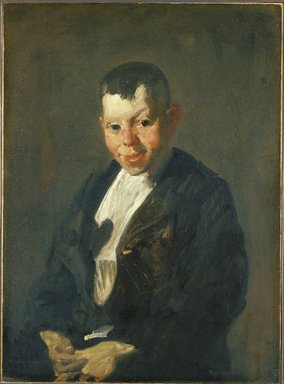
George Bellows's brief fascination with portraying pugnacious urban street boys arose in response to his teacher Robert Henri's passion for painting what contemporary critics called types--portraits of relatively anonymous people seen as representatives of a specific social or ethnic category. The portrayal of "types" was largely indebted to the seventeenth-century Dutch Baroque painter Frans Hals and reemerged with vigor in the art of the nineteenth-century French and Munich Realists. Bellows's powerful, unidealized image of this boy (who was identified simply as Jimmy Flannigan in the painter's record book) strongly conveys an impression of a spirited, streetwise character--a perception amplified by the energetic, bravura brushwork that corresponds to the boy's rough appearance.