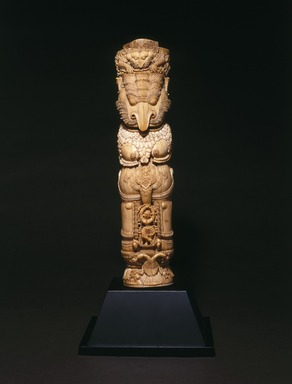
Medium: Ivory with traces of polychrome
Geograhical Locations:
Dates:17th century
Dimensions: 15 1/2 x 4 1/8 in. (39.4 x 10.5 cm) mount (without block): 17 1/4 × 3 1/2 × 4 1/2 in. (43.8 × 8.9 × 11.4 cm) mount (block dims): 4 × 8 × 8 in. (10.2 × 20.3 × 20.3 cm)
Collections:
Museum Location: Asian Galleries, Arts of South Asia, 2nd floor
Accession Number: 1992.83
Image: 1992.83_SL1.jpg,
Catalogue Description: In the shape of a rampant lion (sardula), its head facing forward while its body and limbs point in the opposite direction. It has a large face, with long flattened nose, and a toothy grin, with nostrils and mouth deeply cut. Repeated patterns of curly fur mark brow, moustache and ruff. "Elbows" of lion are thrust forward with rosettes at tips and curly fringe with deep cutting below. Lion is ornamented with beaded and tasseled harness and bejeweled anklets. A dancing, garlanded female figure stands between lion's legs at front. Lion stands on a beaded lotus pedestal. Above the lion at the top of the piece are the face and arms of a mustached, crowned male. This face is repeated, slightly larger and more rudimentally carved, on reverse. Below the face on the reverse is the lion's chest, which is not deeply carved or elaborately detailed. The paws, each with long claws, are visible on either side. Below, between the lion's legs on reverse beneath a group of small figures are shown hunting lions, boar and deer beneath a delicately carved lattice of scrolling, flowering vines. Overall form of the throne leg is cylindrical, curving outwards at slant. Square pegs protrude from base and top, and two square holes appear at either side of top for attachment of leg to rest of chair.