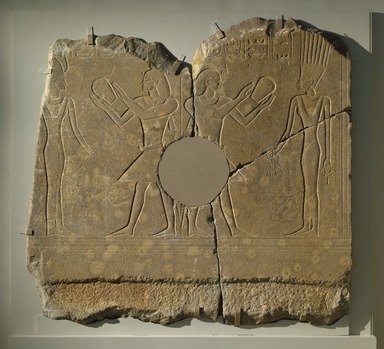
Sobekhotep III offers vessels to the goddesses Satis (left) and Anukis in reliefs that probably formed part of a naos, or a shrine for a cult image. These scenes represent a basic element of Egyptian temple decoration: the king, who theoretically conducts the cult in every temple every day, offers to deities who, in turn, bless him and—through him—Egypt. As is often true in Egyptian art, each scene conveys its message by standard gestures—the king's emphatic and the deities' more subtle. Both goddesses tender three "life" hieroglyphs (ankh) to the king, their number indicating plurality and the idea of "all." In order to suggest a timeless and universal religious truth, the scenes do not indicate a specific time or setting. Some such scenes may also have been magically empowered to act as that which they represented.
These back-to-back scenes seem symmetrical, but deviations from symmetry are noticeable in the inscriptions, the goddesses' crowns, and the king's faces. If the Egyptians abhorred the chaotic and the random, they also disliked mechanical rigidity. Ma'at is the concept of order or equilibrium with some flexibility; most Egyptian art is well balanced rather than truly symmetrical.
