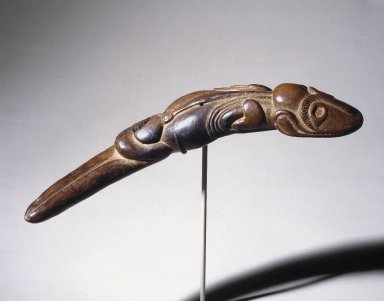
Lizard, human, and avian characteristics merge in these so-called lizard figures. Researchers have advanced many explanations regarding their use. The fact that the legs of of figures like these two form a handle shape suggests they were used as clubs. In addition, the figures may have been held in the hand or worn around the neck by dancers during feasts. Some moko miro were placed in the doorways of houses, eitiher suspended from the roof or set into the ground, to protect the inhabitants from harm. Originally, these figures had inlaid white shell eyes with obsidian pupils.
Catalogue Description:
Carved wooden lizard. Has a characteristic triangular head, protruding eyebrows and ribs, the crested spinal column with a fan-like termination, abdomen on level with under-jaw and chest, long thin arms extending across the chest, and legs extended to a tapering point. According to Metraux, Ethnology of Easter Island, Bernice P. Bishop Museum Bulletin 160, Honolulu Hawaii, 1940, such lizards are made of toromiro wood and have supernatural power in protecting a household. Metraux believed that the lizard images were found at the entrance of a house. There is also some belief that the images may have served as clubs in defending the houses.
