Dance Ornament
Arts of the Pacific Islands
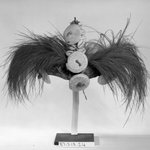
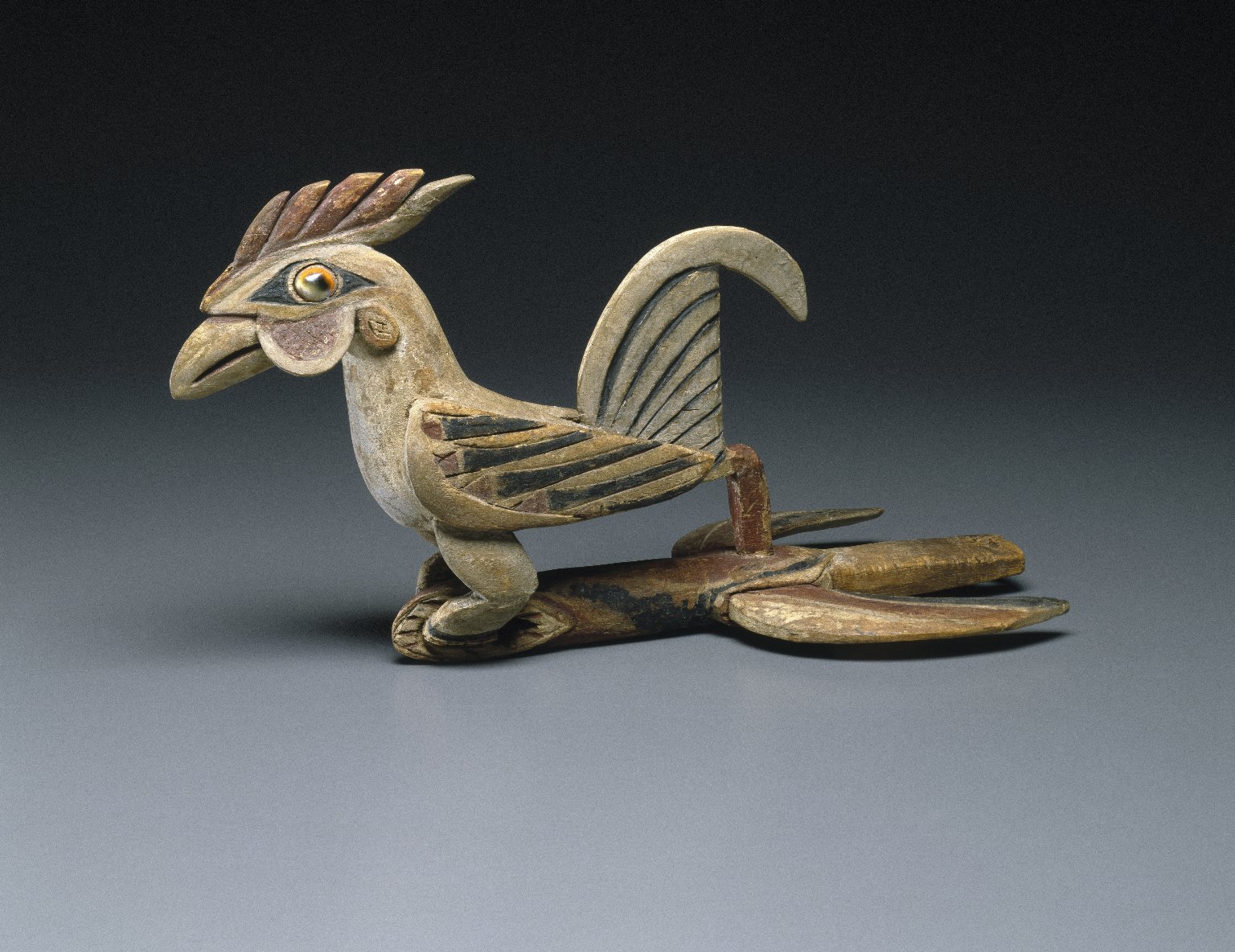
The malagan is a funerary festival held several months or even years after the death of the person honored. Its purpose is to free the living from the spirit of the dead and to enable the deceased's spirit to acclimate itself to the world of the dead. Birds are the most common motif for malagan dance ornaments, but many other type of creatures, either real or imaginary, are known. Though only the carver and dancer usually know the symbolism of these creatures, the bird generally represents the spirit world. The small, flat bit behind the bird on this mouth ornament was held between the dancer's teeth as he performed in imitation of bird movements. The dances in which these mouthpieces are used are part of the concluding rite of the malagan ceremonies.
MEDIUM
Wood, turban snail (Turbo petholatus) opercula, pigment
DATES
19th century
DIMENSIONS
7 1/4 x 6 1/4 x 12 3/4 in. (18.4 x 15.9 x 32.4 cm) (show scale)

COLLECTIONS
Arts of the Pacific Islands
ACCESSION NUMBER
84.109
CREDIT LINE
Helen Babbott Sanders Fund
CATALOGUE DESCRIPTION
Carved and painted malangan dance ornament in the shape of a rooster standing on a flying fish. Painted in black and red with traces of white. Eyes of rooster are inlaid shells.
Condition: Paint flaking off. Piece of the cockscomb has broken off and is stored with the piece. There is already a repair on this tip. Tip of fish's wing is missing. Old repairs: across tail feathers; on cockscomb; across tip of fish's wing (repaired with a nail under fish's wing).
MUSEUM LOCATION
This item is not on view
CAPTION
Dance Ornament, 19th century. Wood, turban snail (Turbo petholatus) opercula, pigment, 7 1/4 x 6 1/4 x 12 3/4 in. (18.4 x 15.9 x 32.4 cm). Brooklyn Museum, Helen Babbott Sanders Fund, 84.109. Creative Commons-BY (Photo: Brooklyn Museum, 84.109_SL1.jpg)
IMAGE
overall, 84.109_SL1.jpg. Brooklyn Museum photograph
"CUR" at the beginning of an image file name means that the image was created by a curatorial staff member. These study images may be digital point-and-shoot photographs, when we don\'t yet have high-quality studio photography, or they may be scans of older negatives, slides, or photographic prints, providing historical documentation of the object.
RIGHTS STATEMENT
Creative Commons-BY
You may download and use Brooklyn Museum images of this three-dimensional work in accordance with a Creative Commons license. Fair use, as understood under the United States Copyright Act, may also apply.
Please include caption information from this page and credit the Brooklyn Museum. If you need a high resolution file, please fill out our online application form (charges apply).
For further information about copyright, we recommend resources at the United States Library of Congress, Cornell University, Copyright and Cultural Institutions: Guidelines for U.S. Libraries, Archives, and Museums, and Copyright Watch.
For more information about the Museum's rights project, including how rights types are assigned, please see our blog posts on copyright.
If you have any information regarding this work and rights to it, please contact copyright@brooklynmuseum.org.
RECORD COMPLETENESS
Not every record you will find here is complete. More information is available for some works than for others, and some entries have been updated more recently. Records are frequently reviewed and revised, and we welcome any additional information you might have.