Teapot
Decorative Arts and Design
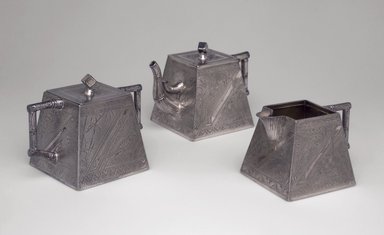
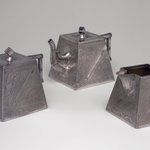
The form of nearly contemporary Japanese ceramic teapots directly inspired this surprisingly modern-looking, intimate tea set. Silverplate, made by electroytically bonding silver particles to base metals, was an inexpensive alternative to costly silver. Because it was inexpensive, silverplate companies often produced adventurous designs that were highly responsive to the latest styles. Here the shape exemplifies the Japanese craze of the late 1870s and 1880s, and the linear, two-dimensional incised floral decoration is rendered in the so-called Eastlake, or Reform, style imported from England at the same time.
MEDIUM
Silver-plate on white metal
DATES
ca. 1880
DIMENSIONS
4 1/4 x 5 5/8 x 3 1/2 in. (10.8 x 14.3 x 8.9 cm)
(show scale)
MARKINGS
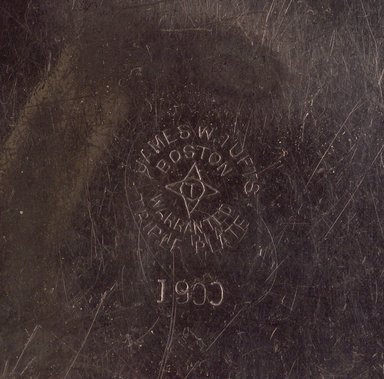
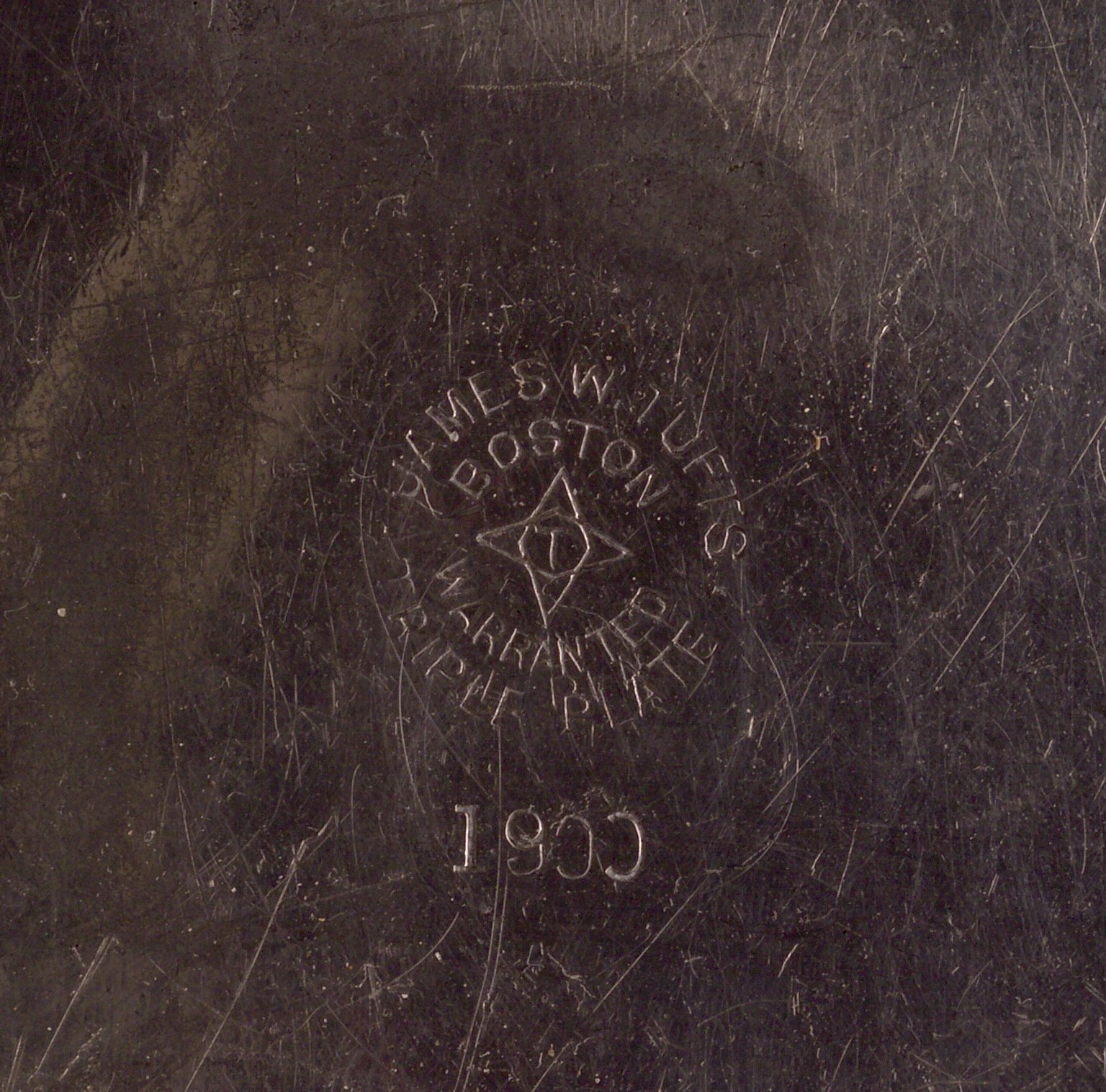
Impressed on bottom: "JAMES W. TUFTS / BOSTON / [four-pointed star enclosing 'T'] / WARRENTED / TRIPLE PLATE / 1900."
SIGNATURE
no signature
INSCRIPTIONS
no inscriptions
ACCESSION NUMBER
1990.39.1
CREDIT LINE
Purchased with funds given by Roy Zuckerberg
CATALOGUE DESCRIPTION
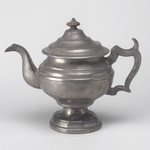
Teapot (en suite with creamer and sugar bowl 1990.39.2-.3), silver-plate on white metal. Body is in the shape of truncated pyramid with square base with flat hinged lid; two S-curving faux bamboo handles spout with C-curve bamboo attached strut above and D-shaped angular faux bamboo handle. Finial is a cube, on point, resting on a short tapered base. Each face of the pyramid is densely engraved. At top of the pyramid is a double band with interlocking chevrons in lower part, interlocking semi-palmettes in upper. At base of pyramid is another band of alternating demi-lunes and chevrons on front and rear of body and alternating half-fans on two ends. On front face of body a diagonal reserve runs from lower left to upper right with the hoped handle of a basket looped over it. Basket depends into right section over vermiculae ground; foliage in lower right corner. In upper left is a bird perched on a branch with blossom, on vermiculae ground. On rear face of body, diagonal reserve runs from lower left to upper right. Above are bamboo shoots on vermiculae ground, standing in marsh with semi-fan shape at lower right. On face behind handle a diagonal reserve runs from lower left to upper right and a diagonal band with cross bandings intersects this at upper handle juncture and runs to lower right edge. Pointed oval lozenge overlaps at the intersection and is filled with stalk and blossoms. In area to upper right is a ground of overlapping semi-discs. To the left of the handle on vermiculae ground are two long-tailed birds, back to back, foliage in lower left corner. On face with spout, diagonal reserve runs from lower left to upper right. To the left is a branching vine on vermicular ground. To the right is a flying, long-beaked bird, on vermiculae ground, with foliage. On lid, a diagonal band runs from corner to corner under the finial and is filled with discs with stylized blossoms on articulated ground. The band runs over a central checkerboard square, which is bordered, by a detached band of scroll pattern.
Condition: Plate worn in places, especially on handle, finial, hinge. Finial slightly depressed. Dent on front face to left of basket handle.
MUSEUM LOCATION
This item is not on view
CAPTION
James W. Tufts (1875-ca. 1914). Teapot, ca. 1880. Silver-plate on white metal, 4 1/4 x 5 5/8 x 3 1/2 in. (10.8 x 14.3 x 8.9 cm). Brooklyn Museum, Purchased with funds given by Roy Zuckerberg, 1990.39.1. Creative Commons-BY (Photo: Brooklyn Museum, 1990.39.1_mark.jpg)
IMAGE
mark, 1990.39.1_mark.jpg. Brooklyn Museum photograph, 2005
"CUR" at the beginning of an image file name means that the image was created by a curatorial staff member. These study images may be digital point-and-shoot photographs, when we don\'t yet have high-quality studio photography, or they may be scans of older negatives, slides, or photographic prints, providing historical documentation of the object.
RIGHTS STATEMENT
Creative Commons-BY
You may download and use Brooklyn Museum images of this three-dimensional work in accordance with a
Creative Commons license. Fair use, as understood under the United States Copyright Act, may also apply.
Please include caption information from this page and credit the Brooklyn Museum. If you need a high resolution file, please fill out our online
application form (charges apply).
For further information about copyright, we recommend resources at the
United States Library of Congress,
Cornell University,
Copyright and Cultural Institutions: Guidelines for U.S. Libraries, Archives, and Museums, and
Copyright Watch.
For more information about the Museum's rights project, including how rights types are assigned, please see our
blog posts on copyright.
If you have any information regarding this work and rights to it, please contact
copyright@brooklynmuseum.org.
RECORD COMPLETENESS
Not every record you will find here is complete. More information is available for some works than for others, and some entries have been updated more recently. Records are frequently reviewed and revised, and
we welcome any additional information you might have.