Hatshepsut
ca. 1479–1425 B.C.E.


1 of 10
Object Label
If the name on a statue is no longer preserved, archaeologists rely on stylistic analysis to identify its subject. Though this head has often been called Thutmose III, it more likely represents the female pharaoh Hatshepsut. The male ruler Thutmose was usually depicted with a rounder, more delicate face.
The feather pattern visible at the back of the head shows that the original statue depicted its subject with the plumage and wings of the falcon-god Horus, denoting kingship.
The feather pattern visible at the back of the head shows that the original statue depicted its subject with the plumage and wings of the falcon-god Horus, denoting kingship.
Caption
Hatshepsut, ca. 1479–1425 B.C.E.. Granodiorite, 10 1/2 × 8 1/2 × 4 3/4 in., 16.5 lb. (26.7 × 21.6 × 12.1 cm, 7.48kg). Brooklyn Museum, Charles Edwin Wilbour Fund, 55.118.
Frequent Art Questions
Do you have any pieces that have to do with Hatshepsut in the Egyptian exhibit?
Absolutely! In our "Early Egypt" gallery, we have a stellar carved head we believe represents the famous female pharaoh! When you find it, look around for the statues of Senenmut and Ahmose, who were officials during her reign.Found it! Thank you!Many of the kingly cartouches on Ahmose's statue have clearly been erased and recarved to now display the names of Thutmose III and Thutmose I. This strongly suggests that all of the rewritten cartouches originally displayed names of Hatshepsut. As you may or may not know, one of the great riddles of Egyptology is why her ultimate successor, Thutmose III, ordered her name to be erased from history in such a manner. You can still see the erasures on the works themselves!Are there known examples of actual casts, as opposed to carved images, as here?
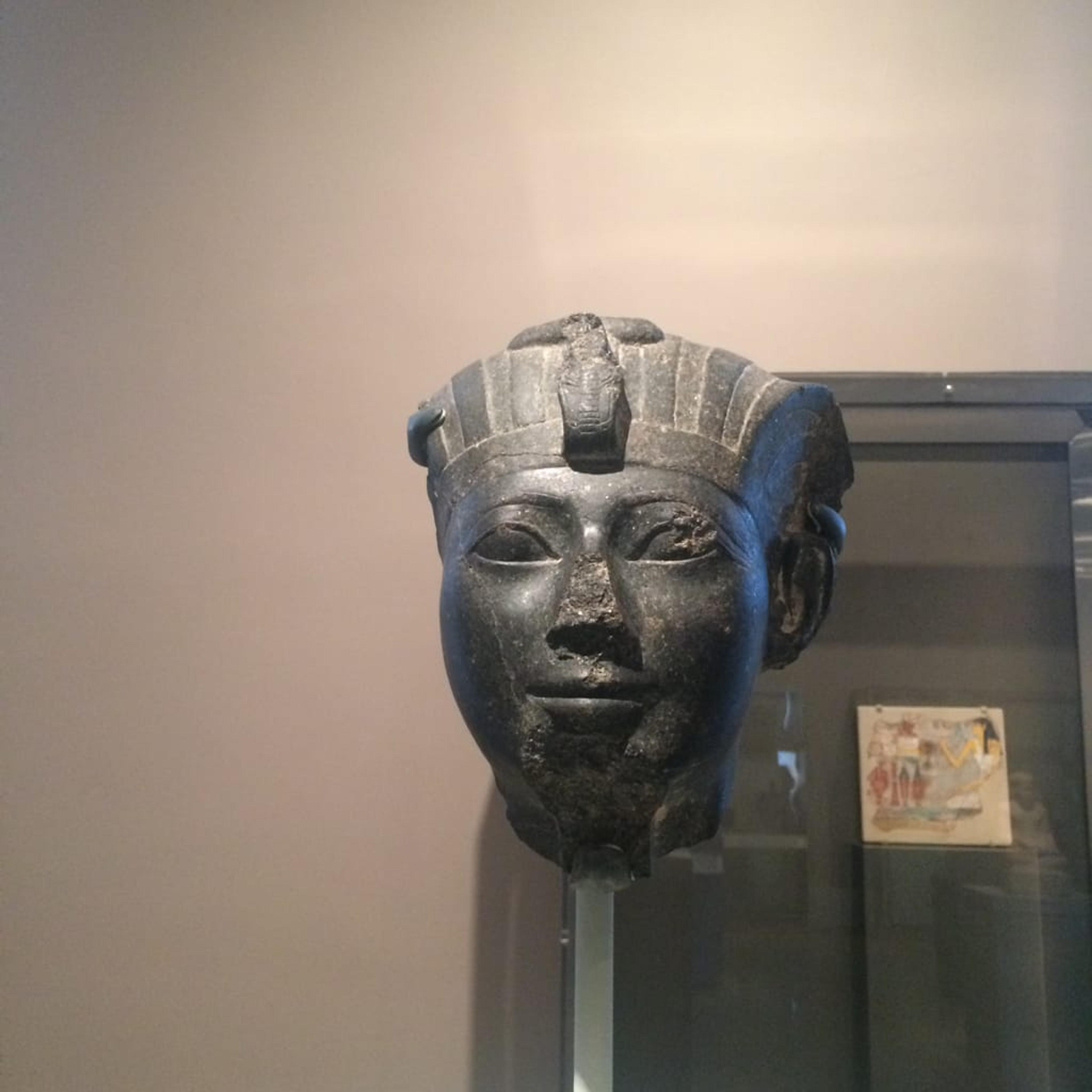 I am not aware of any such tradition. In general, ancient Egyptian art has an idealizing goal. Therefore, a cast of someone's face would not be necessary for a "perfect" depiction of the individual.That said, you can see different trends in idealized faces across time. The head of Hatshepsut that you sent has some distinctive facial features that can easily be contrasted with nearby images of Middle Kingdom kings, like Senwosret III, for example.Thank you! I would assume that casts would be of dead...You're welcome! I see what you mean. While the "death mask" is a tradition in other cultures, it was not a part of the Egyptian mummification process (or rather, pre-mummification ritual). Preparation for the afterlife is a time when idealization would be especially important! Interestingly, there is a plaster mask that was sculpted onto a wrapped mummy, it's on view in the Mummy Chamber. It was not cast directly from the person's face and the practice fell out of fashion.
Was there a particularly intense period of iconoclasm after Hatshepsut died?
There was, but it seems like it was concentrated later in the reign of Thutmose III, decades after her death. Scholars speculate that it was politically motivated rather than personally; that Thutmose III was looking to preempt any issues of succession.Rude. Hatshepsut had a daughter correct? Do we know what happened to her?She did, her name was Neferure. She was married to Thutmose III. I'm not sure how long she lived or if they had any children.Interesting. And how was Thutmose III related to Hatshepsut, younger brother?He was her nephew and stepson. I will explain...Hatshepsut was the daughter of Thutmose I and his primary wife making her a significant princess. Therefore, she was married to Thutmose II (the son of Thutmose I and a minor wife) and became his primary wife they legitimizing his kingship. Together, they had Neferure making her a significant princess. Thutmose III was the son of Thutmose II and a minor wife. When Thutmose II died, Thutmose III was still very young, not old enough to rule. He was crowned king and Hatshepsut, as the primary wife of the previous king, served as the adult regent. Thutmose III was also married to Neferure to legitimize his claim to the throne. This was all standard practice in ancient Egypt.Right, the marrying of princesses to legitimize make rule.What is not standard, is that Hatshepsut had herself also crowned king and continued to rule even once Thutmose III became and adult. Thutmose III sponsored the iconoclasm just to make sure there weren't any questions of succession after that.Why are the nose often damaged in the Egyptian sculptures? Why would they make the nose then turn around and break it?
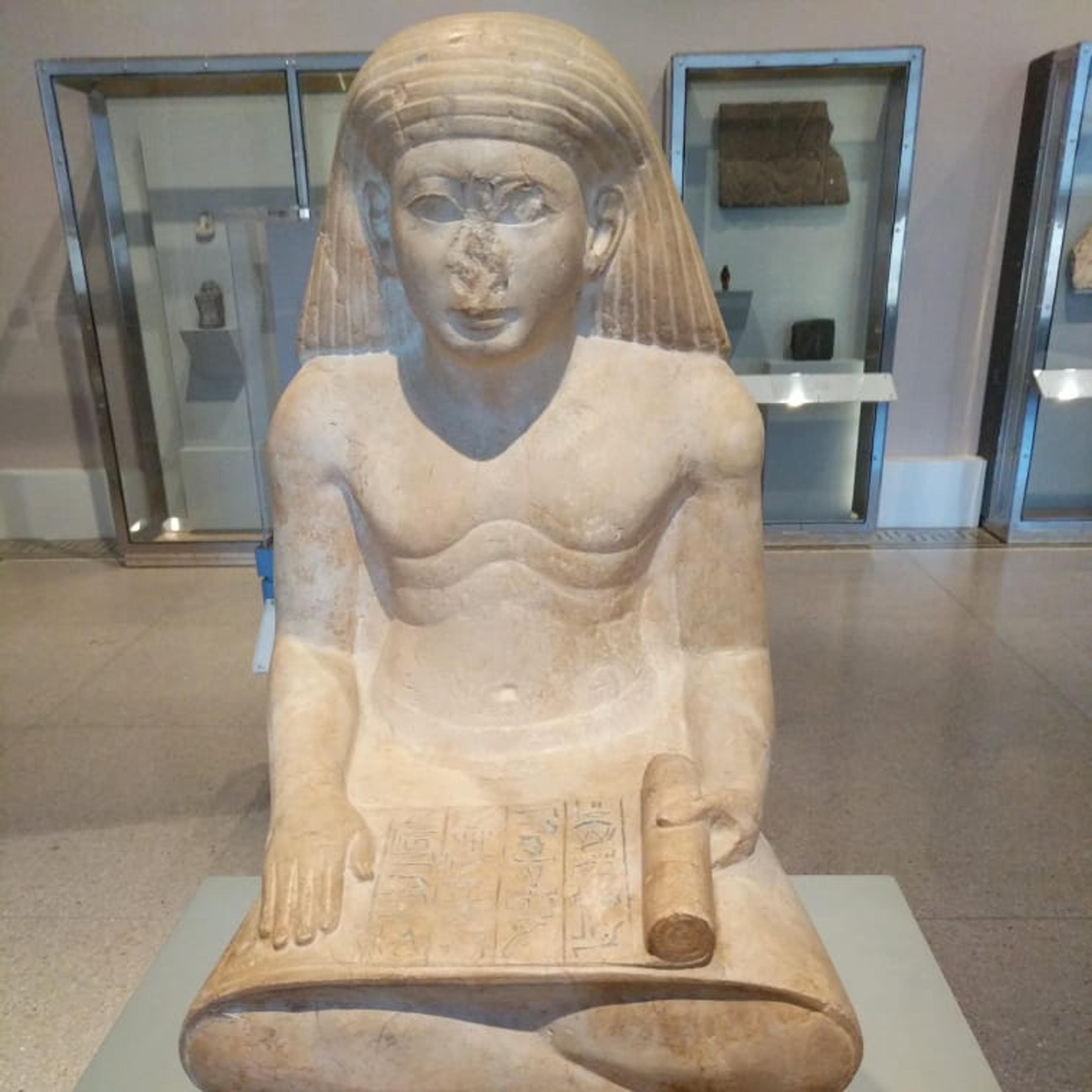 Well the person who made the sculpture is often not the same person who defaces it. For example, a tomb robber might remove the nose of a statue to keep the person's soul from exacting revenge on them.It usually happens much later in the life of the statue. For example, it was popular to deface statues and depictions of unpopular or heretical rulers after their reign like Akhenaten or Hatshepsut.
I’m looking at the Head of Hatshepsut or Thutmose lll and was wondering if it was painted.
I can say that many statues were painted in polychromy (multiple colors), but I can't say for certain if this work was or not, as there is no evidence of pigment now.Is it possible to paint on the black granite?Yes. The ancient Egyptians painted many statues in black and pink granite, though the paint often does not survive on these harder stones.Was the "Head of Hatshepsut or Thutmose lll" reconstructed, because many of Hatshepsut’s pieces were destroyed by Thutmose III?
What you see in our gallery is not a reconstruction, but it is only a fragment of what would have been a full-body statue. The majority of Hatshepsut's statuary from her funerary temple was actually buried in tact rather than destroyed. Outside of her temple, many of her statues were actually recarved to represent other pharaohs, like Thutmose I or Thutmose III which contributes to the difficulty of identifying them. The destruction to this statue likely occurred long after the reign of Thutmose III.Oh interesting. Thank you so much!Is this the only sculpture of Hatshepsut in the museum?
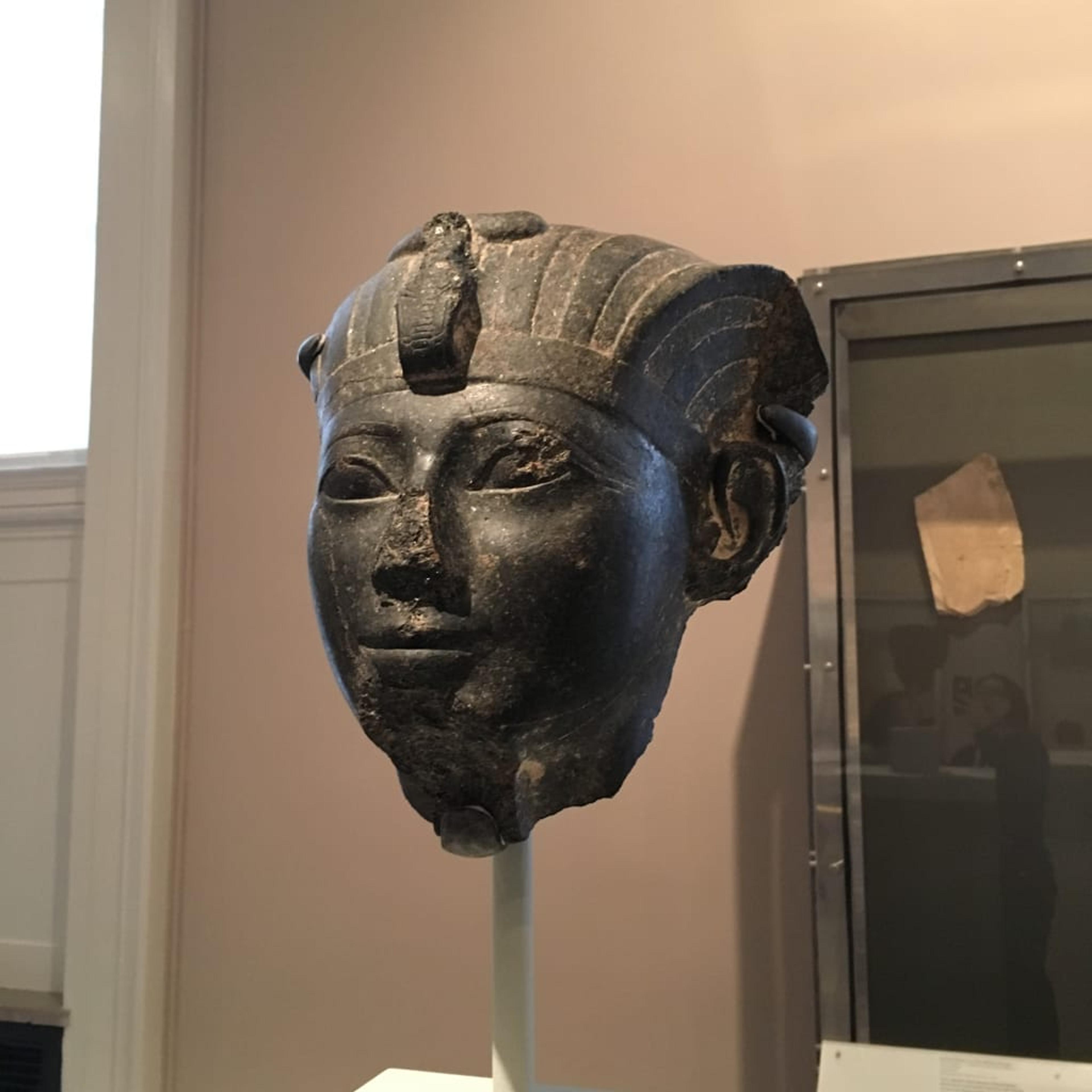 That's correct, this is the only potential image of Hatshepsut on view.Thank you!You're welcome! Did you notice the kneeling statue of Senenmut nearby? He was her closest advisor during her reign and we have an especially well preserved statue of the official.Yes! Thank you again.
Have information?
Have information about an artwork? Contact us at