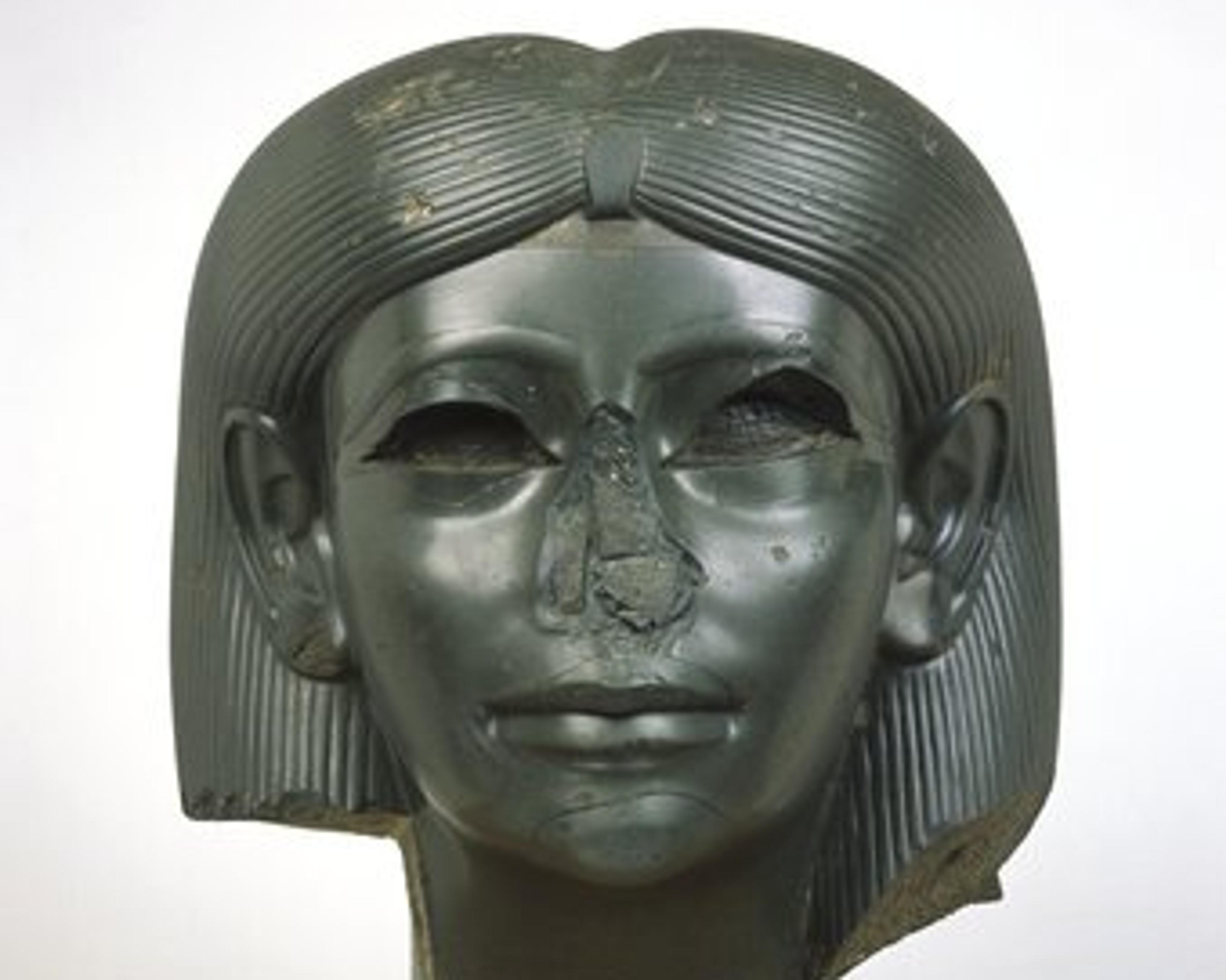
Head from a Female Sphinx
- Medium: Chlorite
- Geographical Locations:
- Place made: Egypt
- Possible place collected: Hadrian's Villa, Rome, Italy
- Possible place collected: Heliopolis, Egypt
- Dates: ca. 1876-1842 B.C.E.
- Dynasty: XII Dynasty
- Period: Middle Kingdom
- Dimensions: 15 5/16 x 13 1/8 x 13 15/16 in., 124.5 lb. (38.9 x 33.3 x 35.4 cm)
- Collections: Egyptian, Classical, Ancient Near Eastern Art
- Museum Location:
This item is on view in Egypt Reborn: Art for Eternity, Old Kingdom to 18th Dynasty, Egyptian Galleries, 3rd Floor - Accession Number: 56.85
- Credit Line: Charles Edwin Wilbour Fund
- Rights Statement: Creative Commons-BY-NC
You may download and use Brooklyn Museum images of this three-dimensional work in accordance with a Creative Commons license. Fair use, as understood under the United States Copyright Act, may also apply.
Please include caption information from this page and credit the Brooklyn Museum. If you need a high resolution file, please contact reproductions@brooklynmuseum.org (charges apply).
For further information about copyright, we recommend resources at the United States Library of Congress, Cornell University, Copyright and Cultural Institutions: Guidelines for U.S. Libraries, Archives, and Museums, and Copyright Watch.
For more information about the Museum's rights project, including how rights types are assigned, please see our blog posts on copyright.
If you have any information regarding this work and rights to it, please contact copyright@brooklynmuseum.org. - Caption: Head from a Female Sphinx, ca. 1876-1842 B.C.E. Chlorite, 15 5/16 x 13 1/8 x 13 15/16 in., 124.5 lb. (38.9 x 33.3 x 35.4 cm). Brooklyn Museum, Charles Edwin Wilbour Fund, 56.85. Creative Commons-BY-NC
- Image: Front, 56.85_front_SL1.jpg. Brooklyn Museum photograph
The great majority of sphinxes bear the heads of kings on lion bodies. From every period, however, a small number of sphinxes are known with the heads of queens or princesses. This colossal head can be recognized as coming from a sphinx because her hairdo extends horizontally at the back, where it rested along the lion's body. Her modest hair decoration suggests that the woman was a princess rather than a queen. The damages to her face, including the removal of her inlaid eyes, probably occurred before the head left Egypt. In Rome, it was apparently part of Emperor Hadrian's large collection of Egyptian art. The repairs, made with stone taken from the interior of the head, may have been made in the eighteenth century, when the head was in the collection of Cardinal Alessandro Albani in Rome.
Related Audio
Head from a Female Sphinx
- Download
- Embed
FAQ


Robert
Louise
shelley
rcherry
z
dsol
paul
patraff
Eastern Parkway/Brooklyn Museum