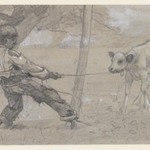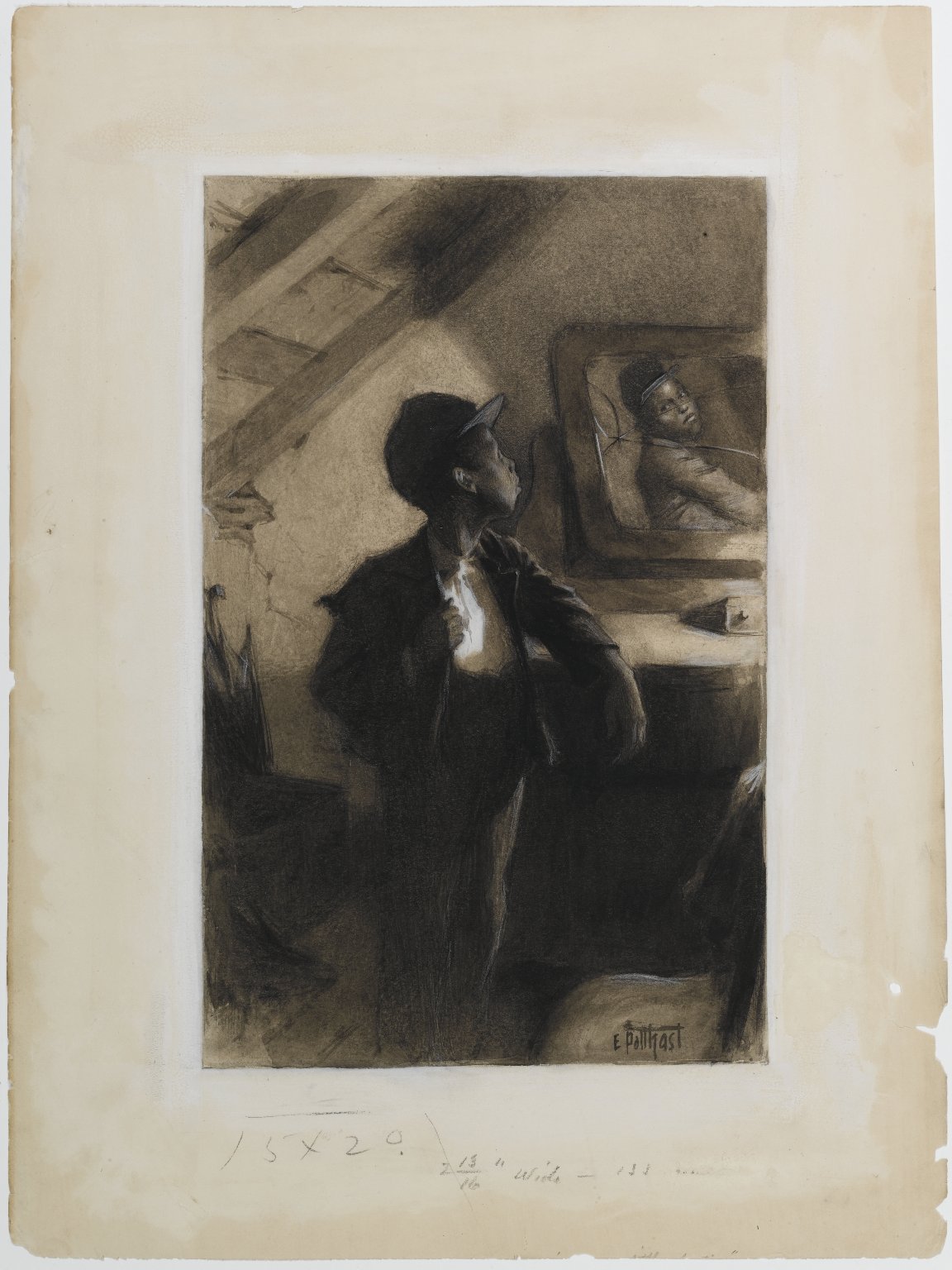
Illustration for "George Washington Jones: A Christmas Gift That Went A-Begging"
Edward Henry Potthast
American Art
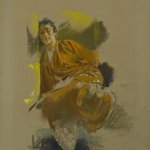
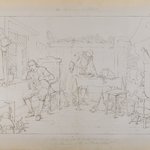
This drawing illustrates a scene from a sentimental novel about a young African American orphan in Reconstruction-era New Orleans. The title character, George, dresses to present himself as a Christmas gift to potential employers in emulation of his late, enslaved grandfather, who had been given to the master’s daughter. Although the novel portrays George as a plucky and industrious hero, it also suggests that African Americans were content to follow old patterns of servitude, perpetuating a stereotype that assuaged some white readers’ anxieties about racial tensions following the Civil War.
In the drawing, Edward Potthast sensitively captured George’s humble circumstances and complex emotions with careful attention to telling details, such as the crumbling wall in the cramped garret and the too-short jacket sleeve. The boy’s erect posture and uptilted head convey determination, but his reflected expression in the mirror is apprehensive. The strong contrast in lighting further enhances the narrative drama, while also foretelling what is presented in the novel as a brighter future for George.
In the drawing, Edward Potthast sensitively captured George’s humble circumstances and complex emotions with careful attention to telling details, such as the crumbling wall in the cramped garret and the too-short jacket sleeve. The boy’s erect posture and uptilted head convey determination, but his reflected expression in the mirror is apprehensive. The strong contrast in lighting further enhances the narrative drama, while also foretelling what is presented in the novel as a brighter future for George.
MEDIUM
Watercolor, charcoal and white crayon on cream, medium-weight, slightly textured wove paper.
DATES
1903
DIMENSIONS
Sheet: 19 3/4 x 14 13/16 in. (50.2 x 37.6 cm)
Image: 14 1/16 x 8 7/8 in. (35.7 x 22.5 cm) (show scale)

SIGNATURE
Signed in charcoal, lower right, "E. Potthast"
COLLECTIONS
American Art
ACCESSION NUMBER
33.392
CREDIT LINE
Peter F. Schofield Fund
CATALOGUE DESCRIPTION
Reproduced as an illustration in Ruth McEnery Stuart, "George Washington Jones: A Christmas Gift That Went A-Begging" (Philadelphia: Henry Altemus Company, 1903), facing p. 28, with the caption, "'Wush't I was a little purtier,' he lamented."
MUSEUM LOCATION
This item is not on view
CAPTION
Edward Henry Potthast (American, 1857–1927). Illustration for "George Washington Jones: A Christmas Gift That Went A-Begging," 1903. Watercolor, charcoal and white crayon on cream, medium-weight, slightly textured wove paper., Sheet: 19 3/4 x 14 13/16 in. (50.2 x 37.6 cm). Brooklyn Museum, Peter F. Schofield Fund, 33.392 (Photo: Brooklyn Museum, 33.392_PS1.jpg)
IMAGE
overall, 33.392_PS1.jpg. Brooklyn Museum photograph, 2007
"CUR" at the beginning of an image file name means that the image was created by a curatorial staff member. These study images may be digital point-and-shoot photographs, when we don\'t yet have high-quality studio photography, or they may be scans of older negatives, slides, or photographic prints, providing historical documentation of the object.
RIGHTS STATEMENT
No known copyright restrictions
This work may be in the public domain in the United States. Works created by United States and non-United States nationals published prior to 1923 are in the public domain, subject to the terms of any applicable treaty or agreement.
You may download and use Brooklyn Museum images of this work. Please include caption information from this page and credit the Brooklyn Museum. If you need a high resolution file, please fill out our online application form (charges apply).
The Museum does not warrant that the use of this work will not infringe on the rights of third parties, such as artists or artists' heirs holding the rights to the work. It is your responsibility to determine and satisfy copyright or other use restrictions before copying, transmitting, or making other use of protected items beyond that allowed by "fair use," as such term is understood under the United States Copyright Act.
The Brooklyn Museum makes no representations or warranties with respect to the application or terms of any international agreement governing copyright protection in the United States for works created by foreign nationals.
For further information about copyright, we recommend resources at the United States Library of Congress, Cornell University, Copyright and Cultural Institutions: Guidelines for U.S. Libraries, Archives, and Museums, and Copyright Watch.
For more information about the Museum's rights project, including how rights types are assigned, please see our blog posts on copyright.
If you have any information regarding this work and rights to it, please contact copyright@brooklynmuseum.org.
RECORD COMPLETENESS
Not every record you will find here is complete. More information is available for some works than for others, and some entries have been updated more recently. Records are frequently reviewed and revised, and we welcome any additional information you might have.