Collections: Photography

  • 1st Floor
    Arts of Africa, Steinberg Family Sculpture Garden
  • 2nd Floor
    Arts of Asia and the Islamic World
  • 3rd Floor
    Egyptian Art, European Paintings
  • 4th Floor
    Contemporary Art, Decorative Arts, Elizabeth A. Sackler Center for Feminist Art
  • 5th Floor
    Luce Center for American Art

On View: The Islets at Port-Villez (Les Iles à Port-Villez)

Throughout his sixty-year painting career, Monet captured the shifting light and color of the Seine River, often from a flat-bottomed studio...

Hiroshige's One Hundred Famous Views of Edo

Hiroshige's 118 woodblock landscape and genre scenes of mid-nineteenth-century Tokyo, is one of the greatest achievements of Japanese art.


Login to play

Login with Google ID

Forgot your password?

Not a Posse member? Register

Brooklyn Museum Posse:
Exploring the collection

When you join the posse, your tags comments and favorites will display with your attribution and save to your profile.

 
A Composition for DetroitConey Island (Thunderbolt)Pretend #2Frances with a FlowerThe Red HorseUntitled[Untitled Film Still]Gloucester 16AMiscegenated Family AlbumConey IslandConey Island (Parachute Jump)Coney IslandConey IslandModern 1947 Coney IslandQue Chiquito es el MundoClimbing into the Promised Land, Ellis Island"Sheik Ali Gournah," EgyptBoy with BubbleCharles, Vasa, MinnesotaUntitledApartment 304, 398 Main StreetDad, Hampton Ponds IIISamar HusseinModel T HeadquartersBoy and Dog, Iron Pier, Coney Island, BrooklynThe PunksThe Girl with a GunThe Nude BatherSoldier: Claxton - 120 days in Afghanistan, Fort Drum, NYSoldier: Mickelson-length of service unknown, Fort Drum, NYIce StormThe Curb Market - New YorkDrift Stump, North CoastCuatro pescaditos (Four Fishes), Juchitán, OaxacaAmerica (Snoop Dogg)Robin, #43, Oakland, CAI Look Just Like My DaddyNuestra Señora de las Iguanas (Our Lady of the Iguanas), Juchitán, OaxacaLa Ascensión (The Ascension), Chalma, State of MexicoTehuantepec, OaxacaMujer Cangrejo (Crab Woman), Juchitán, OaxacaLos Pollos (Chickens), Juchitán, OaxacaMadonna, Mexico CityVendedora de Zacate (Sponge Vendor), OaxacaSeñor de Los Pájaros (Lord of the Birds), NayaritDaily News BuildingUntitledUnderground Paris: St. MichelUntitled (Eleanor)CountingChina Mansion[Untitled] (Tug and Barge, East River)Untitled #180BM (3Fb)Untitled (Man Smoking/Malcolm X), from the Kitchen Table series

Collection – Showing objects 1 - 55 of 6365

View All
 

Behind the Scenes on The Latino List

If you’ve visited The Latino List exhibition, you may have wondered how Timothy Greenfield-Sanders creates such monumental photographs. It all starts with the camera. For over 30 years Greenfield-Sanders’s signature tools have been the large-format camera and the large-format negatives it produces. Essentially unchanged since its introduction in the late 19th-century, large-format cameras and negatives allow photographers to make extremely large prints with incredible detail and resolution, far beyond what can be currently achieved with digitally originated images.

Latino List

Greenfield-Sanders turned to a beautiful wooden 8” x 10” Deardorff view camera from the 1930s, fitted with a modern lens, which he used to shoot The Latino List.

In 1978, Greenfield-Sanders started shooting with an antique 11” x 14” view camera. Film for that format was discontinued around 2000 and Greenfield-Sanders turned to a beautiful wooden 8” x 10” Deardorff view camera from the 1930s, fitted with a modern lens, which he used to shoot The Latino List. The technical procedure, which weds vintage apparatus to modern technology, is relatively straightforward: first, he loads the camera with 8” x 10” color negative film—one plate at a time—and, from the only six or so shots captured in the sitting, he selects the negative he wants to print. Using a drum scanner, he generates a 600 MB scan file from the negative, which is digitally cleaned up only for dirt and spots. The scan is then printed on 44 inch wide Epson UltraSmooth paper, retaining the characteristic black borders and notches on the upper left edge that denote the 8” x 10” format.

Latino List

Greenfield-Sanders on the Latino List set with Pitbull.

Greenfield-Sanders loves the look and feel of large-format photography, particularly how the technique’s typically shallow depth of field focuses attention on the sitter’s face, fostering a sense of stillness, as well as the directness and intimacy that he seeks to capture in his portraits. Apart from its technical capabilities, the physical camera itself plays an important role in Greenfield-Sanders’s work as a portraitist. Sitters are intrigued or amused by the imposing antique camera—some have asked if it belonged to (19th-century photographer) Matthew Brady! Greenfield-Sanders finds that this curiosity about the object, with its rich historical presence, goes a long way toward dissipating any tension even celebrities might feel while having their portrait taken.  So too does the fact that, unlike other photographers whose faces remain semi-hidden behind the camera, Greenfield-Sanders stands next to his.  Once the shot is framed, photographer and subject can talk face to face and develop a relaxed and personal connection, creating the mood for the right picture to happen.

Author profile

About Lisa Small

Lisa Small joined the Brooklyn Museum in Spring 2011 as Curator of Exhibitions. From 2007 until 2011 she was Curator of Exhibitions at the American Federation of Arts (AFA), coordinating traveling exhibitions such as Turner to Cézanne: Masterpieces from the Davies Collection, National Museum Wales, and Gods and Heroes: Masterpieces from the École des Beaux-Arts, Paris. Prior to joining the AFA, Small was a curator at the Dahesh Museum of Art, where she organized numerous exhibitions, including Napoleon on the Nile: Soldiers, Artists, and the Rediscovery of Egypt and Fantasy & Faith: The Art of Gustave Doré. Small has taught art history at Hunter College and Brooklyn College and has been a member of the art history faculty at the School of Visual Arts since 2008. Small earned a B.A. from Colgate University, an M.A. and an M.Phil in Art History from CUNY, and an M.A. in Arts Administration from NYU.
Filed under: Contemporary Art, Photography
Tagged:
Bookmark the permalink

Go to the original blog post

How has your culture shaped your life and accomplishments?

All eyes will be on you this fall when you enter the Great Hall and encounter the twenty-five massive photographic portraits by Timothy Greenfield-Sanders that comprise The Latino List. Those of you who remember his incredibly popular and thought-provoking 2008 exhibition, The Black List, will recognize this new project as of an extension of that one. This time, some of the most interesting, influential, and accomplished members of the American Latino community—from Sonia Sotomayer to Pitbull—pose in front of Greenfield-Sanders’s large-format camera.  The HBO documentary he directed as part of this project transforms these powerful still images into “speaking portraits” whose funny, poignant, and insightful personal narratives collectively explore and celebrate facets of the American Latino experience.  A trailer for the film is on view in the gallery and we’re thrilled to be hosting several screenings of the full film (October 1 & 27, November 20).

Latino List Community Voices Kiosk

iMac kiosks in The Latino List that record video reaction from visitors.

We are also super excited to see how visitors to The Latino List create their own “speaking portraits” at the exhibition’s community voice kiosk, an interactive that was such a successful part of The Black List exhibition that we knew we had to offer it again.  During The Black List visitors were invited to record on-the-spot videos of their response to the question: “How has race made an impact on your life and accomplishments?”  Videos were published to the museum’s YouTube channel and the best of them could also be viewed in the gallery during the course of the exhibition.  I was blown away by the candor, humor, pride, anger, and power in these videos.  One of the most fascinating things about the responses was their diversity and range.  Not only did each individual naturally have their own personal take on the question, but people reflected on how their own race is perceived and experienced as well as how they perceive and experience people of other races.

For The Latino List we wanted to elicit similarly inclusive and reciprocal responses, so the question we pose to visitors this time—in English and Spanish—is: “How has your culture shaped your life and accomplishments? (¿Qué impacto ha tenido su cultura en su vida y en sus logros?). The word “culture” conjures family and community traditions, and certainly one of the things that unite the stories shared by the Latino List participants is the impact and influences that family and tradition have had on their lives and identities.  The word evokes a range of concepts, from race to religion to heritage, without being  limiting or exclusionary: everyone comes from a culture of some kind, whether they abandon it or embrace it, and it shapes the way they experience the world and, to some extent, for better or worse, the way the world experiences them.

This time, we’re expanding the interactive to include not just visitors to the gallery, but anyone, anywhere, through a bilingual iPhone app.  You can record your video response directly on your iPhone, upload it to The Latino List YouTube channel, learn about the exhibition, and watch videos made by other people.

Latino List in the App Store

As always, we want to hear from you:  download the app, come to The Latino List, and make a video to share your thoughts about your culture and experiences.

Author profile

About Lisa Small

Lisa Small joined the Brooklyn Museum in Spring 2011 as Curator of Exhibitions. From 2007 until 2011 she was Curator of Exhibitions at the American Federation of Arts (AFA), coordinating traveling exhibitions such as Turner to Cézanne: Masterpieces from the Davies Collection, National Museum Wales, and Gods and Heroes: Masterpieces from the École des Beaux-Arts, Paris. Prior to joining the AFA, Small was a curator at the Dahesh Museum of Art, where she organized numerous exhibitions, including Napoleon on the Nile: Soldiers, Artists, and the Rediscovery of Egypt and Fantasy & Faith: The Art of Gustave Doré. Small has taught art history at Hunter College and Brooklyn College and has been a member of the art history faculty at the School of Visual Arts since 2008. Small earned a B.A. from Colgate University, an M.A. and an M.Phil in Art History from CUNY, and an M.A. in Arts Administration from NYU.
Filed under: Contemporary Art, Photography, Technology
Tagged: , , , , ,
Bookmark the permalink

Go to the original blog post

Geotag Brooklyn

Trying to track the history of the images of Brooklyn that we’re geotagging for #mapBK on Flickr and Twitter and then porting to Historypin reminds me of the game of tag, with kids dashing from one side of the yard to another.

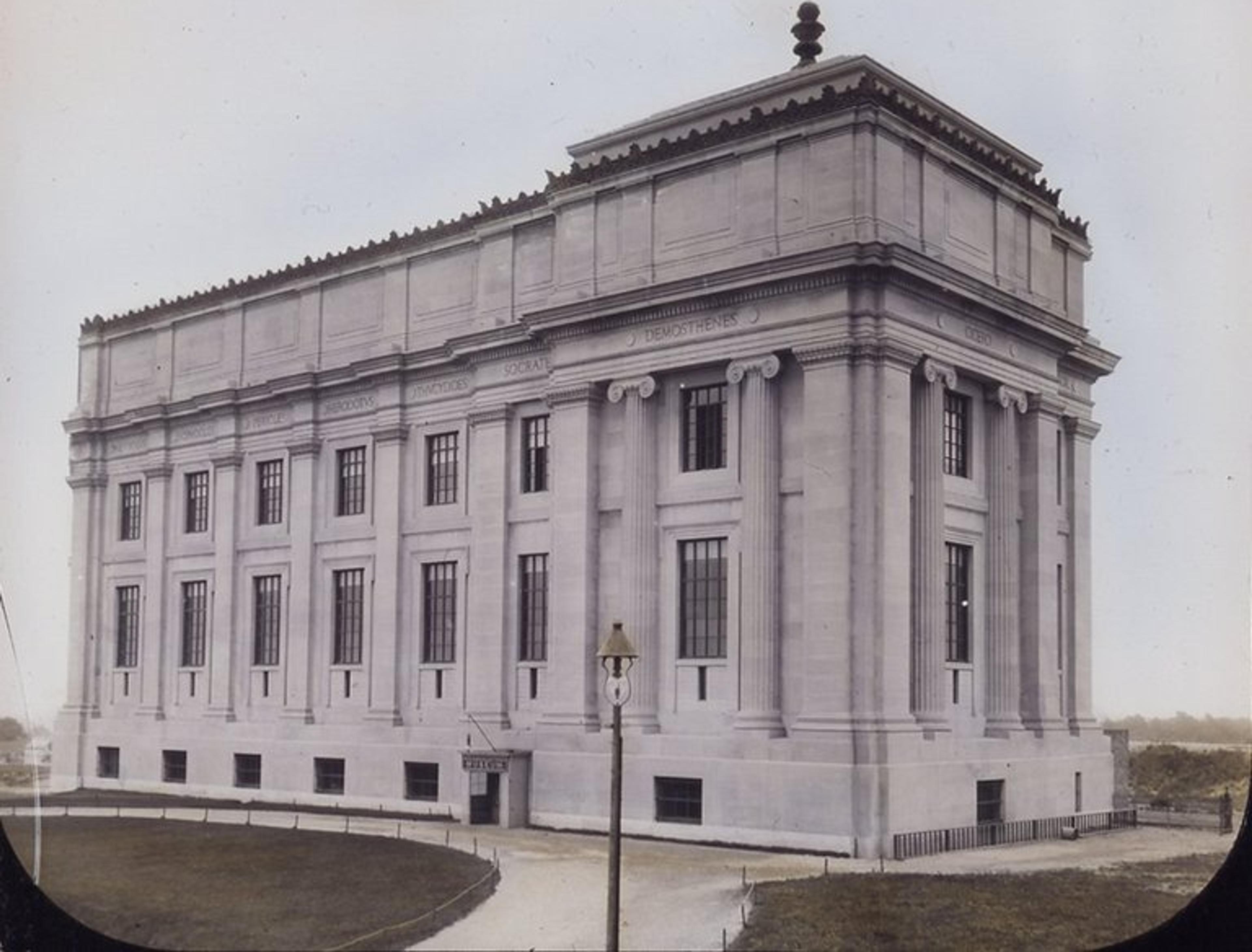
Eugene Wemlinger. Brooklyn Museum, Prospect Park, Brooklyn, ca. 1903-1910. Brooklyn Museum/Brooklyn Public Library, Brooklyn Collection, 1996.164.10-32.

This huge collection of more than 3500 glass and film negatives has had a pretty peripatetic life, even before its current digital excursions. So, here’s a little of the history behind this 21st century project.

Brooklyn Daily Eagle, April 24, 1898

It seems likely that some parts of the collection are the remnants on the late 19th-century collections of the Department of Photography of the Brooklyn Institute of Arts and Sciences, the Museum’s parent organization. George Bradford Brainerd – one of the photographers represented in the glass negative collection — was a member of the Institute’s Photography Department. While the Museum itself didn’t appoint a Photography curator until 1982, we did have a photography studio charged with documenting the art collections as early as 1909. Museum photographer Herman de Wetter, hired in 1934, had curatorial aspirations and began collecting photographs, both historical and contemporary; cataloging the photograph collections already in the Museum; and organizing exhibitions. In 1953, Eye to Eye, the bulletin of the Graphic History Society of America, described nine historical photograph collections at the Brooklyn Museum.

Despite the popularity of the images – they may be seen in many mid-century publications on Brooklyn history – the Museum administration was dubious about committing to photography as part of the art collections. In 1955, shortly after the Director returned the Photography Studio to a service-only mission, the Brooklyn negatives were donated to the Brooklyn Public Library.

Negative collections, especially glass negative collections, are notoriously difficult to store, manage, and provide access to. The negatives are fragile and heavy. Without printing the negatives, it’s very difficult to actually view the images. Photographs are traditionally cataloged at the item level, a time-consuming process. Once BPL’s Brooklyn Collection had printed them (a project they took on in the 1980s), the glass negatives themselves became a burden to preserve.

Collection of glass plate negatives in Brooklyn Museum art storage area.

The Brooklyn Museum’s Photography Curator, Barbara Millstein, still saw them as a treasure, though, and instigated efforts to bring the negatives back under the Museum’s care. In 1996 this was accomplished: the negatives were trucked back up the hill, checked by Conservation staff, rehoused in archival boxes and sleeves, and catalog worksheets created.

The collection, with negatives at the Museum and reference prints at BPL, now has a joint credit line: Brooklyn Museum/Brooklyn Public Library, Brooklyn Collection.

Prepping a negative for scanning (Lisa Adang, Digital Lab)

A recent IMLS grant allowed Digital Lab staff to convert the catalog sheets into database records in the Museum’s collections database and make a start at digitizing the images. Nearly 400 images are now on the Museum’s website and on Flickr, with more scanning underway. The beauty of the Digital Age is that it doesn’t really matter where the actual objects reside – they’re as easily accessible in Breukelen (NL) as in Brooklyn.

What now? Crowd sourcing the research needed to expand and correct the titles and place the images on the map. Bringing the data, tags, comments, and corrections full circle, back to the Museum’s collections pages. Members of the Flickr and Twitter community have been pitching in to geotag the images. People are talking, working together, and solving mysteries. Stay tuned! Research a few mysteries yourself!

Author profile

About Deborah Wythe

Deborah Wythe manages the Brooklyn Museum’s Digital Collections and Services department (the “Digital Lab”), coordinating digital imaging activities museum-wide, including the photo studio, scan lab, digital asset management, and rights and reproductions. Before moving to the Digital Lab, Deb was the Museum Archivist, where she managed the Museum’s historical records and worked on several technology-driven projects. Deb edited the new edition of Museum Archives: An Introduction, published by the Society of American Archivists in 2004, and wrote the chapters on the museum context, appraisal, description, records surveys, and photographs. Prior to joining the Brooklyn Museum staff, she worked on the Steinway Collection at the LaGuardia and Wagner Archives and, as an intern, organized the records of the Department of Musical Instruments at the Metropolitan Museum of Art. In her previous life, before discovering archives work (she has always been a museum maven), Deb earned her Master’s and PhD in musicology at NYU. She still studies the piano.
Filed under: Digital Lab, Photography, Technology
Tagged: , , ,
Bookmark the permalink

Go to the original blog post

Help us pin Brooklyn to the map!

If you know and love Brooklyn we need your help to get 300+ images from our collection pinned to Historypin’s map before their launch on July 11, 2011.  If we don’t get cracking, Brooklyn is going to be woefully under-represented and that’s just not okay. Current Historypin totals have 1,358 images pinned to Manhattan with just 103 pinned to Brooklyn.

Brooklyn, we can do better than that!

Historypin

Historypin launches July 11 with our without Brooklyn. Let's rally BK pride to make sure the borough is well represented!

Historypin is a social sharing site meant to bridge the generation gap by encouraging its users to map historial images to modern day locations in order to show then and now comparisons and get people sharing more about history in the process.  The site has been in beta for a year or so and we’ve been interested in participating, but we didn’t have enough hands around here to take some of our most interesting materials and get them onto the map because while they have been digitized, they’ve not been geotagged.  That’s a major stumbling block and we need your help to get over this hump and ensure the borough of Brooklyn is well represented.

To get started we are going to begin a slow release of some amazing images of Brooklyn from the late 1800s to the Flickr Commons in the hopes that you can help us identify them and place them on a map.

In some cases, it will be very clear where these should be placed, but in others it will be a bit more of a mystery and require some sleuthing. Images that are geotagged by you will get placed on Historypin’s map for their launch on July 11 and we’ll be releasing more images every Tuesday and Thursday.

If you have a few minutes, help us out by mapping a few of these gems and you can continue to chart the project’s progress on our #mapBK leaderboard.  Let’s represent!

Author profile

About Shelley Bernstein

Shelley is the Chief of Technology at the Brooklyn Museum where she works to further the Museum's community-oriented mission through projects including free public wireless access, web-enabled comment books, projects for mobile devices and putting the Brooklyn Museum collection online. She is the initiator and community manager of the Museum's initiatives on the social web. She organized Click! A Crowd-Curated Exhibition, Split Second: Indian Paintings, and GO: a community-curated open studio project. In 2010, Shelley was named one of the 40 Under 40 in Crain's New York Business and she's been featured in the New York Times. She can be found biking to work or driving '74 VW Super Beetle in Red Hook, Brooklyn with her dog Teddy. ::contact::
Filed under: Libraries & Archives, Photography, Technology
Tagged: ,
Bookmark the permalink

Go to the original blog post

Object of the Month: August 2010: Miscegenated Family Album

It’s when a work of art is able to communicate on many different levels at the same time – when it can speak to audiences on both an emotional and intellectual level – that I often feel it’s the most successful. That’s why I was thrilled when we were able to acquire Lorraine O’Grady’s Miscegenated Family Album last year.

Something remarkable happens when O’Grady combines her own family portraits with ancient Egyptian imagery. Some of these juxtapositions are tender and intimate, with mood and gestures strikingly fusing family and family matters millennia apart. The work immediately became a favorite of our installation Extended Family and it merges the personal with the historic, relating beyond the Contemporary Galleries to the Museum’s world renowned collection of Egyptian Art.

CUR.2008.80.jpg

Lorraine O’Grady (American, born 1934). Miscegenated Family Album, 1994. Silver dye bleach (Cibachrome) print, 32 prints each: 20 x 16 in. (50.8 x 40.6 cm). Brooklyn Museum, Purchased with funds given by Shelley and Philip E. Aarons, John and Barbara Vogelstein, and bequest of Richard J. Kempe, by exchange, 2008.80. © Lorraine O’Grady

Miscegenated Family Album consists of sixteen pairs of black-and-white and color portraits. Each framed pair juxtaposes images of members of the artist’s family, often her sister Devonia, with images mostly portraying the Egyptian queen Nefertiti and her family. The work grew out of O’Grady’s 1980 performance, Nefertiti/Devonia Evangeline, which took place in front of a larger series of projected images of a similar kind. Devonia died unexpectedly at the age of thirty-seven before the sisters had time to reconcile their troubled relationship. The performance was a way for the artist to mourn her dead sister, her only sibling, and work through their fraught and complex bond.

The use of Egyptian imagery came naturally to O’Grady who found a physical resemblance between her sister and the Egyptian family imagery she chose. In the same way, she found similarities in the family histories. Nefertiti’s sister Mutnedjmet plays an important role in many of the pictures and the Egyptian queen disappeared from public life at an age close to Devonia’s at the time of her death. Egyptian art from this period around 1340 BC is known for its realistic and informal depictions of family life and its intimate portrayal of affection between family members. (The Brooklyn Museum has a wonderful collection of portrait reliefs from this period, including the piece called A Mother’s Kiss, which O’Grady used for her work—see below.)

60.197.8_PS1.jpg

Relief of Queen Nefertiti Kissing One of Her Daughters, ca. 1352-1336 B.C.E. Limestone, painted, 8 3/4 x 1 5/16 x 17 1/2 in. (22.2 x 3.4 x 44.5 cm). Brooklyn Museum, Charles Edwin Wilbour Fund, 60.197.8.

At the same time as the subject matter is deeply personal, through it O’Grady also addresses issues of class, racism, ethnography and African American art. The piece is also a commentary on hybridity. Born in Boston in 1934 to West Indian parents, O’Grady always approaches biculturalism in her art and acknowledges the importance of the diaspora experience for her life and work: the need to reconcile conflicting values and different backgrounds, and, as O’Grady writes, the necessity “to build a bridge to some other place.”

Miscegenated Family Album will remain on view until September 5.

Author profile

About Patrick Amsellem

Patrick Amsellem is the Associate Curator of Photography at the Brooklyn Museum. Formerly a curator at the Rooseum Center for Contemporary Art in Malmö, Sweden, Patrick organized the first Swedish exhibition of the work of Andreas Gursky and was part of the curatorial team that produced a major series of exhibitions under the leadership of Lars Nittve. He has written about art for Stockholm’s major newspaper Svenska Dagbladet and was also a critic for the Swedish daily newspaper Kvällposten and for Swedish Public Radio. Patrick has taught at New York University and is the author of several exhibition catalogues. He received a Ph.D. in Art History from New York University’s Institute of Fine Arts.
Filed under: Contemporary Art, Photography
Tagged: ,
Bookmark the permalink

Go to the original blog post

Recent Blog Posts

Behind the Scenes on The Latino List
If you’ve visited The Latino List exhibition, you may have wondered how Timothy Greenfield-Sanders creates such monumental photographs. It all... read more.

How has your culture shaped your life and accomplishments?
All eyes will be on you this fall when you enter the Great Hall and encounter the twenty-five massive photographic portraits by Timothy... read more.

Geotag Brooklyn
Trying to track the history of the images of Brooklyn that we’re geotagging for #mapBK on Flickr and Twitter and then porting to Historypin... read more.

Help us pin Brooklyn to the map!
If you know and love Brooklyn we need your help to get 300+ images from our collection pinned to Historypin's map before their launch on July 11... read more.

Object of the Month: August 2010: Miscegenated Family Album
It's when a work of art is able to communicate on many different levels at the same time - when it can speak to audiences on both an emotional... read more.

Read all Photography blog posts

advanced 99,466 records currently online.

Recent Comments

"Hi Charles, Thanks for being in touch here and for letting our copyright project staff know you're not the right Charles Moffat. We'll keep on searching. Deb Wythe Digital Lab"
By debwythe

"That is NOT my photograph. Its either been mislabeled or by a different Charles Moffat."
By Charles Moffat

"All set -- thanks for the correction!"
By debwythe

Join the posse or log in to work with our collections. Your tags, comments and favorites will display with your attribution.