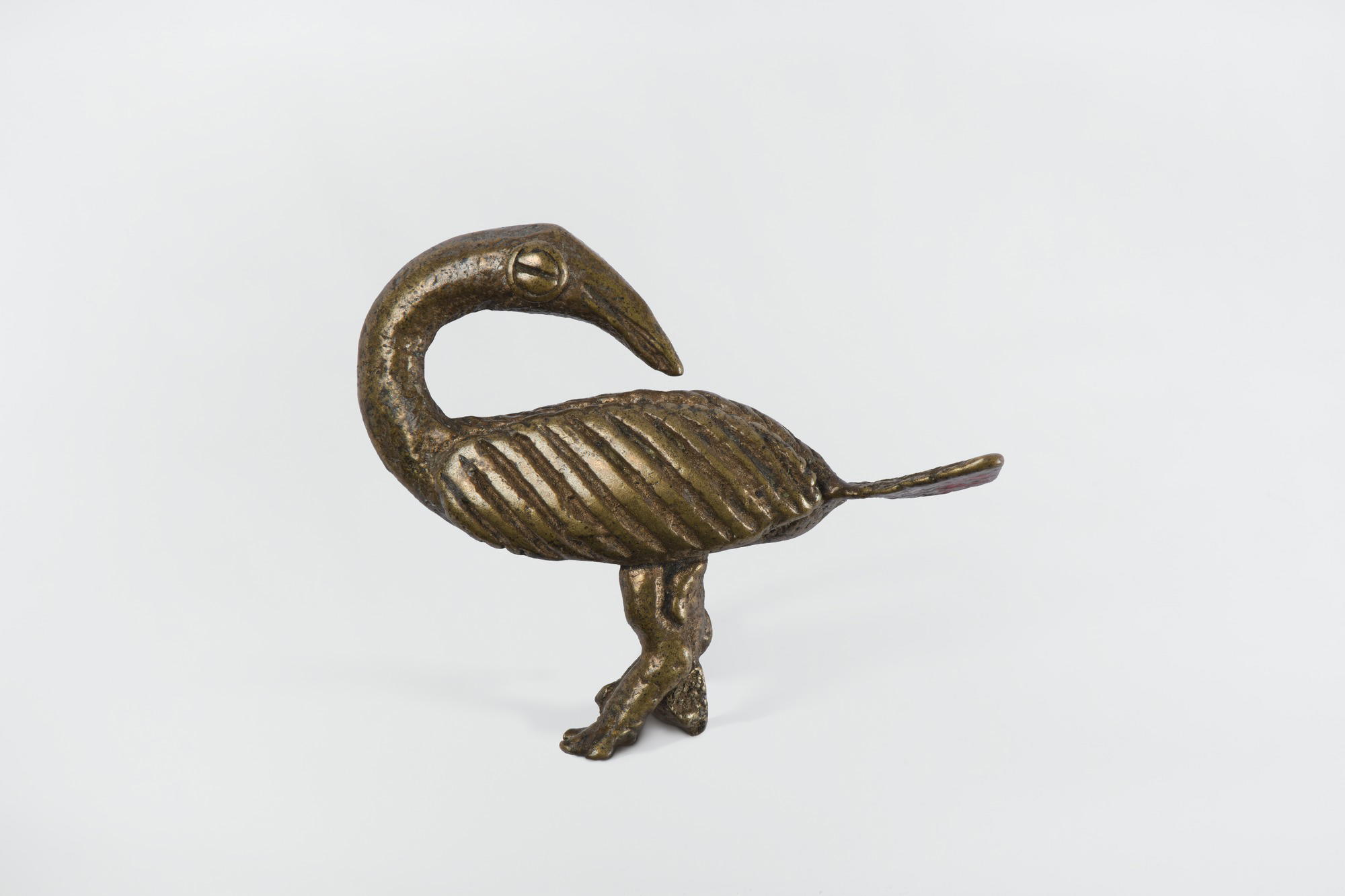
Gold Weight in Form of Sankofa Bird


1 of 3
About this Brooklyn Icon
The Brooklyn Museum is commemorating its 200th anniversary by spotlighting 200 standout objects in its encyclopedic collection.
During the 17th century, the Akan kingdoms in modern-day Ghana and Côte d’Ivoire—including the Asante empire, a powerful Akan stronghold—were members of a complex trading network that connected North, East, and West Africa. Merchants used mrammuo (gold weights) as counterbalances for gold dust, the Akan currency. This example depicts a mythical sankofa bird, with its head turned backward. A prominent symbol in the adinkra writing system used by the Akan peoples of Ghana, the sankofa bird visually represents an Akan proverb in Twi: “Sε wo werε fi na wosan kofa a yenkyiri,” loosely meaning “return and get it.” This proverb underscores the importance of taking past experiences into consideration.
A seasoned Akan merchant would have had a full trading set for measuring gold dust, including scales, spoons, storage, and a complete weight family. Made from copper alloy or brass using the lost-wax casting method, weights created between circa 1500–1700 C.E. often feature geometric motifs that represent Akan proverbs and concepts.
The Brooklyn Museum has a significant holding of Akan trading sets dating from the 15th to 20th century. This mrammuo was featured in two important long-term installations at the Museum: African Innovations (2014) and Double Take: African Innovations (2018), which marked the first time that the Museum focused on a historical overview of the Arts of Africa collection.
Object Label
Caption
Akan. Gold Weight in Form of Sankofa Bird, Brass, 1 x 2 3/4 x 1 1/4 in. (2.5 x 7 x 3.2 cm) mount: 3 × 1 1/4 × 1 1/2 in. (7.6 × 3.2 × 3.8 cm). Brooklyn Museum, Carll H. de Silver Fund, 45.11.5. (Photo: Brooklyn Museum)
Tags
Gallery
Not on view
Collection
Gallery
Not on view
Collection
Have information?
Have information about an artwork? Contact us at