The Silent River
Gustave Courbet
Caption
Gustave Courbet (French, 1819–1877). The Silent River, 1868. Oil on canvas, 27 7/8 x 42 3/16 in. (70.8 x 107.2 cm) Frame: 33 x 47 5/8 x 2 3/4 in. (83.8 x 121 x 7 cm). Brooklyn Museum, Gift of Mrs. Horace O. Havemeyer, 41.1259.
Gallery
Not on view
Gallery
Not on view
Artist
Title
The Silent River
Date
1868
Medium
Oil on canvas
Classification
Dimensions
27 7/8 x 42 3/16 in. (70.8 x 107.2 cm) Frame: 33 x 47 5/8 x 2 3/4 in. (83.8 x 121 x 7 cm)
Signatures
Signed lower right: "G. Courbet"
Credit Line
Gift of Mrs. Horace O. Havemeyer
Accession Number
41.1259
Frequent Art Questions
Can you tell us why Courbet has such different painting styles??
 Absolutely! Courbet spent a substantial part of his career trying to "shake up" the system, to wake his critics and colleagues from what he considered to be a rut of academic styles. Sometimes, he sacrificed stylistic regularity (i.e. taking the effort to have his new painting look like the one he did previously) in order to attain the element of surprise - precisely the "whoa" you seemed to have experienced just a moment ago.
Is that an animal?
 Wow what a close view! Because of the artist's loose, spontaneous style, it is impossible to say for certain. Based on the fact that this work is called "The Silent River" and the fact that Courbet wanted to show us a tranquil landscape, the presence of animals isn't the artist's focus.
I can see cracks in the painting. Has it been conserved?
 Cracking is actually common in oil paintings and may have to do with the varnish and or the flexibility of the canvas support itself. Courbet was known for applying relatively thick layers of paint, as well, which may be a factor.Oh cool! Thanks for that additional context!You're welcome! I do know that conservators' focus is largely on stabilization and preservation. If the cracks in the painting are not further harming the artwork they may be re-varnished, but not necessarily repaired.
Why is this painting called "The Silent River"?
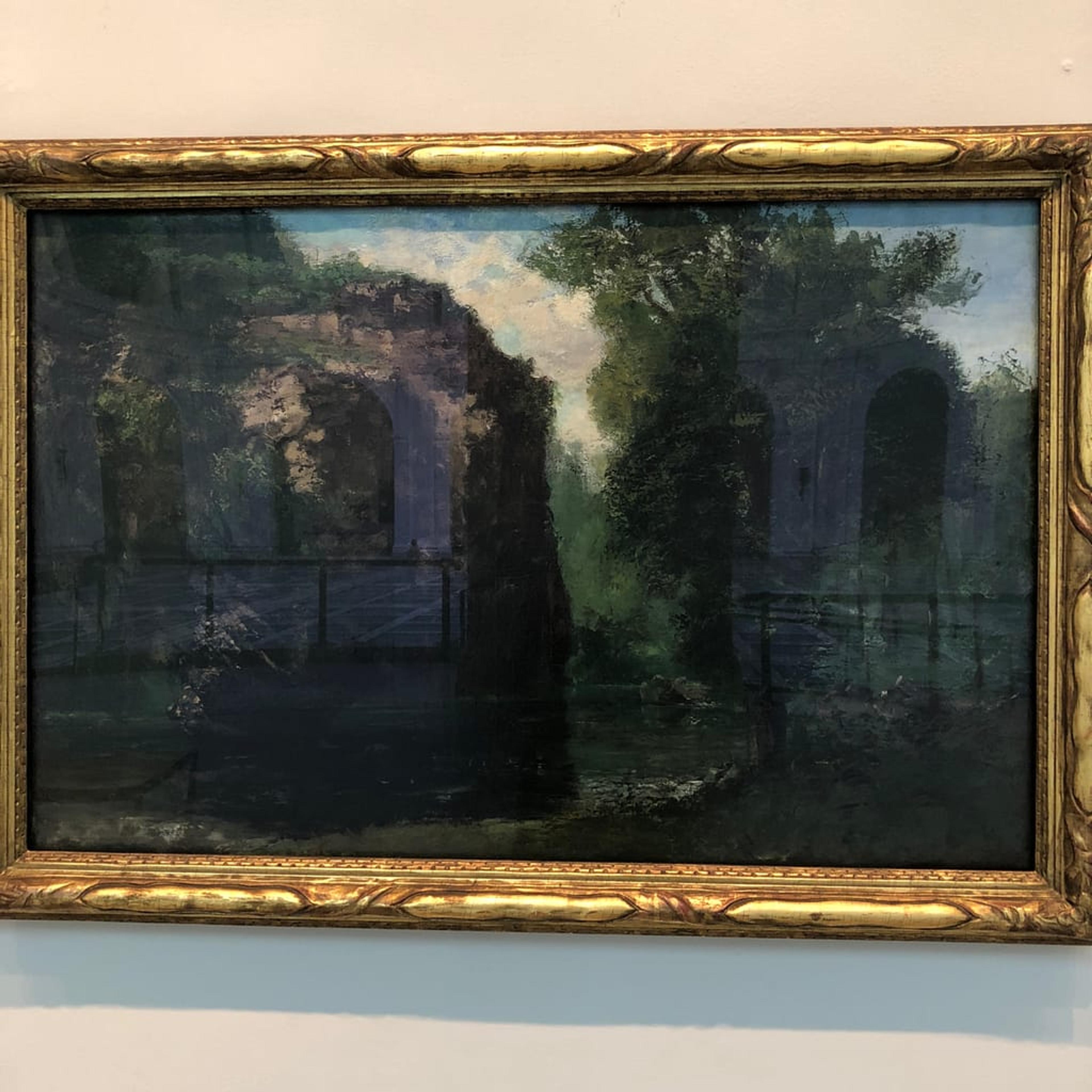 It likely has to do with the tranquility of the landscape he captured here as well as the lack of people in the scene.Many artists during this time were interested in capturing empty landscapes and the fleeting effects of both atmosphere and light.
Tell me more.
Courbet is considered a leader of the French Realist movement which was concerned with conveying truthful and objective visions of contemporary life.Courbet is known for the sense of spontaneity in his landscapes which had an important impact on the later Impressionists like Monet on view nearby
Have information?
Have information about an artwork? Contact us at