Ball-headed War Club with Carvings of Birds and Men
Anishinaabe


1 of 3
Object Label
The Jarvis Collection of Native American Plains Art
The articles in this case and the adjacent clothing case are some of the earliest and finest Eastern Plains pieces in existence. They were collected by Dr. Nathan Sturges Jarvis, a military surgeon stationed at Fort Snelling, Minnesota, between 1833 and 1836. He purchased some of the objects, while some may have been given in exchange for his medical services. These works display indigenous people’s ingenuity in combining trade materials such as cloth, metal, and glass beads with traditional hides, red pipestone, and porcupine and bird quills.
The articles in this case and the adjacent clothing case are some of the earliest and finest Eastern Plains pieces in existence. They were collected by Dr. Nathan Sturges Jarvis, a military surgeon stationed at Fort Snelling, Minnesota, between 1833 and 1836. He purchased some of the objects, while some may have been given in exchange for his medical services. These works display indigenous people’s ingenuity in combining trade materials such as cloth, metal, and glass beads with traditional hides, red pipestone, and porcupine and bird quills.
Caption
Anishinaabe. Ball-headed War Club with Carvings of Birds and Men, early 19th century. Wood, pigment, 22 1/2 x 6 x 3 in. (57.2 x 15.2 x 7.6 cm). Brooklyn Museum, Henry L. Batterman Fund and the Frank Sherman Benson Fund, 50.67.84. (Photo: Brooklyn Museum)
Gallery
Not on view
Collection
Gallery
Not on view
Collection
Culture
Title
Ball-headed War Club with Carvings of Birds and Men
Date
early 19th century
Geography
Possible place collected: Fort Snelling, Minnesota, United States
Medium
Wood, pigment
Classification
Dimensions
22 1/2 x 6 x 3 in. (57.2 x 15.2 x 7.6 cm)
Credit Line
Henry L. Batterman Fund and the Frank Sherman Benson Fund
Accession Number
50.67.84
Frequent Art Questions
Do you know what this was used for?
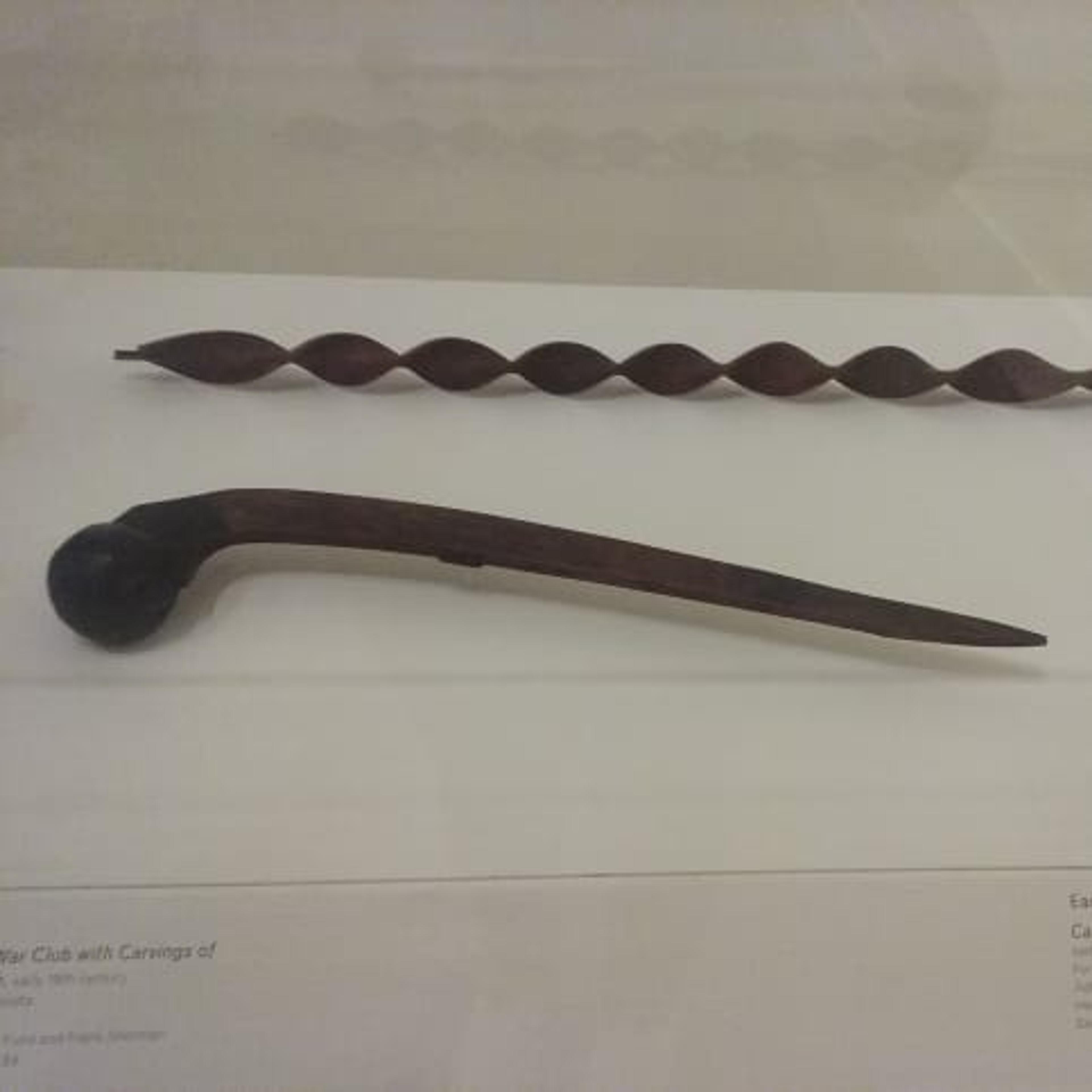 The spiral-shaped object is a pipe stem by an Eastern Sioux artist. It would have been part of the ceremonial equipment used in tobacco smoking.What about the club?It is a Ball-headed War Club by a Chippewa (Ojibwe) artist. These clubs, and those of similar design, were used throughout the Great Lakes region. If you look closely, there are birds and men carved onto the surface. The club was a weapon but it could also have been carried during ceremonies as a status object indicating that the man was a great warrior.
Have information?
Have information about an artwork? Contact us at