This image is presented as a "thumbnail" because it is protected by copyright. The Brooklyn Museum respects the rights of artists who retain the copyright to their work.
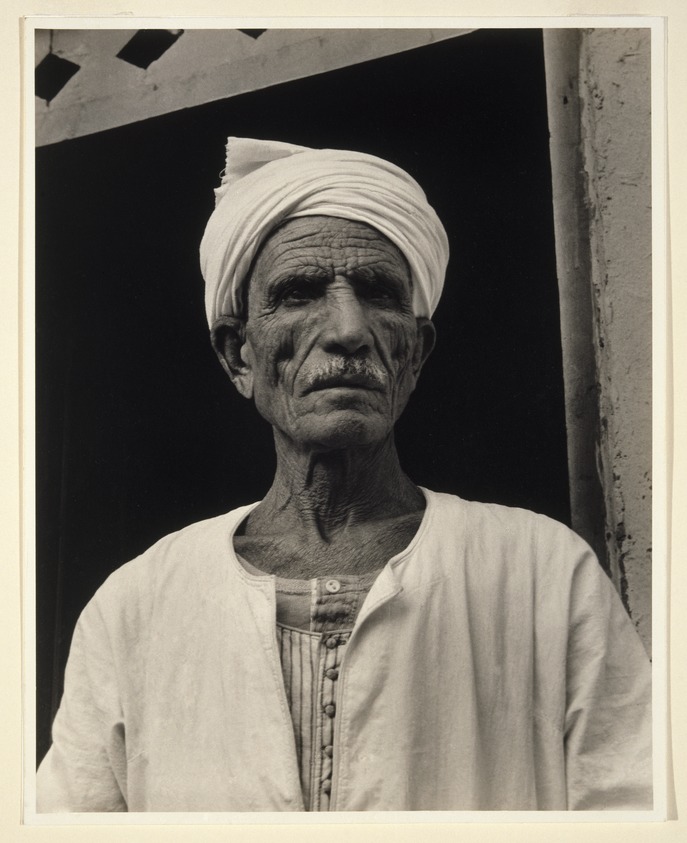
"Sheik Ali Gournah," Egypt
Paul Strand
Photography
Paul Strand was a pupil of Lewis Wickes Hine, who encouraged Strand to turn his hobby into his life’s work. After a visit to Alfred Stieglitz’s 291 gallery in New York, Strand dedicated himself to the modernist aesthetic. Although his early interests focused on urban sites and machinery, eventually he turned to nature and portraiture in his search for purity of vision. His simple, straightforward portraits gradually became a quest for ideal beauty, seen in the inherent dignity of his subjects.
Strand left the United States in the early 1950s to escape McCarthyism and lived in France for the rest of his life. He also travelled widely and spent long periods of time in Italy, the Outer Hebrides, Egypt, and Ghana. Strand turned experiences from his trips into photographic books, in which he tried to encapsulate the distinctive character of the places and the people he photographed. In this portrait from Egypt of Sheik Ali Gournah, Strand sought a precise vision of character through contrast, texture, and light. This technique expresses what he termed “an aesthetic based on the objective nature of reality.”
Strand left the United States in the early 1950s to escape McCarthyism and lived in France for the rest of his life. He also travelled widely and spent long periods of time in Italy, the Outer Hebrides, Egypt, and Ghana. Strand turned experiences from his trips into photographic books, in which he tried to encapsulate the distinctive character of the places and the people he photographed. In this portrait from Egypt of Sheik Ali Gournah, Strand sought a precise vision of character through contrast, texture, and light. This technique expresses what he termed “an aesthetic based on the objective nature of reality.”
MEDIUM
Gelatin silver print
DATES
1959
DIMENSIONS
Image: 13 3/8 x 10 5/8 in. (34 x 27 cm)
Sheet: 13 7/8 x 11 in. (35.2 x 27.9 cm) (show scale)

SIGNATURE
Signed center verso on mount in blue ball point pen: "Paul Strand"
INSCRIPTIONS
Inscribed center verso under signature in blue ball point pen: "1959"; inscribed upper left verso in pencil: "Sheik Ali Gournah, Egypt, 1959"
COLLECTIONS
Photography
ACCESSION NUMBER
85.193.2
CREDIT LINE
Gift of Naomi and Walter Rosenblum
MUSEUM LOCATION
This item is not on view
CAPTION
Paul Strand (American, 1890–1976). "Sheik Ali Gournah," Egypt, 1959. Gelatin silver print, Image: 13 3/8 x 10 5/8 in. (34 x 27 cm). Brooklyn Museum, Gift of Naomi and Walter Rosenblum, 85.193.2. © artist or artist's estate (Photo: Brooklyn Museum, 85.193.2_SL1.jpg)
IMAGE
overall, 85.193.2_SL1.jpg. Brooklyn Museum photograph
"CUR" at the beginning of an image file name means that the image was created by a curatorial staff member. These study images may be digital point-and-shoot photographs, when we don\'t yet have high-quality studio photography, or they may be scans of older negatives, slides, or photographic prints, providing historical documentation of the object.
RIGHTS STATEMENT
© artist or artist's estate
Copyright for this work may be controlled by the artist, the artist's estate, or other rights holders. A more detailed analysis of its rights history may, however, place it in the public domain.
The Museum does not warrant that the use of this work will not infringe on the rights of third parties. It is your responsibility to determine and satisfy copyright or other use restrictions before copying, transmitting, or making other use of protected items beyond that allowed by "fair use," as such term is understood under the United States Copyright Act.
For further information about copyright, we recommend resources at the United States Library of Congress, Cornell University, Copyright and Cultural Institutions: Guidelines for U.S. Libraries, Archives, and Museums, and Copyright Watch.
For more information about the Museum's rights project, including how rights types are assigned, please see our blog posts on copyright.
If you have any information regarding this work and rights to it, please contact copyright@brooklynmuseum.org.
If you wish to contact the rights holder for this work, please email copyright@brooklynmuseum.org and we will assist if we can.
RECORD COMPLETENESS
Not every record you will find here is complete. More information is available for some works than for others, and some entries have been updated more recently. Records are frequently reviewed and revised, and we welcome any additional information you might have.
![[Untitled]](https://d1lfxha3ugu3d4.cloudfront.net/images/opencollection/objects/size2_sq/86.49.1.jpg)
![[Untitled] (West Indian Day Parade)](https://d1lfxha3ugu3d4.cloudfront.net/images/opencollection/objects/size2_sq/1991.58.2_PS20.jpg)