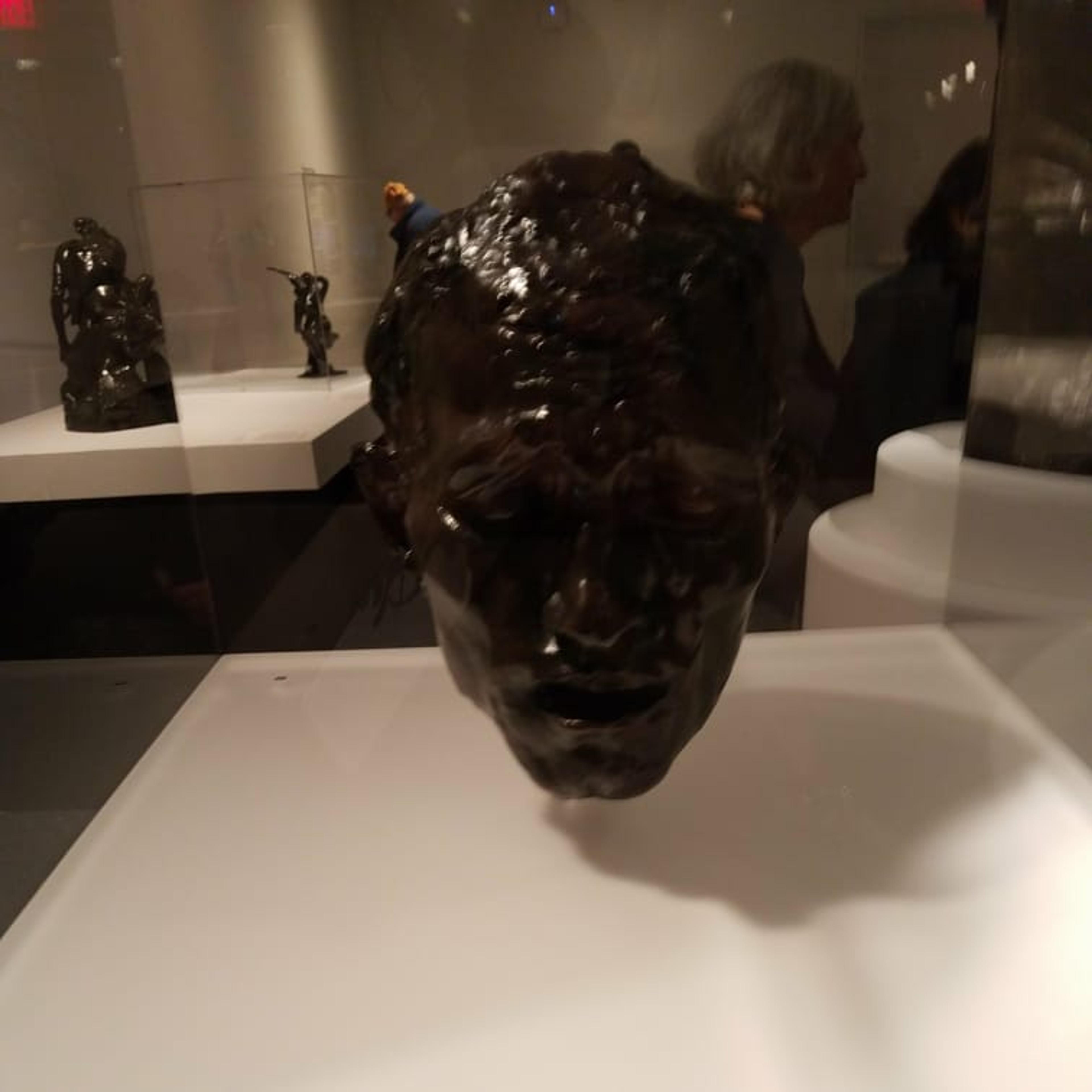
Pierre de Wiessant, Type B Head (Pierre de Wissant, tête Type B)

Brooklyn Museum photograph
Object Label
The rough contours and the knuckle impression at the top of the nose are evidence of the artist’s forceful manipulation of the clay model. For Rodin, this undulating surface manifested his subject’s inner psychological turbulence: ‘‘I have always tried to express interior feelings through the mobility of the muscles.’’ He allowed this emotional realism to coexist with clear evidence of the sculpture’s manufacture: The seams of the casting process remain visible on its surface.
Caption
Auguste Rodin (French, 1840–1917). Pierre de Wiessant, Type B Head (Pierre de Wissant, tête Type B), 1885 or 1886; cast before 1952. Bronze, 11 1/4 × 8 1/2 × 9 in., 11 lb. (28.6 × 21.6 × 22.9 cm). Brooklyn Museum, Gift of Iris and B. Gerald Cantor, 84.77.9. (Photo: Brooklyn Museum)
Gallery
Not on view
Gallery
Not on view
Artist
Cast by
Title
Pierre de Wiessant, Type B Head (Pierre de Wissant, tête Type B)
Date
1885 or 1886; cast before 1952
Geography
Place made: France
Medium
Bronze
Classification
Dimensions
11 1/4 × 8 1/2 × 9 in., 11 lb. (28.6 × 21.6 × 22.9 cm)
Signatures
Neck, proper left: "A. Rodin"
Markings
Back of neck: ".Alexis Rudier./.Fondeur. Paris."
Credit Line
Gift of Iris and B. Gerald Cantor
Accession Number
84.77.9
Frequent Art Questions
Who did Rodin use as his models? People he knew or just from memory?
 Rodin did sculpt people he knew personally, including his long-time companion Rose Beuret, whose body was the model for many of Rodin's female figures.He was also interested in the professionally trained body and hired dancers and athletes to pose in his studio. Sometimes when he wanted to sculpt the portrait of a deceased person, he would try to find a living model that resembled them. For example, when Rodin won the commission to make a monument to Balzac, he traveled to the writer's hometown to find a man that resembled him!Did he ever do a sculpture of himself?I know that he drew self portraits of himself. One scholar has argued that one of the sculpted figures for the Gates of Hell is a self-portrait, although I think that is open to debate!
Have information?
Have information about an artwork? Contact us at