Table


1 of 5
Object Label
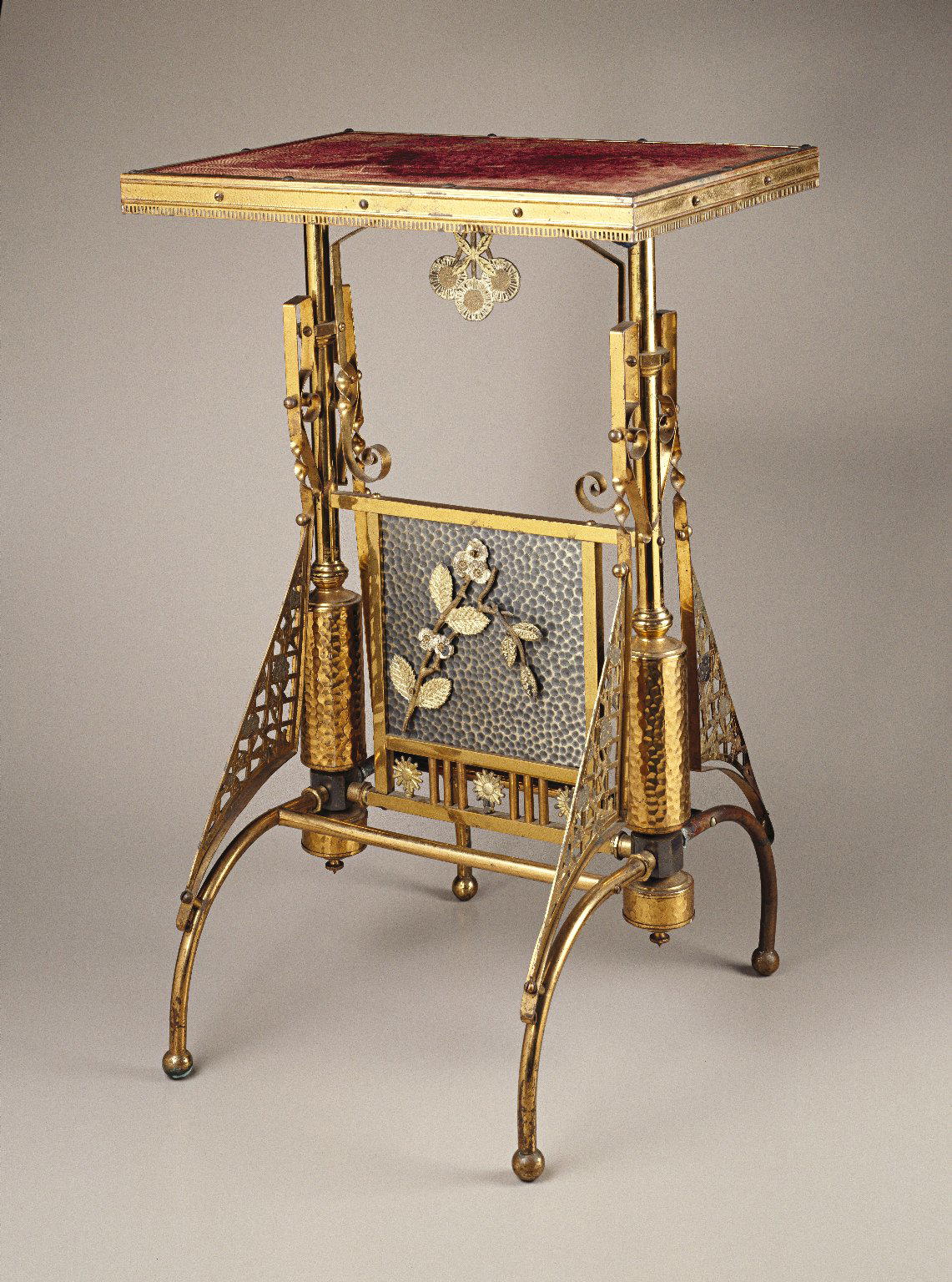
How do curators know who made an object? In many instances, unfortunately, the maker is unknown. However, curators have ways to establish the maker of an object. For example, they can look to a period catalogue or advertisement a description or illustration, or there may be an affinity with a documented piece that permits a reasonable attribution. Rarely, a piece, is marked or signed by the artist or manufacturer. In the case of this table, a printed paper label has survived on the underside of the tabletop. It identifies the manufacturer, the Charles Parker Company, a little-known firm that produced art brass, focusing on lighting fixtures and small occasional furniture.
Caption
The Charles Parker Company (American, established 1832). Table, ca. 1880. Brass, other metals, wood, fabric, 29 x 19 x 17 1/2 in. (73.7 x 48.3 x 44.5 cm). Brooklyn Museum, H. Randolph Lever Fund, 85.12.1. (Photo: Brooklyn Museum)
Gallery
Not on view
Collection
Gallery
Not on view
Collection
Title
Table
Date
ca. 1880
Medium
Brass, other metals, wood, fabric
Classification
Dimensions
29 x 19 x 17 1/2 in. (73.7 x 48.3 x 44.5 cm)
Signatures
no signature
Inscriptions
no inscriptions
Markings
on paper label glued to bottom of table: THE CHAS> PARKER CO./ (A) RTISTIC BRONZE GOODS(S)
Credit Line
H. Randolph Lever Fund
Accession Number
85.12.1
Frequent Art Questions
Tell me more.
I love the table on the right. It is made from brass tubing, which was an incredibly cutting-edge material to use in the domestic home in the 19th century!Metal furniture for the home didn't become commonplace until the 1930s, so this designer was way ahead of their time!
Have information?
Have information about an artwork? Contact us at