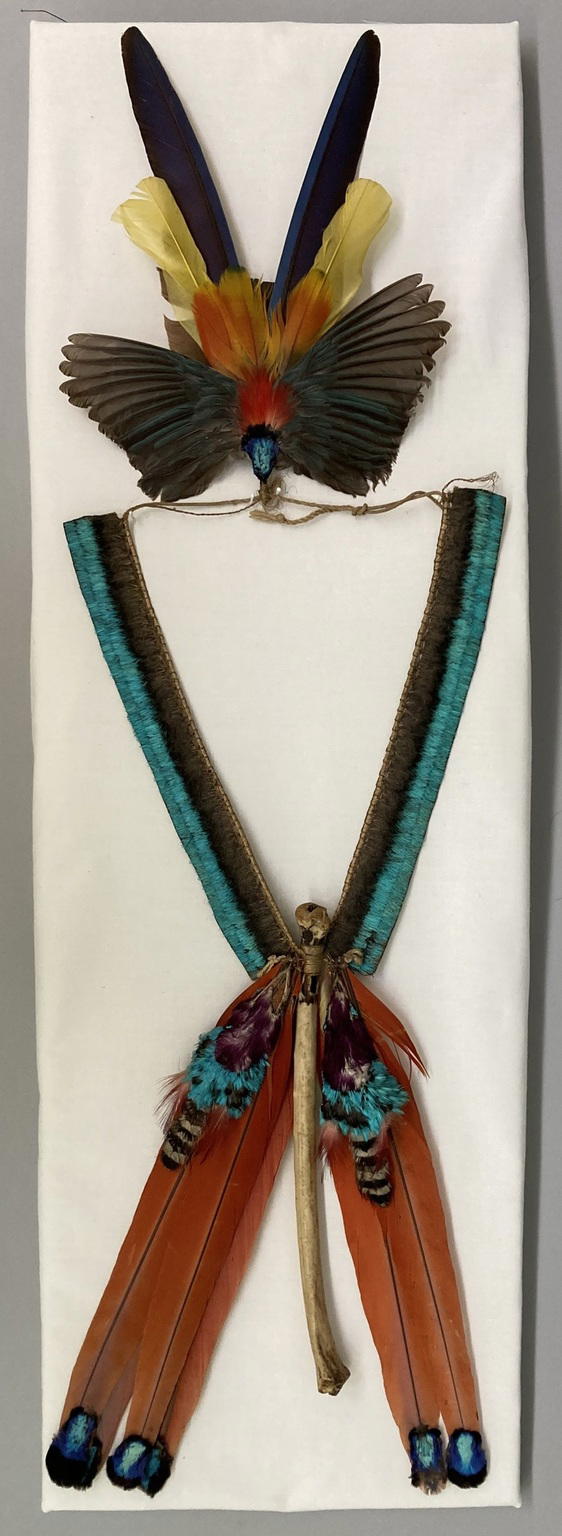
Man's Bone Flute Necklace, "awa-tukaniwar" in Ka'apor
Kaapor

1 of 2
Object Label
The Ka’apor are known for their spectacular feather ornaments, which they call putir (meaning “flowers”). The finest ornaments, such as this man’s visor and bird-bone flute necklace, are traditionally worn (and the latter played) during naming ceremonies for children. The featherwork art form relates directly to the legendary exploits of the Ka’apor cultural hero Maíra, who created the world and all its peoples and wears regalia of this type. Through stories about Maíra, children learn the symbolism of the ornaments. For example, blue feathers evoke the sky and the supernatural beings who live there. Habitat loss affects birds as well as people, and it may not always be possible to gather the materials to make traditional objects such as these.
Caption
Kaapor. Man's Bone Flute Necklace, "awa-tukaniwar" in Ka'apor, 20th century. Feathers, fiber, bird skins, cotton cloth, bone, 9 x 30 x 1 1/2 in. (22.9 x 76.2 x 3.8 cm). Brooklyn Museum, Anonymous gift, 88.89.10. (Photo: Brooklyn Museum)
Gallery
Not on view
Collection
Gallery
Not on view
Collection
Have information?
Have information about an artwork? Contact us at