Christ Child with Passion Symbols
Unknown Artist

Brooklyn Museum photograph
Object Label
Religious paintings in private chapels often had both didactic and devotional purposes. From the sixteenth century, missionaries intent on imposing Catholic doctrine and Christian morality on native people promoted domestic scenes of the Holy Family such as The Carpenter’s Shop in Nazareth as models for proper family conduct. An oratory would also have been an apt location for a painting such as the Christ Child with Passion Symbols, whose emblematic elements made it particularly suitable for devotion.
Caption
Unknown Artist. Christ Child with Passion Symbols, late 17th century. Oil on canvas, 39 1/8 x 31 3/4in. (99.4 x 80.6cm) frame: 44 11/16 x 37 3/8 x 2 1/8 in. (113.5 x 94.9 x 5.4 cm). Brooklyn Museum, Gift of Elizabeth Clare, 64.207. (Photo: Brooklyn Museum)
Gallery
Not on view
Collection
Gallery
Not on view
Collection
Artist
Frequent Art Questions
Is this ball the apple of Eden?
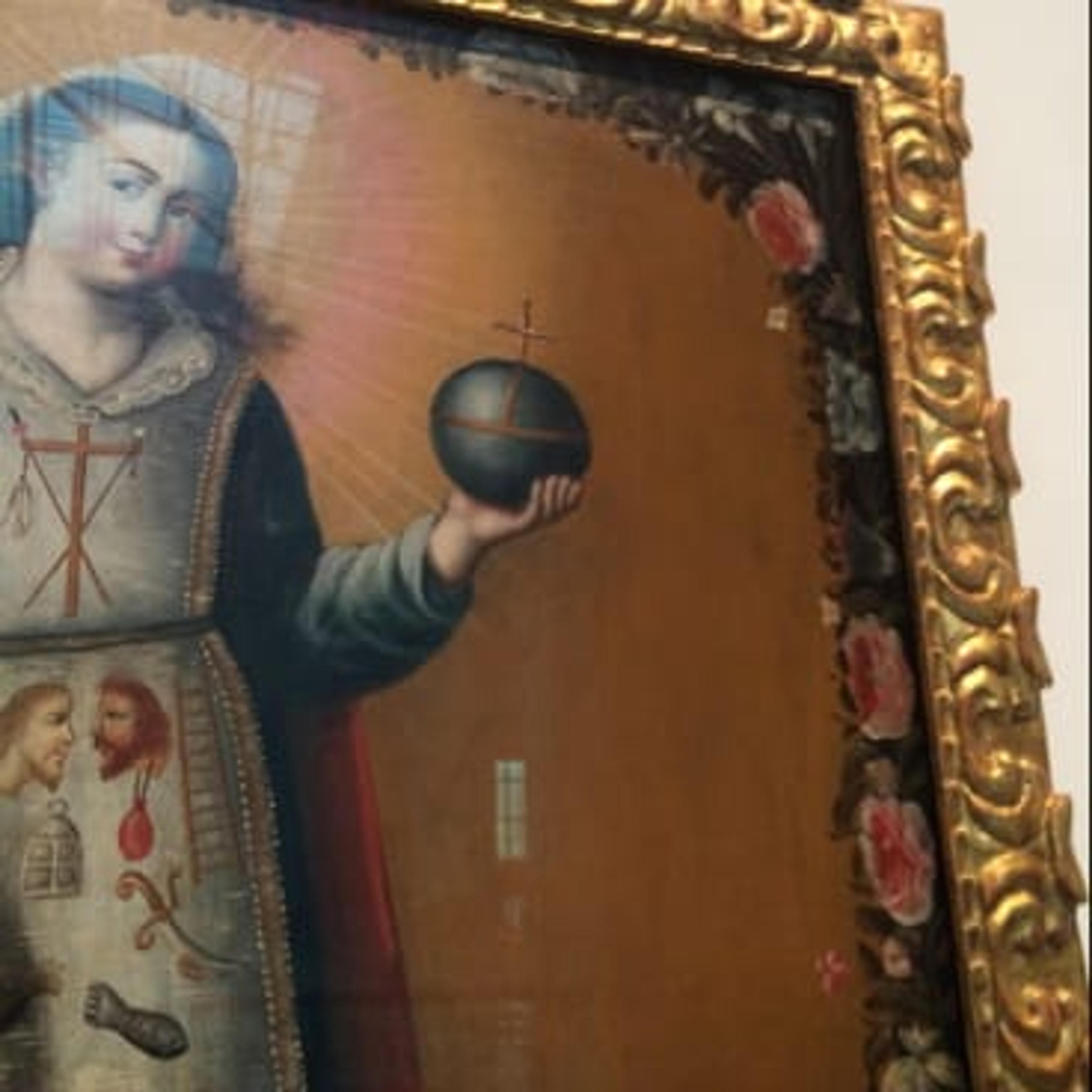 No, it is not, but I could see how you would make that observation! Other visitors have also interpreted it as a globe. It is actually an "imperial orb," a symbol of the cosmos or of the universe as a harmonious whole. (This is derived from the ancient Romans, who associated it with Jupiter and, hence, with the emperor as his earthly representative). Christians adapted the symbol by setting a cross above the ball to signify the world dominated by Christianity. In many of these paintings of Christ or depictions of the infant Jesus, the orb is said to represent "worldly sovereignty" or "one nation under God." So Christ holding a ball is a way of symbolizing "Christ the King". Rulers/Kings are also sometimes depicted with such orbs (the first to hold it in hand at his coronation was the Holy Roman emperor Henry II in 1014; thereafter the “imperial apple” became an important emblem of the royal power invested in the monarch).
Hi there, thank you for using our app. I see that you are looking at the "Christ Child with Passion Symbols." What do you think about it?
It's very striking in a way that it stands out from the other works on this wall. I can't say why. In painting religious icons, did artists generally use the faces of their models or were they more inclined to base faces on previously established works?Great question! Artists would often paint the faces based on previously established works. If you look at the Christ Child's face you will notice the blush cheeks, fair skin, and pink lips. These were common characteristics used for painting christ as an infant/child.The orb that he is holding is something that is not common in paintings of the christ child. It is identified as an "imperial orb." Such balls are often a symbol of the cosmos, or of the universe as a harmonious whole (this is derived from the ancient Romans, who associated it with Jupiter and, hence, with the emperor as his earthly representative). Christians adapted the symbol by setting a cross above the ball to signify the world dominated by Christianity. In many of these paintings of Christ or depictions of the infant Jesus, the orb is said to represent "worldly sovereignty" or "one nation under God." So Christ holding a ball is a way of symbolizing "Christ the King." Rulers or kings are also sometimes depicted with such orbs (the first to hold it in hand at his coronation was the Holy Roman emperor Henry II in 1014. The “imperial apple” became an important emblem of the royal power invested in the monarch).I didn't think of this figure as a he! I found the figure to be more feminine than masculine.For many centuries, art has shown male figures in ways that we now associate with femininity. Historically, paintings of youth (male and female) are often presented with round faces, long eyelashes, and blushed cheeks. It is a technique to show the age before maturity.If you look at the portrait of a "Boy with a Floral Garland in His Hair" in the Ancient Egyptian galleries you will see the rounded face and other "feminine" characteristics. Visitors often mistake him for a girl!
Have information?
Have information about an artwork? Contact us at