Ox Mask (Dugn'be)
Bijagó


1 of 2
Object Label
Masks representing dugn’be, meaning “the ox raised in the village,” are used in young men’s initiation ceremonies in the Bijagós Islands, on the Atlantic coast of Guinea-Bissau. The cord that runs through the nostrils of this mask shows that the initiate is like a tethered ox. His strengths, like those of the ox, must be both encouraged and controlled.
Caption
Bijagó. Ox Mask (Dugn'be), 20th century. Wood, raffia, bone, glass, metal, fur, paint, fiber, 15 1/2 x 19 x 9in. (39.4 x 48.3 x 22.9cm). Brooklyn Museum, Gift of Mr. and Mrs. Joseph Gerofsky, 1992.69.3. (Photo: Brooklyn Museum)
Gallery
Not on view
Collection
Gallery
Not on view
Collection
Culture
Title
Ox Mask (Dugn'be)
Date
20th century
Geography
Place made: Bijagós Islands, Guinea-Bissau
Medium
Wood, raffia, bone, glass, metal, fur, paint, fiber
Classification
Dimensions
15 1/2 x 19 x 9in. (39.4 x 48.3 x 22.9cm)
Credit Line
Gift of Mr. and Mrs. Joseph Gerofsky
Accession Number
1992.69.3
Frequent Art Questions
Holy Cow! Tell moo more!
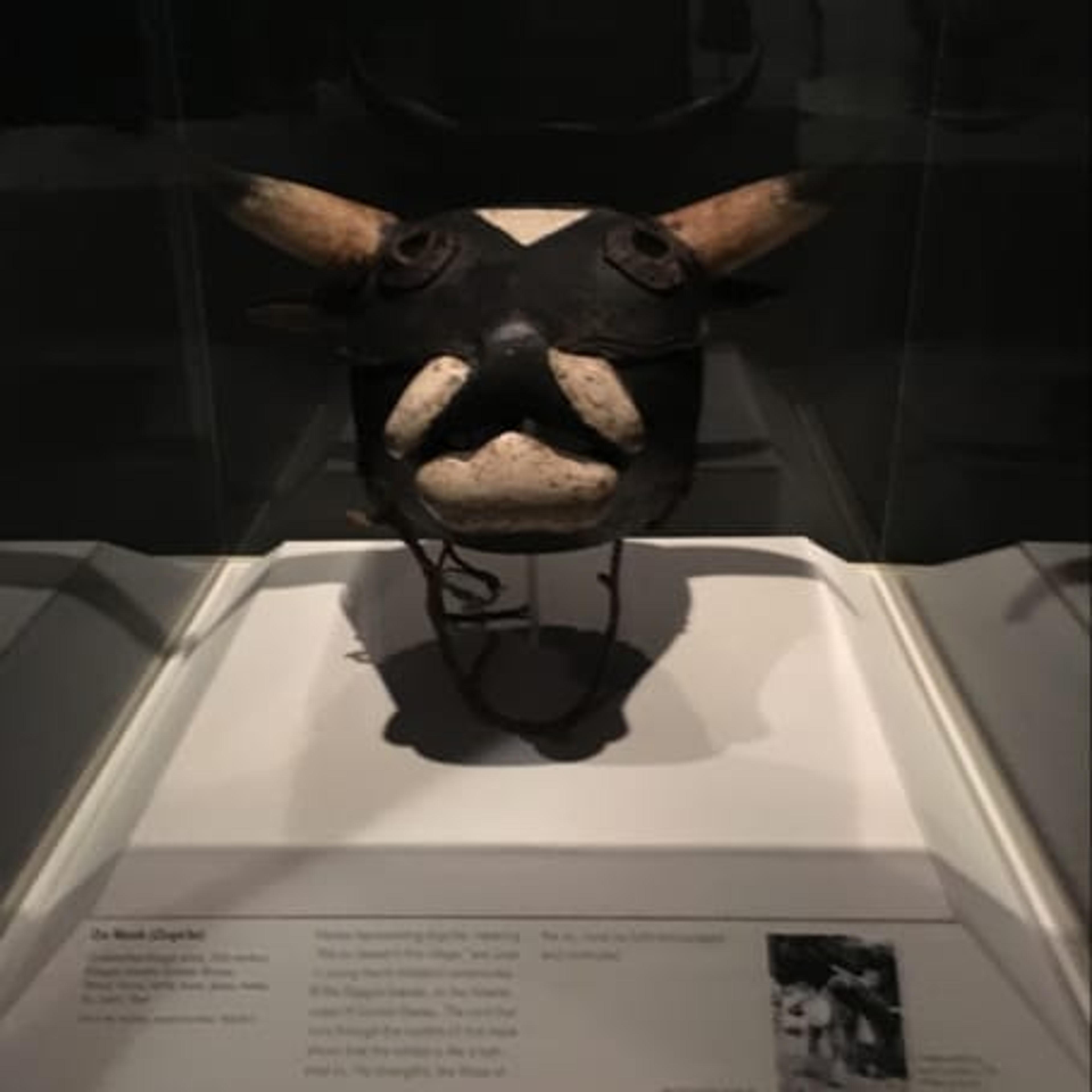 This mask from the Bijagos Islands depicts an ox, as you may have noticed. It isn't hard to see why the Bijogo are best known for their animal masks. This mask in particular would have been worn by young men during initiation ceremonies, where young men would imitate the movements of bulls.
Have information?
Have information about an artwork? Contact us at