Julu Xian Ewer
early 12th century
Brooklyn Museum photograph
Object Label
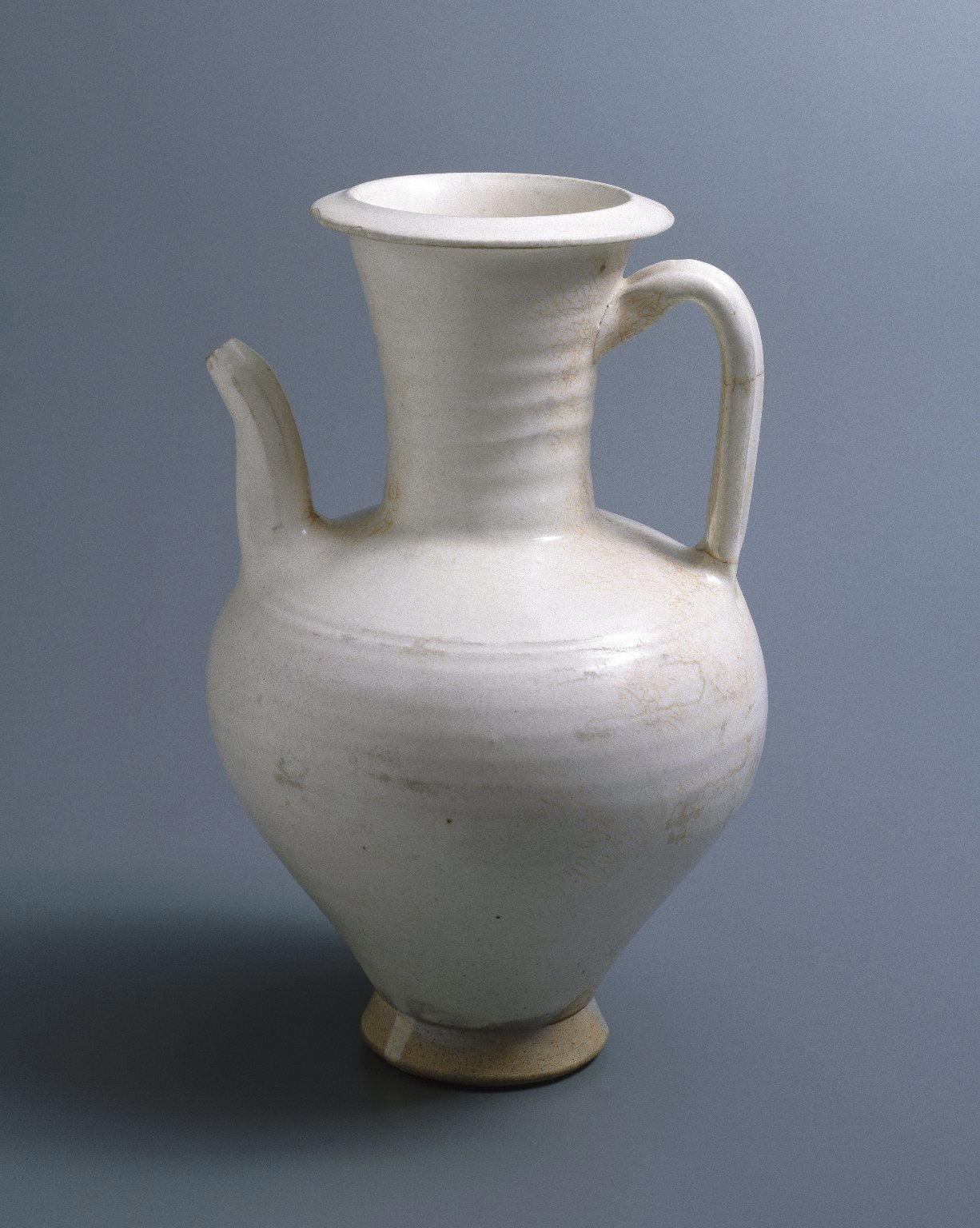
According to historical records, the Yellow River flooded the region of Julu county in southern Hebei province on September 10, 1108. Like the ancient city of Pompeii, which was buried in 79 C.E. by ash after the eruption of Mount Vesuvius, the Julu marketplace was buried until the 1930s, when farmers discovered it while digging a well. The site was rich in Cizhouware ceramics used as daily vessels by the burgeoning Song merchant class. White Cizhou wares imitated the more luxurious ivory-white Ding ware used by elite Confucian bureaucrats. A distinctive feature of Juluxian ceramics is the pale red-brown crackle covering part of the interior of the neck and exterior of this vessel, evidence of burial in the iron-rich silt from the Yellow River.
Caption
Julu Xian Ewer, early 12th century. Earthenware, white slip and transparent glaze, 10 x 6 3/8 in. (25.4 x 16.2 cm). Brooklyn Museum, Gift of the Asian Art Council, 1993.55. (Photo: Brooklyn Museum)
Gallery
Not on view
Collection
Gallery
Not on view
Collection
Title
Julu Xian Ewer
Date
early 12th century
Dynasty
Song Dynasty
Period
Song Dynasty
Geography
Place made: Cizhou, China
Medium
Earthenware, white slip and transparent glaze
Classification
Dimensions
10 x 6 3/8 in. (25.4 x 16.2 cm)
Credit Line
Gift of the Asian Art Council
Accession Number
1993.55
Have information?
Have information about an artwork? Contact us at