Amulets or Balangandãs
19th century
Caption
Amulets or Balangandãs, 19th century. Silver, stone, wood, amulet one: 6 × 4 1/2 × 2 in. (15.2 × 11.4 × 5.1 cm) amulet two: 11 × 4 3/4 × 2 in. (27.9 × 12.1 × 5.1 cm) chain: 28 1/2 in. (72.4 cm). Brooklyn Museum, Bequest of Margarita H. Button, 2011.60.41.
Gallery
Not on view
Collection
Gallery
Not on view
Collection
Title
Amulets or Balangandãs
Date
19th century
Geography
Place made: Brazil
Medium
Silver, stone, wood
Classification
Dimensions
amulet one: 6 × 4 1/2 × 2 in. (15.2 × 11.4 × 5.1 cm) amulet two: 11 × 4 3/4 × 2 in. (27.9 × 12.1 × 5.1 cm) chain: 28 1/2 in. (72.4 cm)
Credit Line
Bequest of Margarita H. Button
Accession Number
2011.60.41
Frequent Art Questions
What are these?
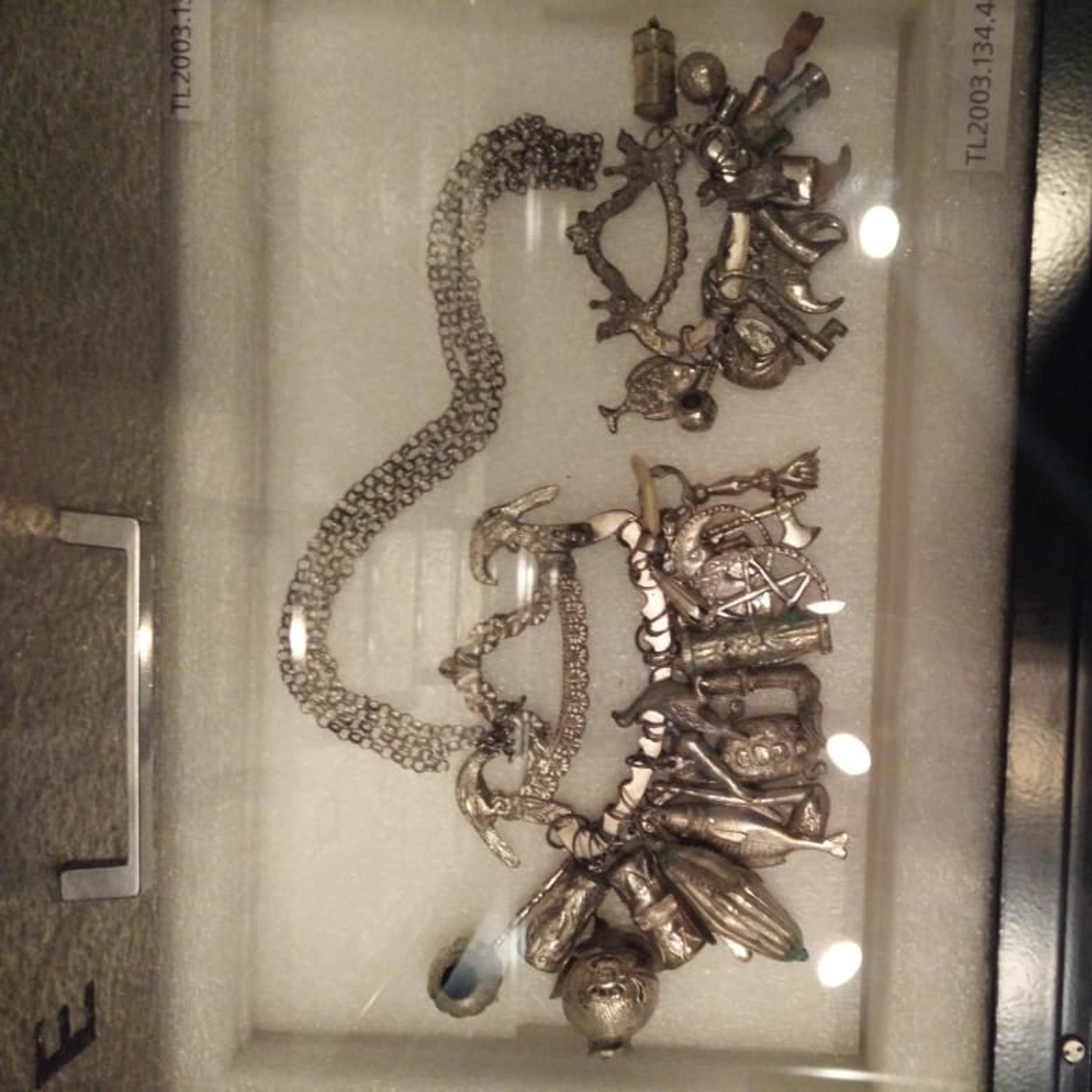 An amulet, or a balangandãs in Portuguese, is a good luck charm that is worn around the neck or on belts. It assures good fortune and protection. They were mostly worn by African slaves or former slaves in Brazil during the 18th and 19th centuries. These amulets include coins dated 1859 and 1869; closed hands; birds, fish; turtle; sheep; dogs; keys, fruits, pipes; knife; and an eyeball.
Have information?
Have information about an artwork? Contact us at