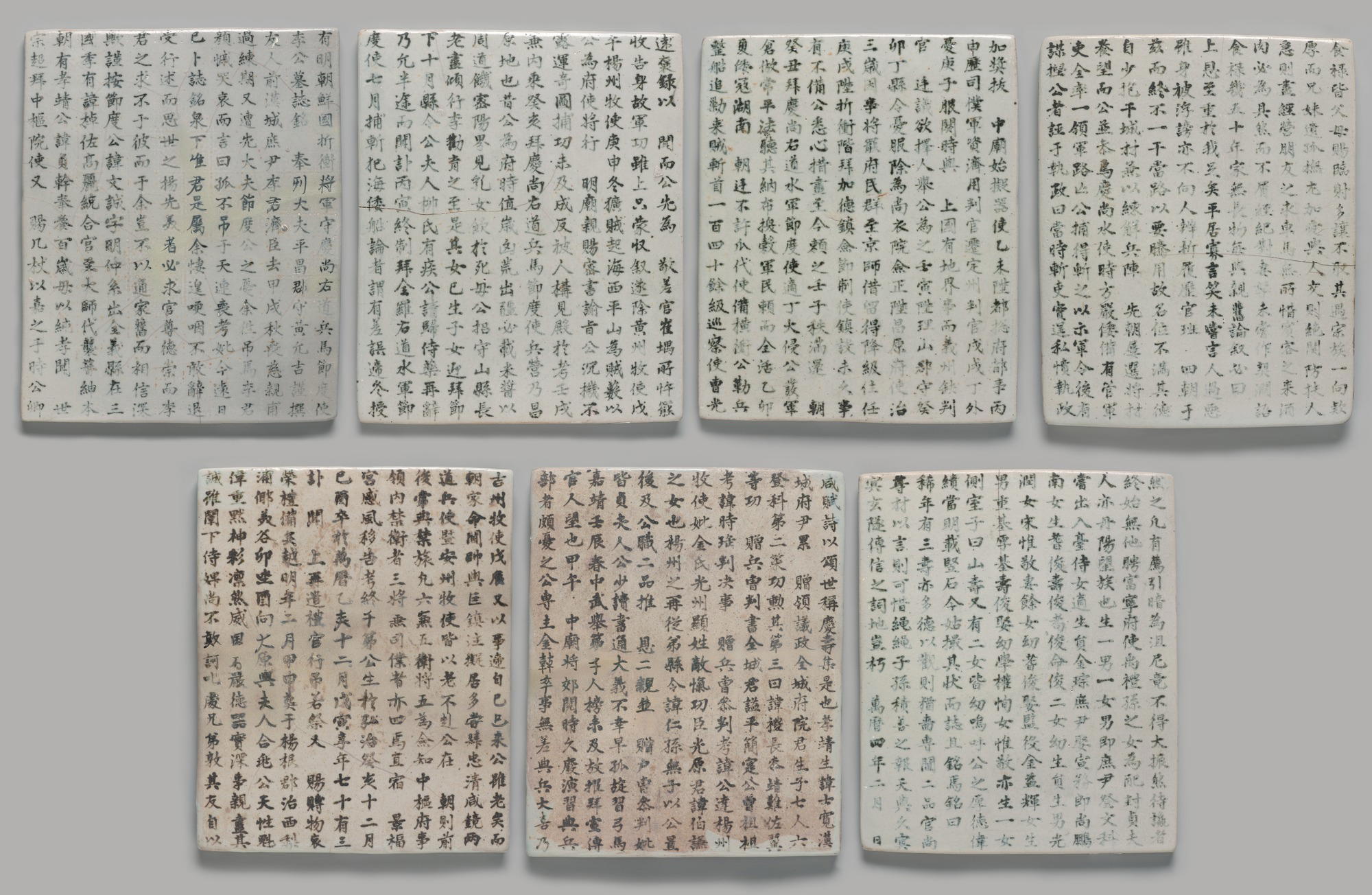
Epitaph Tablet for Yi Munseong (1503-1575), from a Set of 7
Korean

1 of 2
Caption
Korean. Epitaph Tablet for Yi Munseong (1503-1575), from a Set of 7, circa 1579. Porcelain with underglaze, 9 7/16 × 7 7/8 in. (24 × 20 cm). Brooklyn Museum, Gift of the Carroll Family Collection, 2017.29.21.
Collection
Collection
Culture
Title
Epitaph Tablet for Yi Munseong (1503-1575), from a Set of 7
Date
circa 1579
Dynasty
Joseon dynasty
Geography
Place made: Korea
Medium
Porcelain with underglaze
Classification
Dimensions
9 7/16 × 7 7/8 in. (24 × 20 cm)
Credit Line
Gift of the Carroll Family Collection
Accession Number
2017.29.21
Frequent Art Questions
For the Epitaph Plaques, why is the text in Chinese instead of Korean?
Many people wonder the same thing. Hangul, the syllabary you recognize as Korean, is actually incredibly young. It was invented in the 1440s by King Sejong, along with a group of linguists, with the goal of inventing a writing system that would better fit with the spoken Korean language and allow the common people to communicate more easily with the government.Many scholars and nobles continued to use Chinese characters for centuries afterwards, however, as they were reluctant to give up the power that came with being literate where commoners weren't.It's also "fancier," having a similar effect as Latin used in modern Christian contexts.Ahhh I see. Thanks!
Have information?
Have information about an artwork? Contact us at