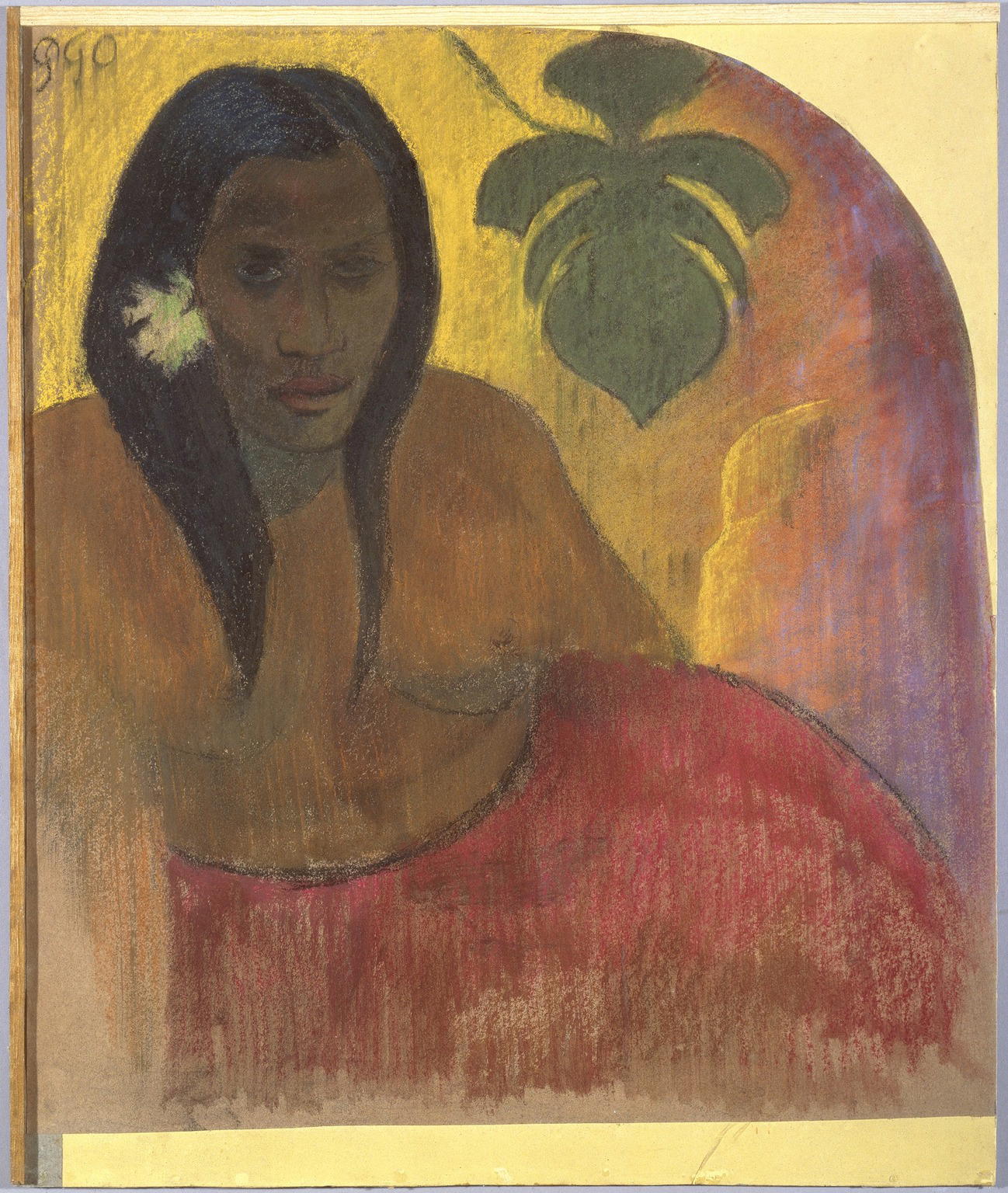
Tahitian Woman
Brooklyn Museum photograph
Object Label
Nevertheless, the artist created his own imaginary Tahiti, largely centered on the native women—and young girls—on whom he projected his own exotic and sensual fantasies. Works such as this pastel broke new artistic ground with their heightened, expressive color and bold forms and greatly influenced many twentieth-century modernists. At the same time, they reveal the disturbing sexual and racial dynamic of his objectifying gaze. This unidentified sitter is likely one of the girls (perhaps Tehamana) to whom Gauguin transmitted syphilis, which killed him at the age of fifty-four.
In 1921 Tahitian Woman was exhibited at the Brooklyn Museum in a landmark show of modern French paintings. When the Museum purchased it that year, it became one of the first Gauguins in a public American collection, reflecting this institution’s commitment to modern art at a time when it was still considered very daring.
Titus Kaphar: I don’t think that you scrub history of all the bad things that happened. I don’t think that’s an effective process, and I don’t think it’s an enlightening process. What is important is acknowledging it, telling the truth about it, and saying it unapologetically right now. These are no longer our values. We don’t accept this anymore as in the same way that it was then. Yes, you have technique. Yes, you understand color. Yes, you understand composition and form. Yes. All of that. Yeah, yeah, yeah, but what this symbolizes, what this represents, we as a society are beyond this now. If you are ambiguous about that statement, then you are complicit. That’s what I’m saying. There has to be a decision to not be complicit. That happens from being unambiguous about how you analyze the work, how you talk about the work in this moment, in this time. It’s going to upset some people. . . . The question is, How does this fit in our day in time, our society today?. . . If an artist made this today, what would we say about them? What would we think about them? The truth of the matter is, there are artists who are making work like this, who are getting passes, who we are not confronting.
Caption
Paul Gauguin (French, 1848–1903). Tahitian Woman, ca. 1894. Charcoal and pastel on paper, glued to yellow wove paper and mounted on grey millboard, 21 5/8 x 19 1/2in. (54.9 x 49.5cm) frame: 31 1/2 × 27 5/8 × 2 3/8 in. (80 × 70.2 × 6 cm). Brooklyn Museum, Museum Collection Fund, 21.125. (Photo: Brooklyn Museum)
Gallery
Not on view
Gallery
Not on view
Artist
Title
Tahitian Woman
Date
ca. 1894
Geography
Place made: Europe
Medium
Charcoal and pastel on paper, glued to yellow wove paper and mounted on grey millboard
Classification
Dimensions
21 5/8 x 19 1/2in. (54.9 x 49.5cm) frame: 31 1/2 × 27 5/8 × 2 3/8 in. (80 × 70.2 × 6 cm)
Signatures
Signed upper left: "PGO"
Credit Line
Museum Collection Fund
Accession Number
21.125
Have information?
Have information about an artwork? Contact us at