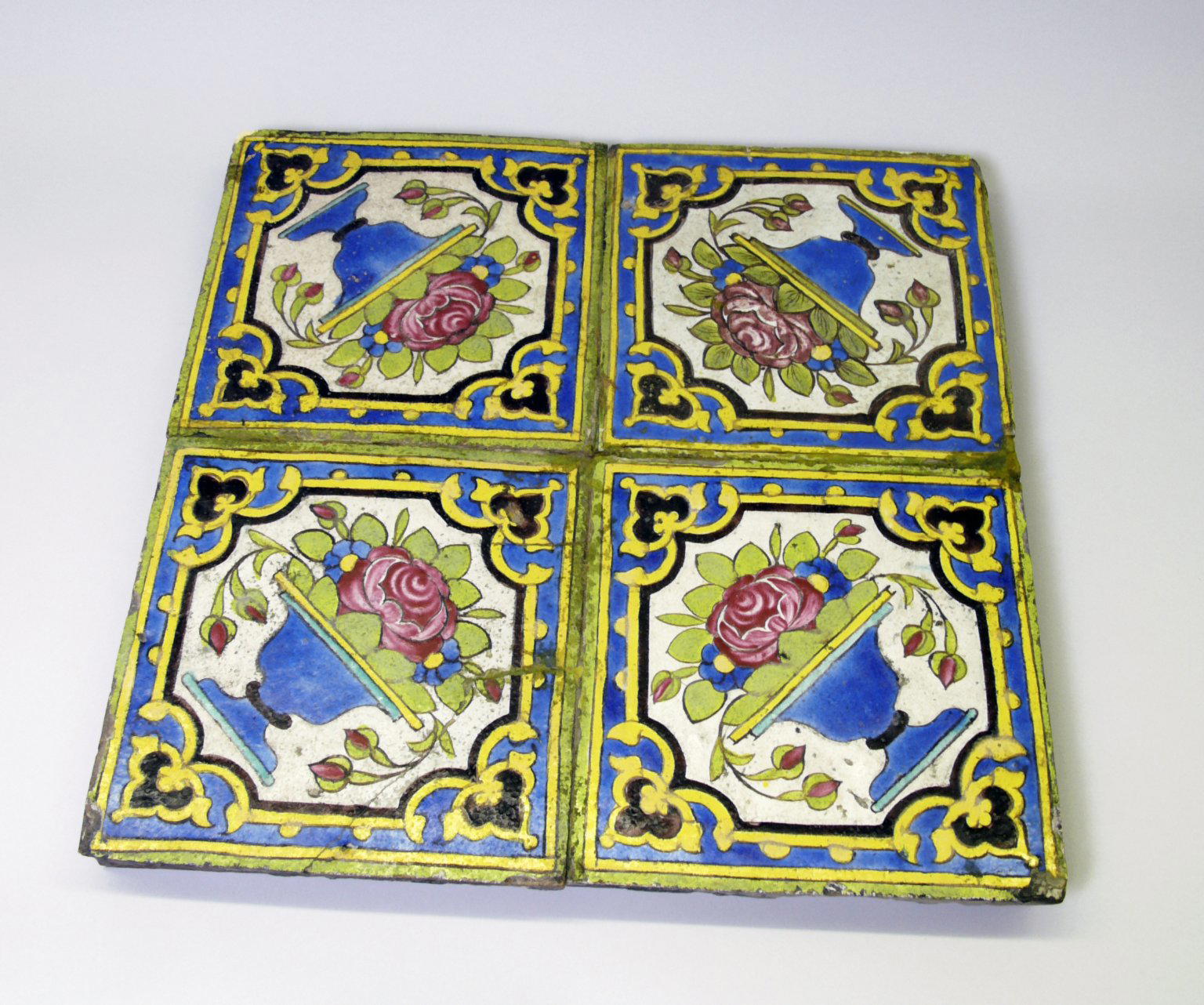
Panel of Four Tiles
ca.1830–1840
Brooklyn Museum photograph
Object Label
Even before the nineteenth century, merchants fostered European and later American fascination with the art, culture, and peoples of Asia. These merchants manipulated Asian resources, materials, and labor to produce and promote luxury goods for European consumers. Although China and Japan were never in the true sense part of European empires, they were economically tied to these powerful European kingdoms, supplying porcelains, silks, wallpaper, lacquerwares, and tea to the wealthy throughout Europe.
The Japanese and Chinese porcelains shown here were made not for domestic but for European markets; they exhibit the fashion for Asian-produced goods with motifs and colors that were seen as quintessentially Asian. It was not until 1709 that European manufacturers discovered how to fabricate true hard, translucent porcelain. Therefore, works created in this expensive and exclusive material were both desirable and fashionable among the elite. Their production in distant Asia added allure but also ignorance about who made them and how they were created. The markets for goods like these, which benefited from the exploitation of cheap labor in remote or unfamiliar locations, continued through the nineteenth century and still endures today.
Here, the European-style floral vases decorating these Qajar period tiles from Iran indicate that designers as well as their clients sought ornament derived from European sources. The Japanese porcelains display the fashion for European-style objects: coffee was popular in European households, and the coffee urn shown here would have been a conversation starter as well as an object of great fascination. The barber’s bowls may have been functional—they were designed to hang around a man’s neck to hold water and soap while shaving—but, more likely, these examples would have been decoratively hung on a wall as an indication of wealth and sophistication. Part of a very large dinner service produced for the Portuguese Saldanha family, the enameled food cover and platter were fabricated in China applying European forms, techniques, and decoration.
The Japanese and Chinese porcelains shown here were made not for domestic but for European markets; they exhibit the fashion for Asian-produced goods with motifs and colors that were seen as quintessentially Asian. It was not until 1709 that European manufacturers discovered how to fabricate true hard, translucent porcelain. Therefore, works created in this expensive and exclusive material were both desirable and fashionable among the elite. Their production in distant Asia added allure but also ignorance about who made them and how they were created. The markets for goods like these, which benefited from the exploitation of cheap labor in remote or unfamiliar locations, continued through the nineteenth century and still endures today.
Here, the European-style floral vases decorating these Qajar period tiles from Iran indicate that designers as well as their clients sought ornament derived from European sources. The Japanese porcelains display the fashion for European-style objects: coffee was popular in European households, and the coffee urn shown here would have been a conversation starter as well as an object of great fascination. The barber’s bowls may have been functional—they were designed to hang around a man’s neck to hold water and soap while shaving—but, more likely, these examples would have been decoratively hung on a wall as an indication of wealth and sophistication. Part of a very large dinner service produced for the Portuguese Saldanha family, the enameled food cover and platter were fabricated in China applying European forms, techniques, and decoration.
Caption
Panel of Four Tiles, ca.1830–1840. Decorated ceramic, 17 1/8 x 7/16 x 17 3/16 in. (43.5 x 1.1 x 43.7 cm) mount (display dimensions including board): 17 1/2 × 17 1/2 × 1 in. (44.5 × 44.5 × 2.5 cm). Brooklyn Museum, Gift of Mr. and Mrs. Paul E. Manheim, 74.100. (Photo: Brooklyn Museum)
Title
Panel of Four Tiles
Date
ca.1830–1840
Dynasty
Qajar
Period
Qajar Period
Medium
Decorated ceramic
Classification
Dimensions
17 1/8 x 7/16 x 17 3/16 in. (43.5 x 1.1 x 43.7 cm) mount (display dimensions including board): 17 1/2 × 17 1/2 × 1 in. (44.5 × 44.5 × 2.5 cm)
Credit Line
Gift of Mr. and Mrs. Paul E. Manheim
Accession Number
74.100
Have information?
Have information about an artwork? Contact us at