Temple of Edfou
Brooklyn Museum photograph
Object Label
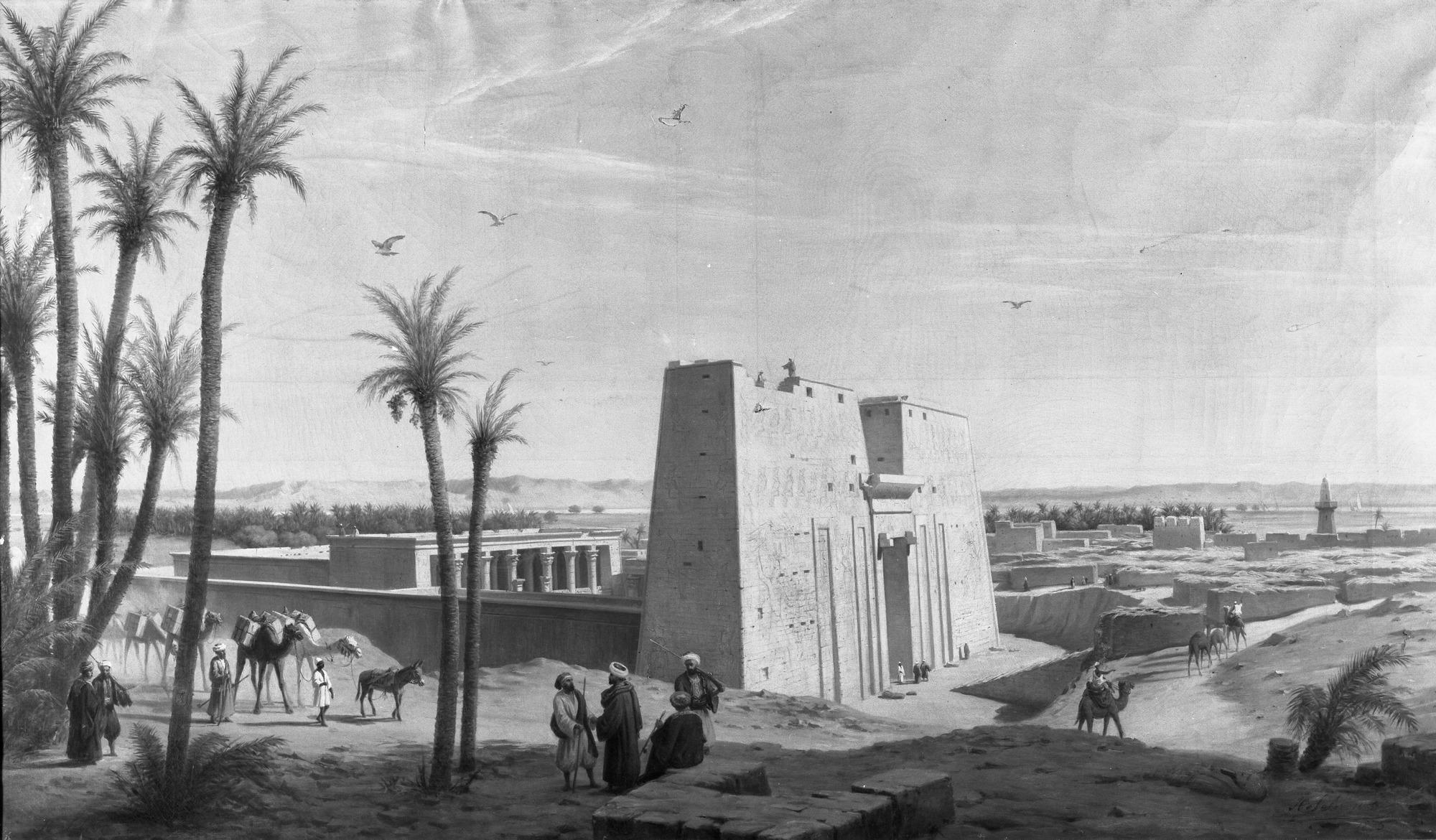
An image of the hawk-headed ancient Egyptian god Horus is shown carved into the left side of the temple portal in the center of this painting. Horus was the god of day and the rising sun. His temple at modern Edfou, south the the ancient city of Luxor along the Nile River, is one of the best preserved of all ancient monuments and was a popular tourist site in the nineteenth century, when this view was painted.
Caption
Hyppolyte Victor Valentin Sébron (French, 1801–1879). Temple of Edfou, 1876. Oil on canvas, 28 7/8 × 48 3/4 in. (73.3 × 123.8 cm) frame: 33 × 53 1/2 × 1 in. (83.8 × 135.9 × 2.5 cm). Brooklyn Museum, Gift of Evangeline Wilbour Blashfield, Theodora Wilbour, and Victor Wilbour honoring the wishes of their mother, Charlotte Beebe Wilbour, as a memorial to their father Charles Edwin Wilbour, 16.685. (Photo: Brooklyn Museum)
Gallery
Not on view
Gallery
Not on view
Title
Temple of Edfou
Date
1876
Geography
Place made: Europe
Medium
Oil on canvas
Classification
Dimensions
28 7/8 × 48 3/4 in. (73.3 × 123.8 cm) frame: 33 × 53 1/2 × 1 in. (83.8 × 135.9 × 2.5 cm)
Signatures
Signed and dated lower right: "H Sebron/1876"
Credit Line
Gift of Evangeline Wilbour Blashfield, Theodora Wilbour, and Victor Wilbour honoring the wishes of their mother, Charlotte Beebe Wilbour, as a memorial to their father Charles Edwin Wilbour
Accession Number
16.685
Frequent Art Questions
Is there a specific reason this painting was placed behind the sculpture of Moses being found? The ancient Egyptians were polytheists and Jews and Christians monotheists, so they don't seem to fit.
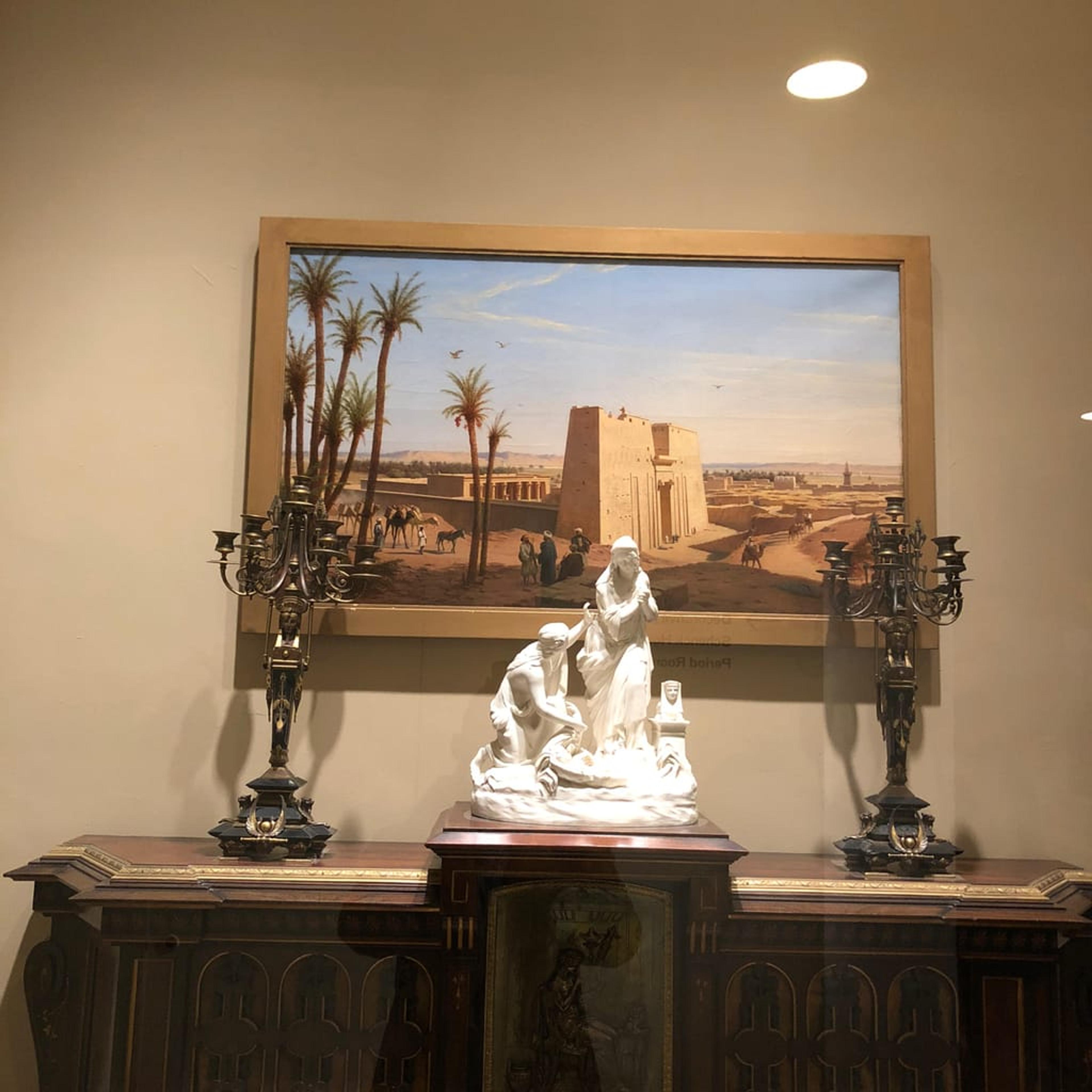 The finding of Moses is set in ancient Egypt and in the 19th century, design went through a phase called "Egyptomania" when anything remotely connected to Egypt was seen as fashionable. This trend was partially stimulated by the growing number of artists traveling abroad to places like Egypt. Some artists used the story of Moses as a pretense for creating an "Egyptian" scene that was suitable for a moralistic Victorian home. Altogether, the impression would be one of exoticism, rather than historical accuracy.
Have information?
Have information about an artwork? Contact us at