Woodblock Print
Utagawa Kuniyoshi

Brooklyn Museum photograph
Object Label
This print offers a glimpse into Tokyo street life in the nineteenth century. Here, a beauty self-consciously tugs at her outfit while walking briskly to the theater. The text elaborates: “She is first going to the stage, where there are many beautiful ladies. So she took great care and neatly changed the way she wore her kimono.”
Caption
Utagawa Kuniyoshi (Japanese, 1798–1861). Woodblock Print, ca. 1830. Woodblock print, 14 5/8 x 10 5/16 in. (37.1 x 26.2 cm). Brooklyn Museum, Anonymous gift, 76.151.19. (Photo: Brooklyn Museum)
Gallery
Not on view
Collection
Gallery
Not on view
Collection
Artist
Frequent Art Questions
So the red stamps on the prints are ownership marks?
Typically the marks in red are the artist's seal. Publisher and censor marks would also appear on prints, but tend not to be red.What can you tell me about the picture "Among Beautiful Ladies?"
The woman in the print offers a glimpse into 19th century Tokyo street life. She's on her way to the theater and the text surrounding her reads "She is first going to the stage, where there are many beautiful ladies. So she took great care and neatly changed the way she wore her kimono." You can see that she is slightly adjusting her kimono in the print itself.This print falls into the genre of Ukiyo-e, a genre of woodblock prints and paintings that focus on the transitory world of pleasure and beauty. More specifically it is Aizuri-e, which are a monochrome type of Ukiyo-e print. In this case, the color used is blue. This print is further categorized as bijinga, which means literally "beautiful person picture."Tell me more, please!
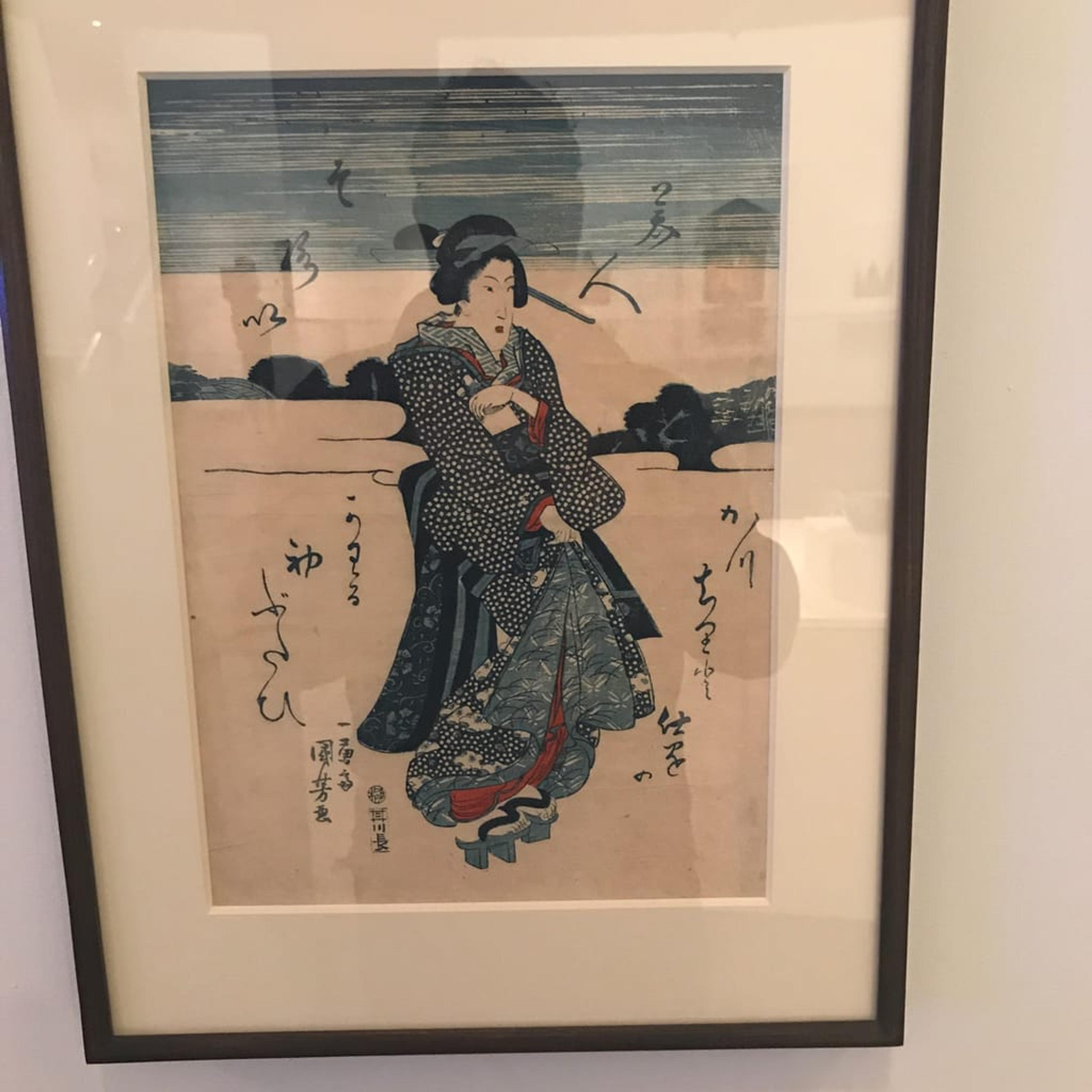 I love the varieties of blue in this print. The color came from a newly developed chemical color called Prussian Blue. Before Prussian Blue was developed in Germany, Japanese printmakers used vegetable-based dyes and colors, which were not as bright and tended to fade quickly.
Have information?
Have information about an artwork? Contact us at