Queen Nefertiti
ca. 1352–1348 B.C


1 of 6
Object Label
The remains of blue paint on Nefertiti’s wig suggest a close relationship with the gods, who were believed to have hair of lapis lazuli, a rare stone. She raises her arms to worship Aten, the chief god of this period, and receives in return from the god an ankh sign at her nose, ensuring her life. The inscription refers to her as “Beloved of Aten.”
Caption
Queen Nefertiti, ca. 1352–1348 B.C. Sandstone, pigment, 8 1/4 × 1 3/8 × 16 1/2 in. (21 × 3.5 × 41.9 cm). Brooklyn Museum, Gift of Christos G. Bastis in honor of Bernard V. Bothmer, 78.39. (Photo: Brooklyn Museum)
Title
Queen Nefertiti
Date
ca. 1352–1348 B.C
Dynasty
Dynasty 18
Period
New Kingdom, Amarna Period
Geography
Possible place collected: Thebes (Karnak), Egypt
Medium
Sandstone, pigment
Classification
Dimensions
8 1/4 × 1 3/8 × 16 1/2 in. (21 × 3.5 × 41.9 cm)
Credit Line
Gift of Christos G. Bastis in honor of Bernard V. Bothmer
Accession Number
78.39
Frequent Art Questions
Is this relief Nefertiti? The features seem very masculine.
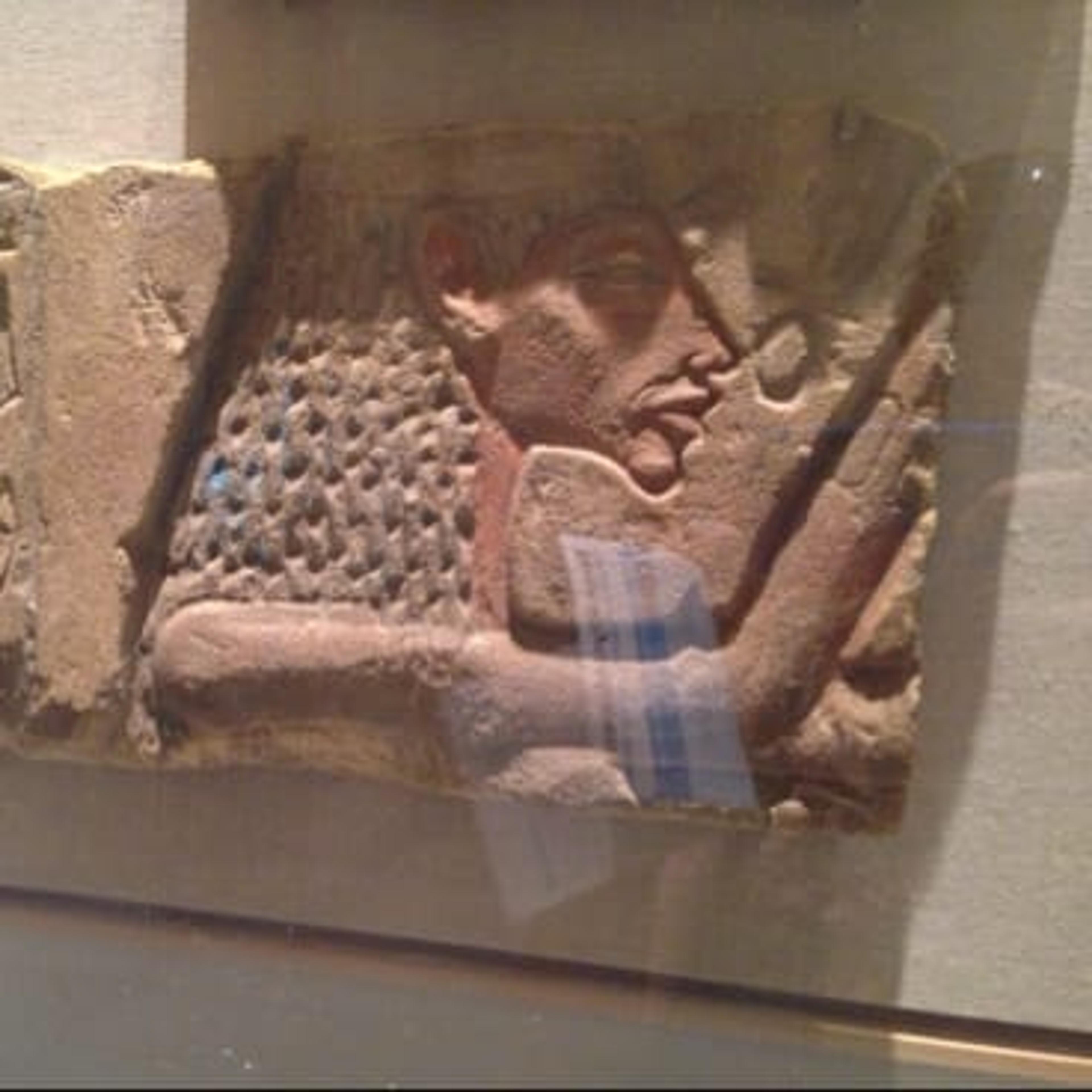 It is Nefertiti! This is a great question because during the Amarna Period (the room that you're in features all art from this period) the standards of Egyptian art were drastically different than any other period. If you spend some time in this room looking at details and features--like this masculine-looking queen--and then explore the other Egyptian art rooms, you will see the Amarna Period art breaks from traditions in many ways.
Can you tell me more about this sculpture of Nefertiti in sandstone?
This sunken relief shows how drastically different art was during the Amarna period. You can see that Nefertiti is depicted with laugh lines and neck creases, for instance.Her arms are raised in a gesture of worship towards Aten, a manifestation of the Sun god, Re, depicted as a solar disk. Aten generally has solar arms that protrude from the sun disk, and was the sole deity during the Amarna period, representing a dramatic break from previously polytheistic ancient Egyptian religion.According to Akhenaten and Nefertiti, they were the only people with direct contact to Aten, and were themselves semi-divine.Thank you so much. Was this relief made in honor of their relationship?An inscription behind her head does describe Nefertiti as "beloved of Aten," though we don't know why it was made. The relief serves, generally, to show Nefertiti honoring Aten, but as for location or intention in making the piece, we are unsure.It most likely comes from a temple context, and is a good example of Nefertiti's (and by extension Akhenaten's) relationship with the Aten.Many of the temples related to Aten were located at Amarna, or Akhetaten ("The Horizon of Aten"). This was the capital city of the period, a place where ceremonies, offerings, and hymns could be performed to honor the Aten.Why are some of the Egyptian reliefs of women painted with red, which is the typical portrayal of men in Egyptian society?
During the Amarna period (when Nefertiti and her husband, Akhenaten, ruled), there were significant changes in art.There was a gender ambiguity in depictions of Akhenaten and Nefertiti and the use of red coloring for both is likely tied to this as well.
Have information?
Have information about an artwork? Contact us at