A Morning Snow--Hudson River
George Wesley Bellows

Brooklyn Museum photograph
Object Label
Assured, slashing strokes of a heavily loaded brush capture the effects of morning light reflected from freshly fallen snow. This view shows the Hudson River and New Jersey from Manhattan’s Upper West Side. George Wesley Bellows conveyed the sense of the city awakening through his depiction of the man shoveling snow, people going to work, boats plying the river, and smoke and steam interrupting the still, crisp atmosphere.
Elements of this composition move toward abstraction. The elevated vantage point reduces the illusion of depth, while horizontal and vertical components, seen particularly in the fence and tall trees, provide a subtle gridlike structure.
Elements of this composition move toward abstraction. The elevated vantage point reduces the illusion of depth, while horizontal and vertical components, seen particularly in the fence and tall trees, provide a subtle gridlike structure.
Caption
George Wesley Bellows (American, 1882–1925). A Morning Snow--Hudson River, 1910. Oil on canvas, 45 1/16 x 63 3/16 in. (114.5 x 160.5 cm) frame: 49 1/4 x 67 1/4 x 3 1/2 in. (125.1 x 170.8 x 8.9 cm). Brooklyn Museum, Gift of Mrs. Daniel Catlin, 51.96. (Photo: Brooklyn Museum)
Gallery
Not on view
Collection
Gallery
Not on view
Collection
Artist
Title
A Morning Snow--Hudson River
Date
1910
Medium
Oil on canvas
Classification
Dimensions
45 1/16 x 63 3/16 in. (114.5 x 160.5 cm) frame: 49 1/4 x 67 1/4 x 3 1/2 in. (125.1 x 170.8 x 8.9 cm)
Signatures
Signed lower left: "Geo Bellows."
Credit Line
Gift of Mrs. Daniel Catlin
Accession Number
51.96
Frequent Art Questions
Can you tell me about the artist?
 Another of my favorites! George Bellows was born in Ohio and spent his artistic career in New York. He was important member of the Ashcan School, a group of artists who worked in a realist style and took urban life as their central subject matter.He was famous for his scenes of boxing matches and his scenes of everyday life in New York, including tenement neighborhoods and public parks like this one.I like the mix of things happening here...the boy and man are just out for a stroll, but behind them you can see the train tracks and industrial machinery that would be busy during the work week.
Why do you think Bellows used this palette? It is white but it looks quite dirty in some parts.
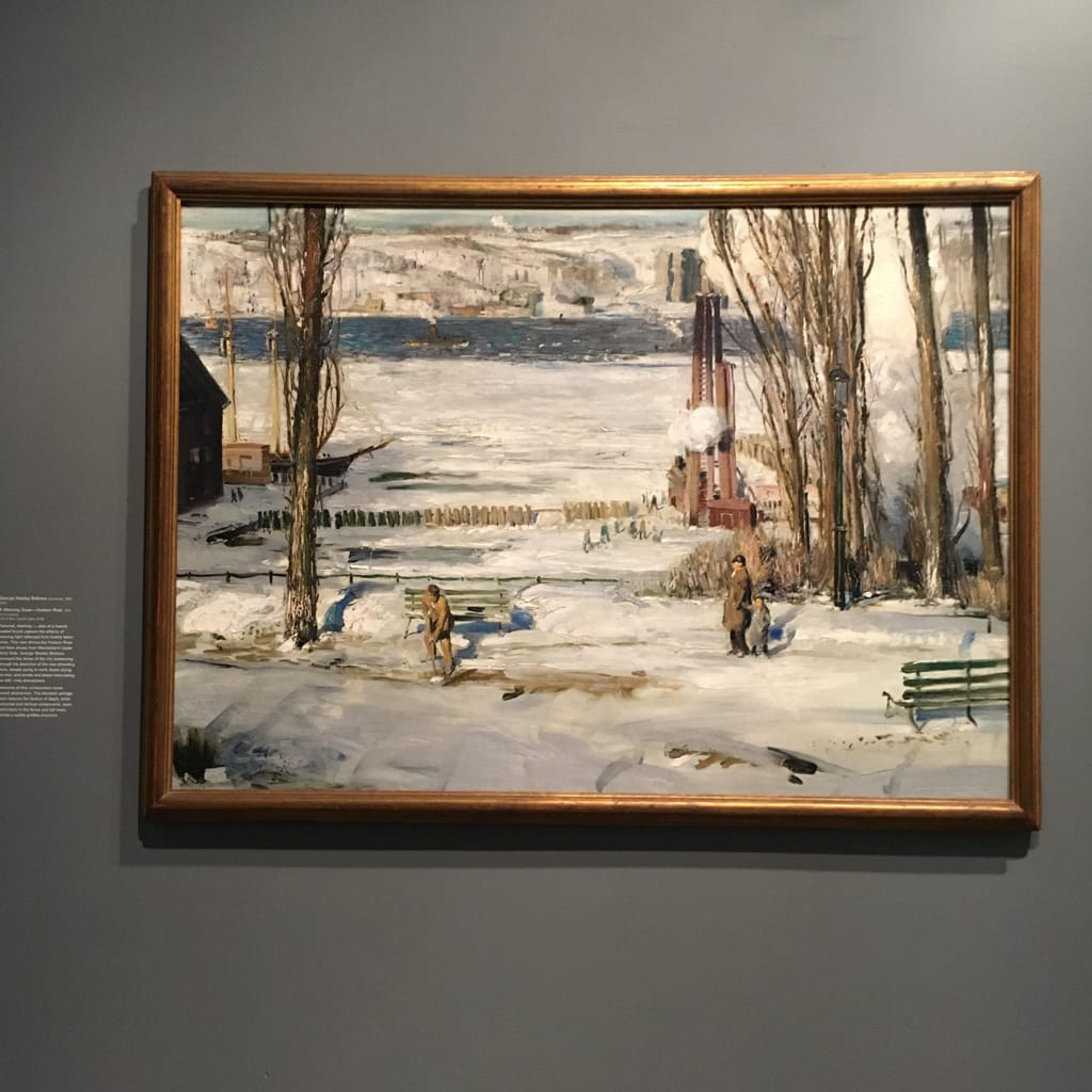 I think the colors allow certain elements to stand out more than others. The white snow makes it easy to create contrast. What do you think the palette is saying?I think it allows the people and the dirtiness of the industrial items to stand out.
Have information?
Have information about an artwork? Contact us at