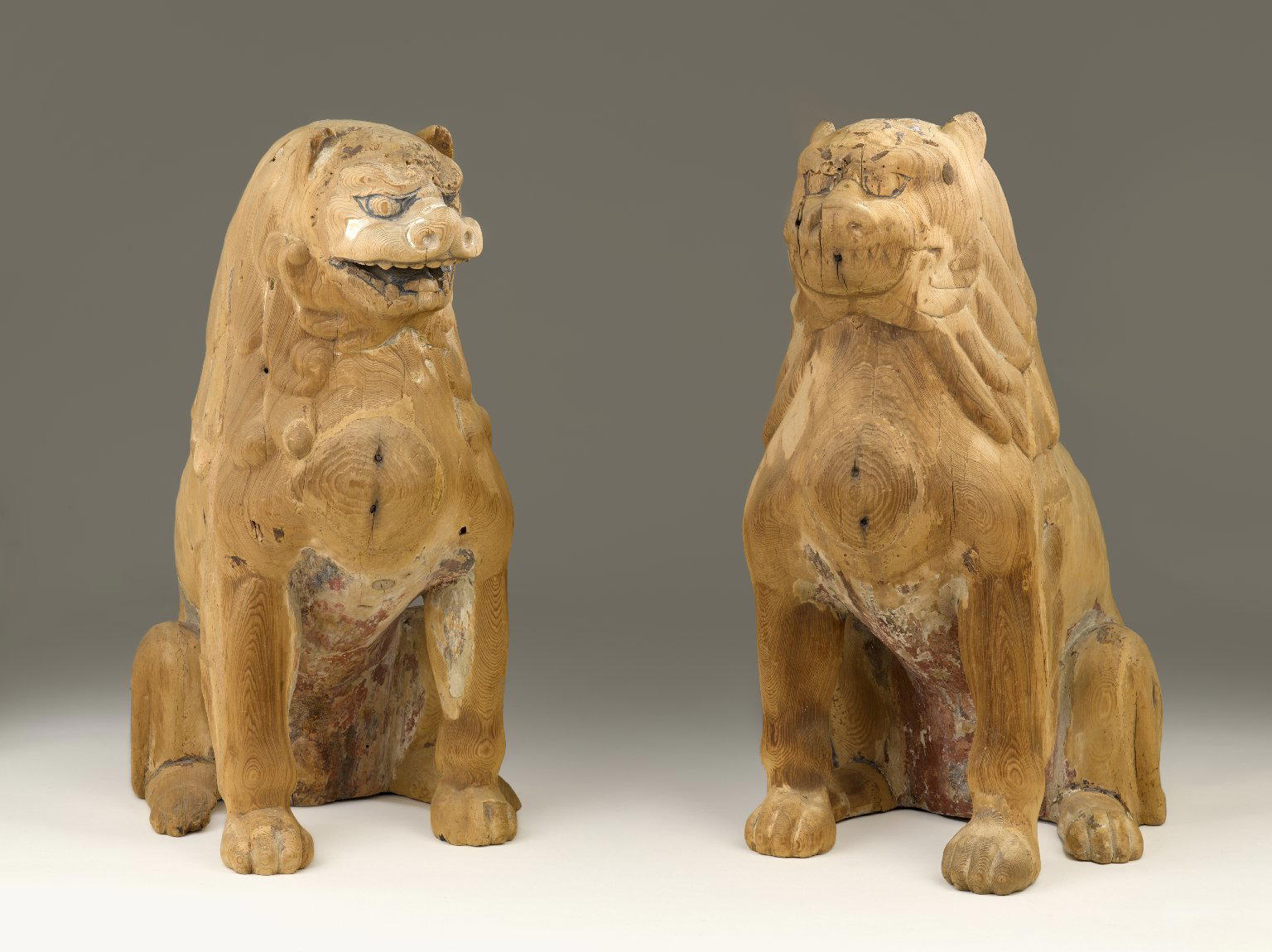
Koma-Inu (Mouth Closed); One of Pair

1 of 2
Object Label
These beasts are known in Japanese as koma-inu, or “Korean lions,” a name that acknowledges their foreign origins. The closest prototypes for the koma-inu are found in China, but the tradition of using lion-like figures as guardians can be traced to ancient India and Iran.
Caption
Koma-Inu (Mouth Closed); One of Pair, early 13th century. Hinoki (cypress wood) with traces of pigment, 21 x 11 1/4 in. (53.3 x 28.6 cm). Brooklyn Museum, Purchased with funds given by Mr. and Mrs. Milton F. Rosenthal and Dr. and Mrs. Robert Feinberg, A. Augustus Healy Fund, Frank L. Babbott Fund, and Designated Purchase Fund, 85.171.2. (Photo: Brooklyn Museum)
Collection
Collection
Title
Koma-Inu (Mouth Closed); One of Pair
Date
early 13th century
Period
Kamakura Period
Geography
Place made: Japan
Medium
Hinoki (cypress wood) with traces of pigment
Classification
Dimensions
21 x 11 1/4 in. (53.3 x 28.6 cm)
Credit Line
Purchased with funds given by Mr. and Mrs. Milton F. Rosenthal and Dr. and Mrs. Robert Feinberg, A. Augustus Healy Fund, Frank L. Babbott Fund, and Designated Purchase Fund
Accession Number
85.171.2
Have information?
Have information about an artwork? Contact us at