The Last Days of Pompeii

Brooklyn Museum photograph
Object Label
This cataclysmic theme, which lends itself to ruminations on the cyclical nature of societies and civilizations, continued to appeal to artists in the mid-nineteenth century.
Caption
James Hamilton (American, 1819–1878). The Last Days of Pompeii, 1864. Oil on canvas, 59 15/16 x 48 1/16 in. (152.2 x 122 cm) frame: 69 1/2 x 57 1/2 x 4 in., 96 lb. (176.5 x 146.1 x 10.2 cm, 43.55kg). Brooklyn Museum, Dick S. Ramsay Fund, 55.138. (Photo: Brooklyn Museum)
Gallery
Not on view
Collection
Gallery
Not on view
Collection
Artist
Title
The Last Days of Pompeii
Date
1864
Medium
Oil on canvas
Classification
Dimensions
59 15/16 x 48 1/16 in. (152.2 x 122 cm) frame: 69 1/2 x 57 1/2 x 4 in., 96 lb. (176.5 x 146.1 x 10.2 cm, 43.55kg)
Inscriptions
Inscribed verso: "From Bulwers/ "The Last Days of Pompeii'/ Jas Hamilton/ Philada 1864"
Credit Line
Dick S. Ramsay Fund
Accession Number
55.138
Frequent Art Questions
Can you give me an in depth description of how the different parts of these paintings evoke the end of the world aside from their darkness?
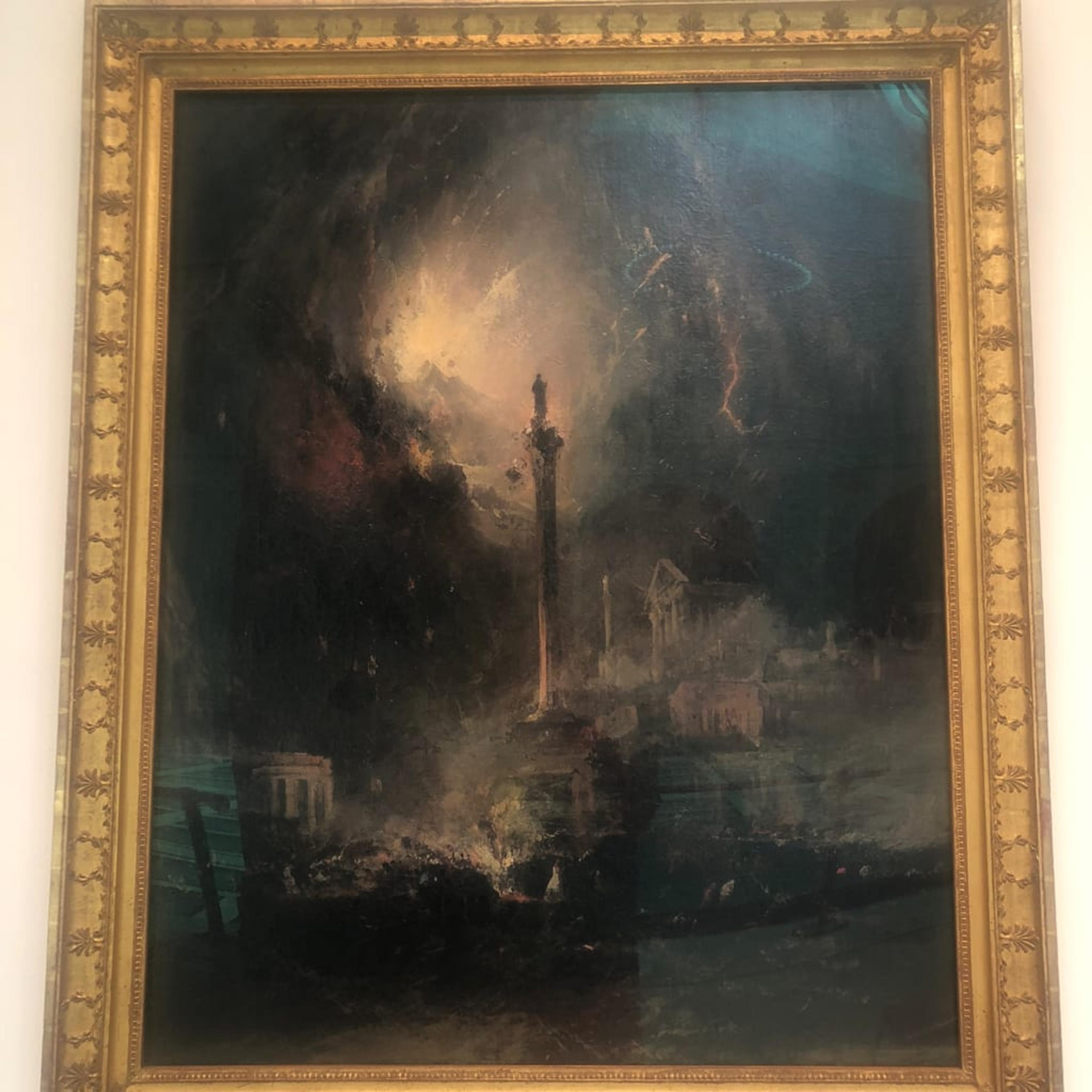 Besides the darkness, both also focus explicitly on destruction, including with the use of sometimes violent brushstrokes. In the case of Colman's painting, there is also a good amount of symbolism implying apocalyptic destruction. For instance, the falling winged figure is a representation of father time, one fundamental aspect of the world that is falling apart!In the case of the Hamilton, while Hamilton is showing us a real event, the end of a city rather than the world, his interest is in the cyclical nature of civilizations.Thanks for the answer, well said.
Have information?
Have information about an artwork? Contact us at