The Confidence Man

Brooklyn Museum photograph
Caption
Guy Pène du Bois (American, 1884–1958). The Confidence Man, 1919. Oil on plywood panel, 20 x 15 in. (50.8 x 38.1 cm) Frame: 28 x 22 1/2 x 2 in. (71.1 x 57.2 x 5.1 cm). Brooklyn Museum, Gift of Chester Dale, 63.148.3. (Photo: Brooklyn Museum)
Gallery
Not on view
Collection
Gallery
Not on view
Collection
Artist
Title
The Confidence Man
Date
1919
Medium
Oil on plywood panel
Classification
Dimensions
20 x 15 in. (50.8 x 38.1 cm) Frame: 28 x 22 1/2 x 2 in. (71.1 x 57.2 x 5.1 cm)
Signatures
signed lower right: "Guy Pene duBois / 19"
Inscriptions
verso inscriptions, in pencil: "$500.00"; "The Confidence Man / by Guy Pene ..."; in crayon: "Bx - 49 - 1" Gummed label: "28151" Gummed label: "From the / Chester Dall Collection / 20 East 79th Street. / New York, N.Y."
Credit Line
Gift of Chester Dale
Accession Number
63.148.3
Frequent Art Questions
I’m looking at these three paintings by du Bois and the frame seems to be integral to the paintings which raises a question for me: Are they part of the art or does the museum choose the frames? I wonder that a lot when I’m looking at art in museums.
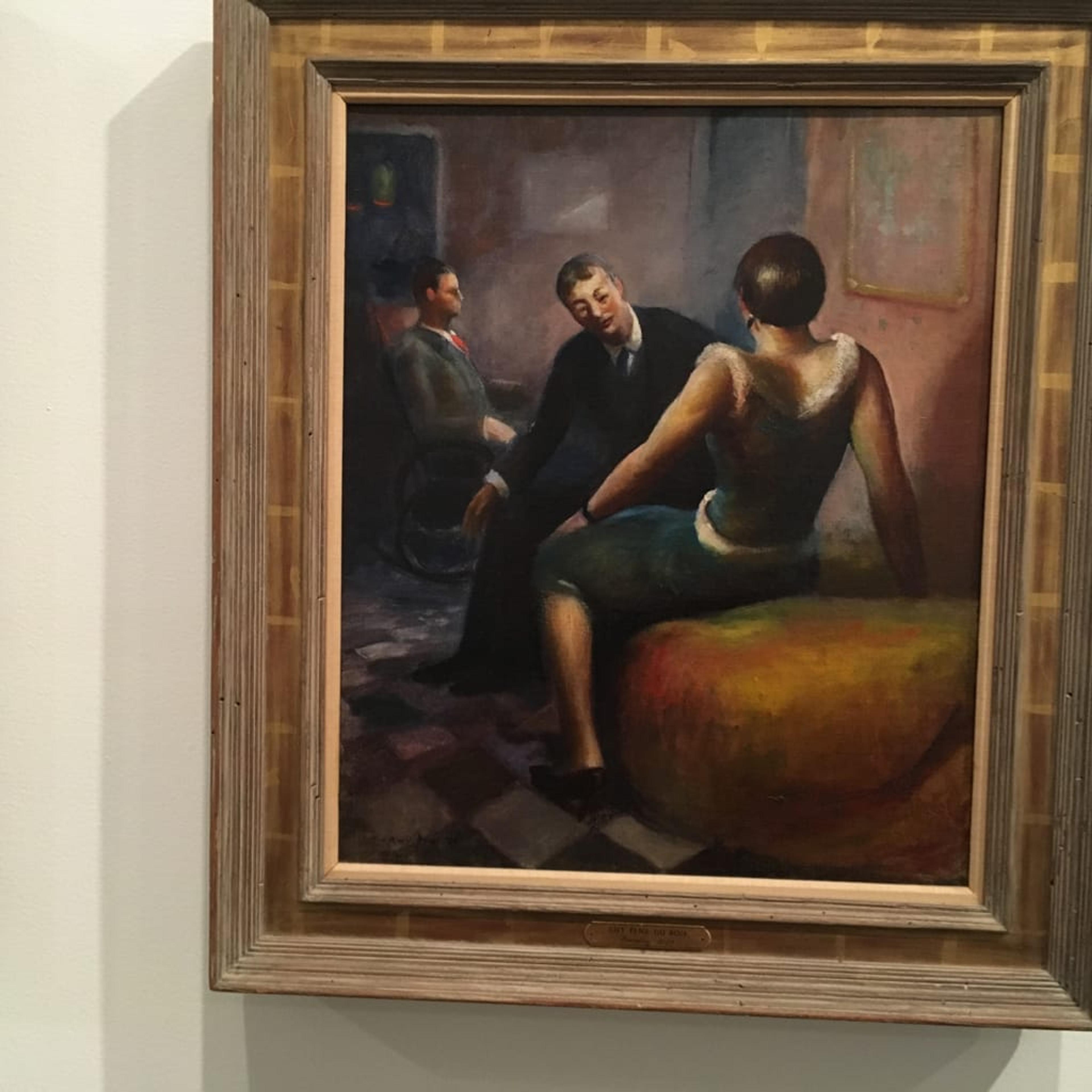 A lot of visitors wonder the same thing! My understanding is that most of often, paintings do come to the museum in a frame (which may or may not be original). If the museum is charged with selecting a frame we aim to remain true the period in which the painting was created.In the case of the du Bois paintings and other works from the 20th century, it is probable that they are still in their original frames! These frames may have been selected by the artist or an early collector. And, as du Bois was working in a post-photography world, the concept of “framing” and “cropping” would have been a consideration in his compositions.
Can you tell me about Guy Pene du Bois, "The Confidence Man"?
Guy Pène du Bois was known for presenting witty and mocking views of New York society in his paintings.Early in his career he abandoned the dark palette and quick, gestural brushstrokes of his teachers Chase and Henri and developed a style dominated by simplified and stylized figures. He depicted his figures with a directness and sharp awareness of the artifice of social encounters. Here, we see a tense moment between a formally dressed man and woman. His aggressive gaze wilts the woman, who hangs her head and looks downward. A Confidence Man, or Con Man, manipulates victims for personal gain. Perhaps du Bois is suggesting that within the context of this relationship, the man is manipulative towards the woman. Their uncomfortable dynamic betrays the elegance suggested by their dress.Thank you!
Have information?
Have information about an artwork? Contact us at