Pair of Woman’s Ear Pendants
17th or 18th century


1 of 3
Object Label
These ornaments were not worn in the ear itself, but appended to a Tibetan woman’s headdress near the ears to frame the face. They served to demonstrate her personal wealth and social status. The most highly prized, sky-blue turquoise originated from mines near Nishapur in Khorosan, Iran, and was traded to Tibet via India; darker colored turquoise came from both Tibet and China. The color turquoise was important to Tibetans as a reference to the sky and lakes, while the mineral turquoise was thought to have powers that added to its appeal as a material for personal adornment. According to the Blue Beryl, an important Tibetan medical treatise written by Sangye Gyatso (1653–1705), turquoise had healing properties: an antidote for poison and a cure for diseases, including liver ailments.
Caption
Pair of Woman’s Ear Pendants, 17th or 18th century. Silver inlaid with turquoise, 1 1/2 × 1 × 4 in. (3.8 × 2.5 × 10.2 cm). Brooklyn Museum, Gift of the Ernest Erickson Foundation, Inc., 86.227.43a-b. (Photo: Brooklyn Museum)
Gallery
Not on view
Collection
Gallery
Not on view
Collection
Frequent Art Questions
Can you tell me about these?
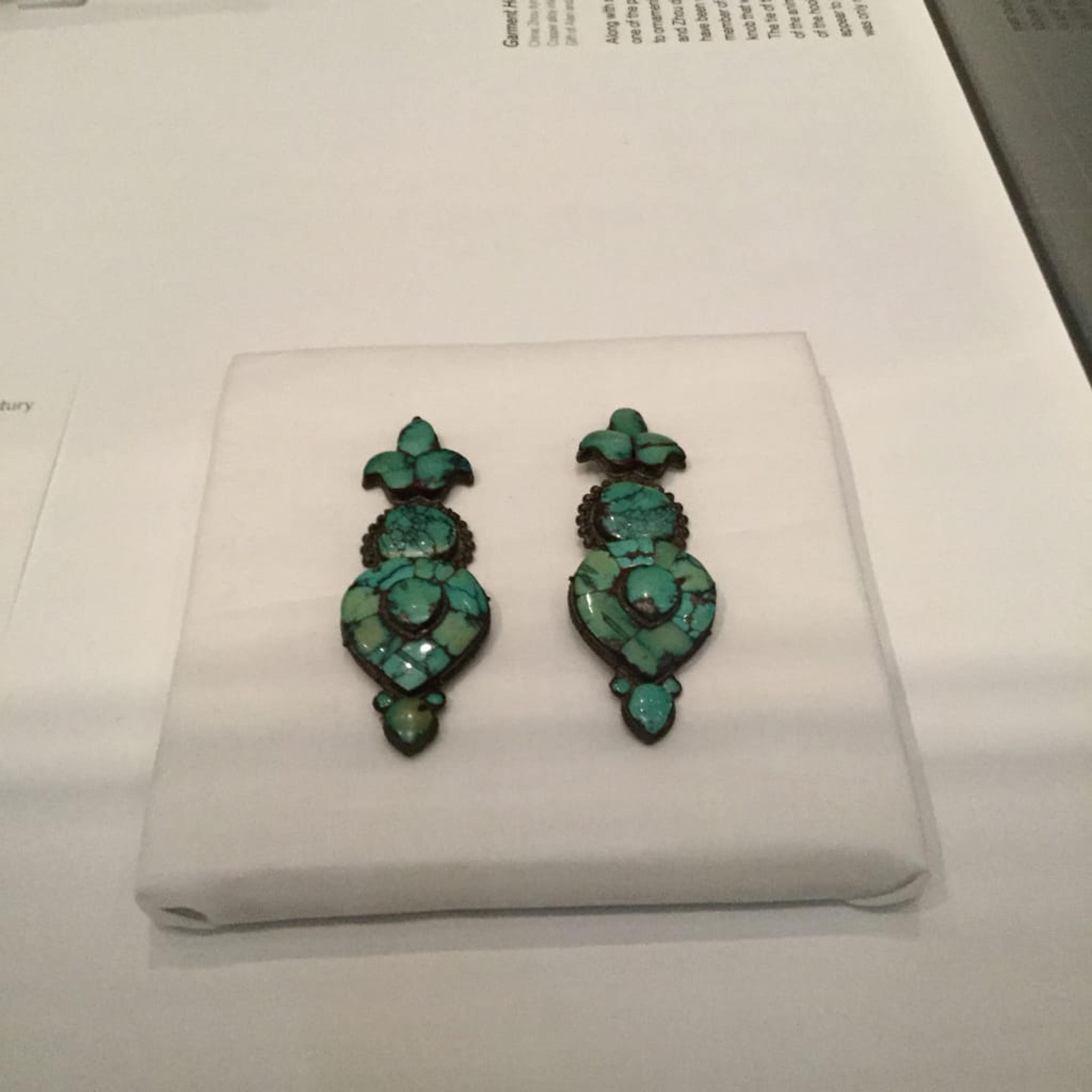 Those ear pendants are so beautiful! They look like earrings, but they would actually be attached to a headdress and would hang in front of a Tibetan woman's ears.Back when these were made, in the 17th-18th century, women in Central Tibet would have worn this type of jewelry everyday. Today, it's more reserved for special occasions.
Most East Asian pieces in the Infinite Blue exhibition seem to be turquoise. Is there a reason for that? Maybe availability of pigments and gems?
Turquoise is the primary blue stone that was used in East Asian art. Lapis is much more rare and costly. Synthetic blue pigments were, historically, difficult to produce as well. Cobalt and Prussian Blue had to be imported.How was turquoise used in Tibetan medicine?
In Tibet, turquoise was worn as a protective substance, believed to strengthen bones and protect an individual from injury. In fact, turquoise with no flaws could protect an individual from supernatural harm as well as physical.Turquoise is also an ingredient in pills called rinchen rilbu, translated to "precious pills." In these pills, ground turquoise is mixed with herbs and other medicinal substances and swallowed, kept in charm boxes, or made as offerings.Turquoise even had use as an antidote for poisons and a cure for liver based illnesses.Turquoise was also a popular precious gem in Tibet starting in the 7th century C.E. So it did have use for it's beauty and precious nature as well, just like other turquoise objects in this case!
Have information?
Have information about an artwork? Contact us at