Kachina Doll (Paiyatemu)
A:shiwi (Zuni Pueblo)


1 of 2
Object Label
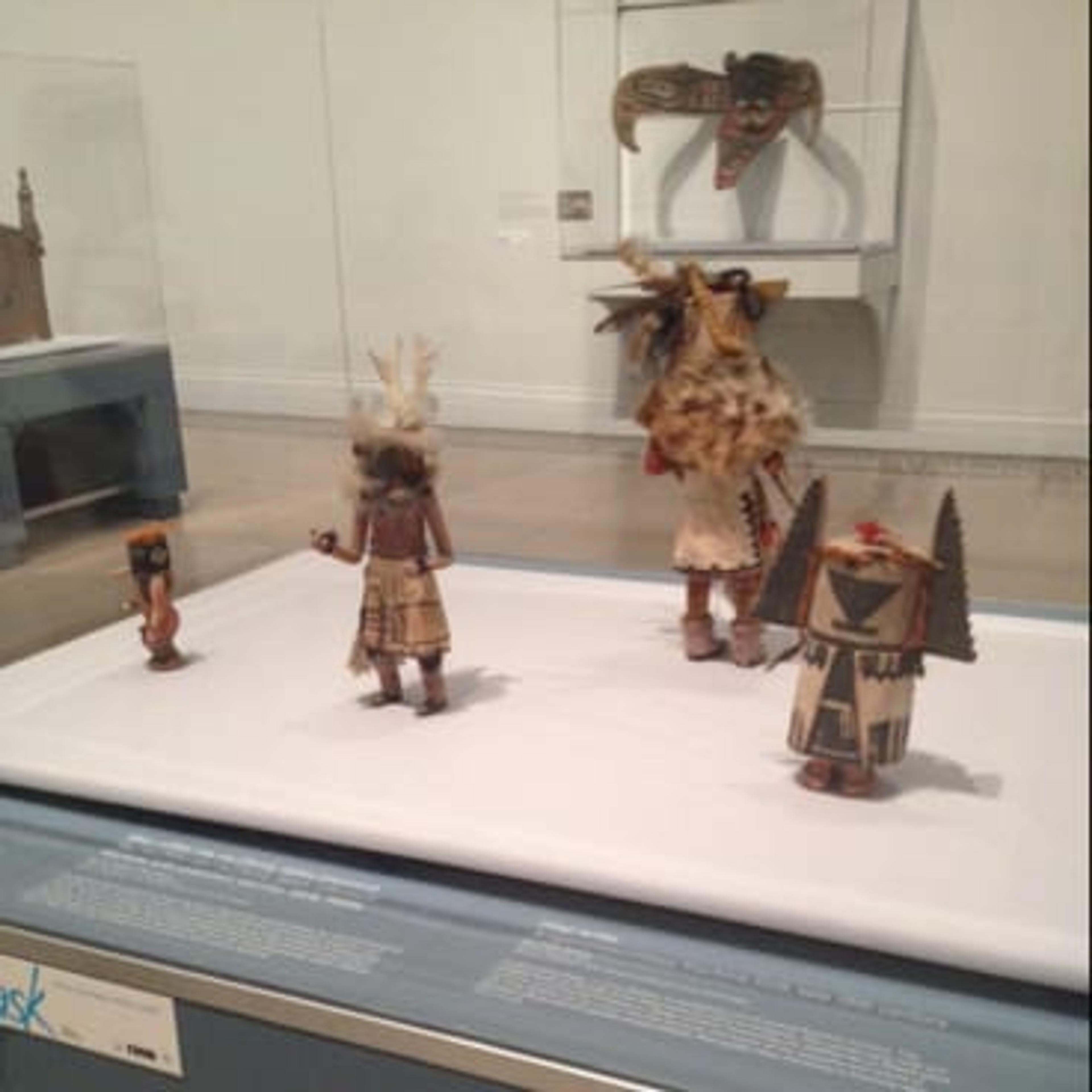
Kachinas are representative of three types of entities within the religion of the Hopi and Zuni people. First, a Kachina is a spiritual ancestor who is a messenger to and from the gods. Second, a Kachina is a male dancer personifying these spirits. And third, a Kachina doll is carved as a secular representation of the spirits. Curator Stewart Culin identified this elaborate doll as Chilchi in his journals when he collected it at Zuni. However, no exact attribution can be made to a specific, known character, and it appears that Kachinas are so numerous and change so much over time that exact meanings and names of historical representations are often no longer known.
Religious ceremonies for the Hopi and Zuni people revolve around the cyclical calendar of seasons. During the time of the winter solstice, the invisible spirits of ancestors return to their villages as Kachina. Hopi and Zuni men, who belong to secret societies, believe that they actually assume the powers and persona of Kachina spirits when they enter the village dressed with painted skins, furs, and clothes and wearing the appropriate mask. During this period, several different occasions are held to dance, chant, and pray to the gods, who are believed to live in the distant mountains. These important ceremonies ensure rains for the coming agricultural season but also help renew all life. The Zuni and Hopi regard the life-size Kachina masks and clothing as sacred because of their religious, transformative powers.
Men, often a matrilineal uncle, carve Kachina dolls to give as gifts to young children during religious ceremonies. Since women cannot belong to the secret societies and become Kachina personifications and young boys are not members until they are initiated, these dolls help them learn about their religion. Children may therefore play respectfully with them or hang them on the walls of their homes. In the late nineteenth century, connoisseurs began to value and collect Kachina dolls as sculptural works of art, and Zuni and Hopi artists began making additional dolls for sale.
Religious ceremonies for the Hopi and Zuni people revolve around the cyclical calendar of seasons. During the time of the winter solstice, the invisible spirits of ancestors return to their villages as Kachina. Hopi and Zuni men, who belong to secret societies, believe that they actually assume the powers and persona of Kachina spirits when they enter the village dressed with painted skins, furs, and clothes and wearing the appropriate mask. During this period, several different occasions are held to dance, chant, and pray to the gods, who are believed to live in the distant mountains. These important ceremonies ensure rains for the coming agricultural season but also help renew all life. The Zuni and Hopi regard the life-size Kachina masks and clothing as sacred because of their religious, transformative powers.
Men, often a matrilineal uncle, carve Kachina dolls to give as gifts to young children during religious ceremonies. Since women cannot belong to the secret societies and become Kachina personifications and young boys are not members until they are initiated, these dolls help them learn about their religion. Children may therefore play respectfully with them or hang them on the walls of their homes. In the late nineteenth century, connoisseurs began to value and collect Kachina dolls as sculptural works of art, and Zuni and Hopi artists began making additional dolls for sale.
Caption
A:shiwi (Zuni Pueblo). Kachina Doll (Paiyatemu), late 19th century. Wood, pigment, horsehair, feathers, wool, hide, cotton, tin, ribbon, 22 1/2 x 9 x 8 in. (57.2 x 22.9 x 20.3 cm). Brooklyn Museum, Museum Expedition 1903, Museum Collection Fund, 03.325.4631. (Photo: Brooklyn Museum)
Gallery
Not on view
Collection
Gallery
Not on view
Collection
Culture
Title
Kachina Doll (Paiyatemu)
Date
late 19th century
Geography
Place collected: Zuni, New Mexico, United States
Medium
Wood, pigment, horsehair, feathers, wool, hide, cotton, tin, ribbon
Classification
Dimensions
22 1/2 x 9 x 8 in. (57.2 x 22.9 x 20.3 cm)
Credit Line
Museum Expedition 1903, Museum Collection Fund
Accession Number
03.325.4631
Frequent Art Questions
I also wanted to thank you for placing a Zuni jar with contemporaneous paintings. What a great reminder of other art going on at the same time!
 How did you choose what to display in the Life & Death exhibit? Did you work with Native people to find out what would be ok to show? For example, some kachinas are taboo. Very interesting exhibit!Good point about the Kachinas, the Zuni and the Hopi have very different views about the secrecy of the Kachina culture.The Hopi actually make and sell Kachinas at Indian Market, while the Zuni are much more secretive. Some of the Zuni ones we have on display were actually commissioned for the museum in 1920s in secrecy. Others were purchased from traders working in the area. However, since the days of our collecting ideas and approaches to curating from these cultures have significantly changed. Members of both Zuni and Hopi tribes have worked with the curators for this display. The curators also work closely with many Native people tribes to ensure that the exhibits are respectful of the native cultures.I knew the modern ones were for sale. I'm fascinated by the old commissioned ones. I didn't know that was done back then.It's actually a really interesting story, about the Zuni figures in particular. Give me a second to write out for you what it entailed.Stewart Culin, our curator of Ethnology from 1903-1929, traveled often to the Southwest to collect for the museum. He tried really hard to get some Kachina dolls and masks over multiple visits, but the Zuni made it impossible. He was even supervised during his stay to make sure no sacred objects were purchased by him.However, in 1904 (sorry, not the 1920s as I mentioned earlier..) Andrew Vanderwagen, a missionary who had a trading store in the Pueblo at the time, was able to secure many dolls and different masks for Culin. Vanderwagen had hired three She-we-na (Zuni) to make these objects, and had them work in a locked room in his basement.Culin expressly stated that all the kachina dolls on view at the museum were new, and hadn't been used during any of the Kachina ceremonies. Authenticity in fact, couldn't be guaranteed, since the men were working in secrecy and under the pressure of a deadline, and the dolls were not viewed by the community for vetting. These dolls do not carry ritual paraphernalia like most dolls, and their kilts are not hemmed, so it's questionable whether they represent specific Kachina spirits or not. Though the Zuni who have visited the museum since have approved their display and have expressed that they do seem authentic.It's part of the complexity of being a museum of such long standing, where collecting practices, understanding of culture, and respect for communities has shifted so dramatically over time. That's why our curators are so eager to work with different tribes and First Nation communities about the display and explanation of their objects.I'm glad to hear that, thank you. Your integration of Native art in the American story is a huge contrast from some others nearby (I visited AMNH earlier this week and was pretty traumatized!). It's great to see the old and contemporary Native items together, too. Thanks so much for sharing all this with me. This app is a great resource, btw.
Have information?
Have information about an artwork? Contact us at