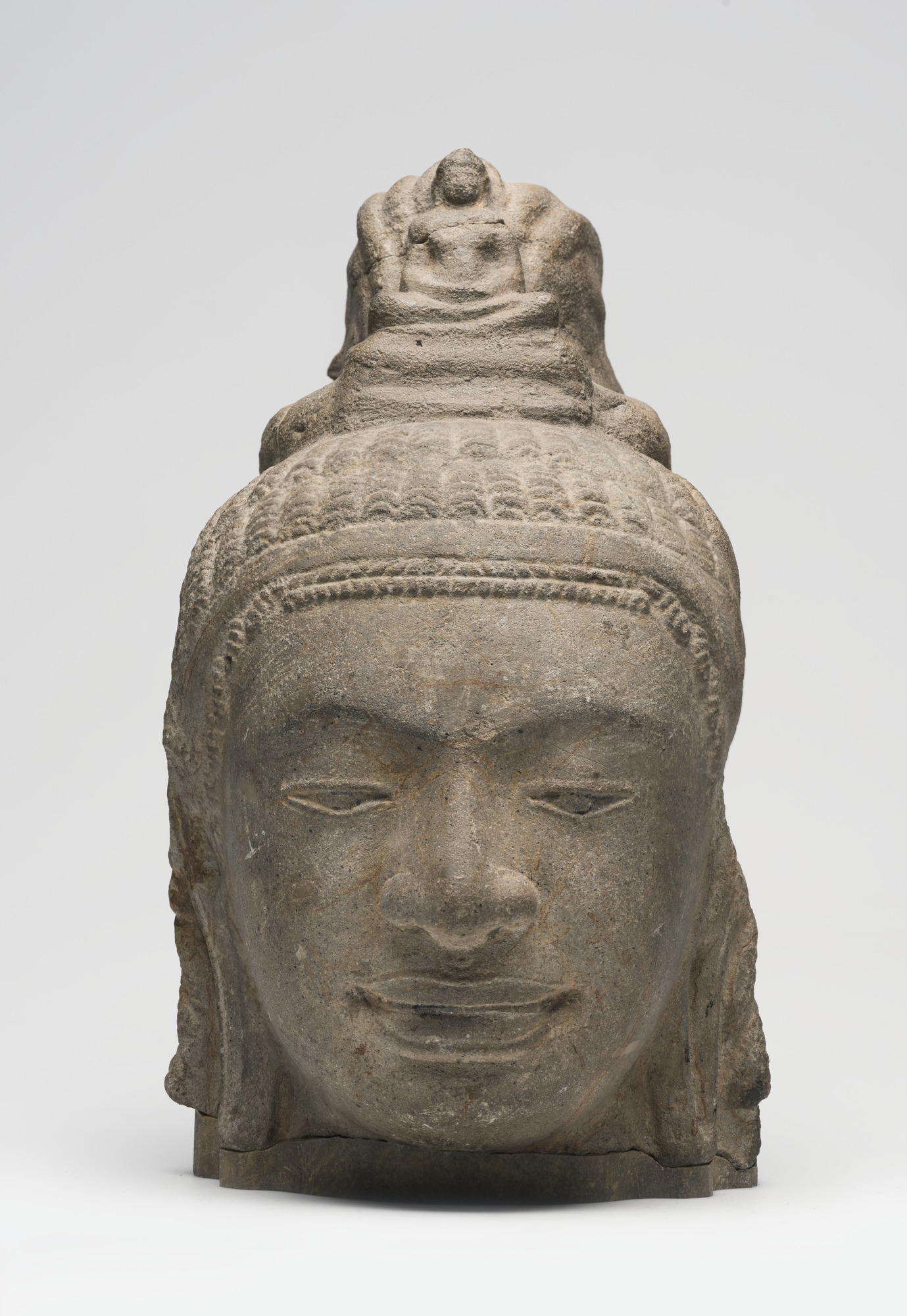
Head of a Male Deity
540–600 C.E.


1 of 3
Object Label
With its round, soft features and narrow eyes, this head is typical of the earliest Cambodian stone sculptures. In this period, Cambodian rulers strove to adopt and emulate aspects of Indian culture that had traveled to Southeast Asia via maritime trade and missionaries. Most of the sculptures from this early period are Hindu in subject matter, whereas the seated Buddha atop this head indicates that it represents a Buddhist deity. It is likely that this image originally represented a Hindu deity, probably the god Vishnu, who wears a tall crown, and that it was repurposed as a Buddhist image at a later date by carving the Buddha into the stone of the crown.
Caption
Head of a Male Deity, 540–600 C.E.. Gray sandstone, 10 x 5 3/4 x 6 1/2 in. Brooklyn Museum, Gift of Georgia and Michael de Havenon, 1996.210.3. (Photo: Brooklyn Museum)
Collection
Collection
Frequent Art Questions
Great smile. Is this buddah?
I agree! It is likely that this image originally represented a Hindu deity, probably the god Vishnu, who wears a tall crown. But interestingly, it seems to have been repurposed as a Buddhist image at a later date when it would have represented a BodhisattvaTell me more about these two heads.
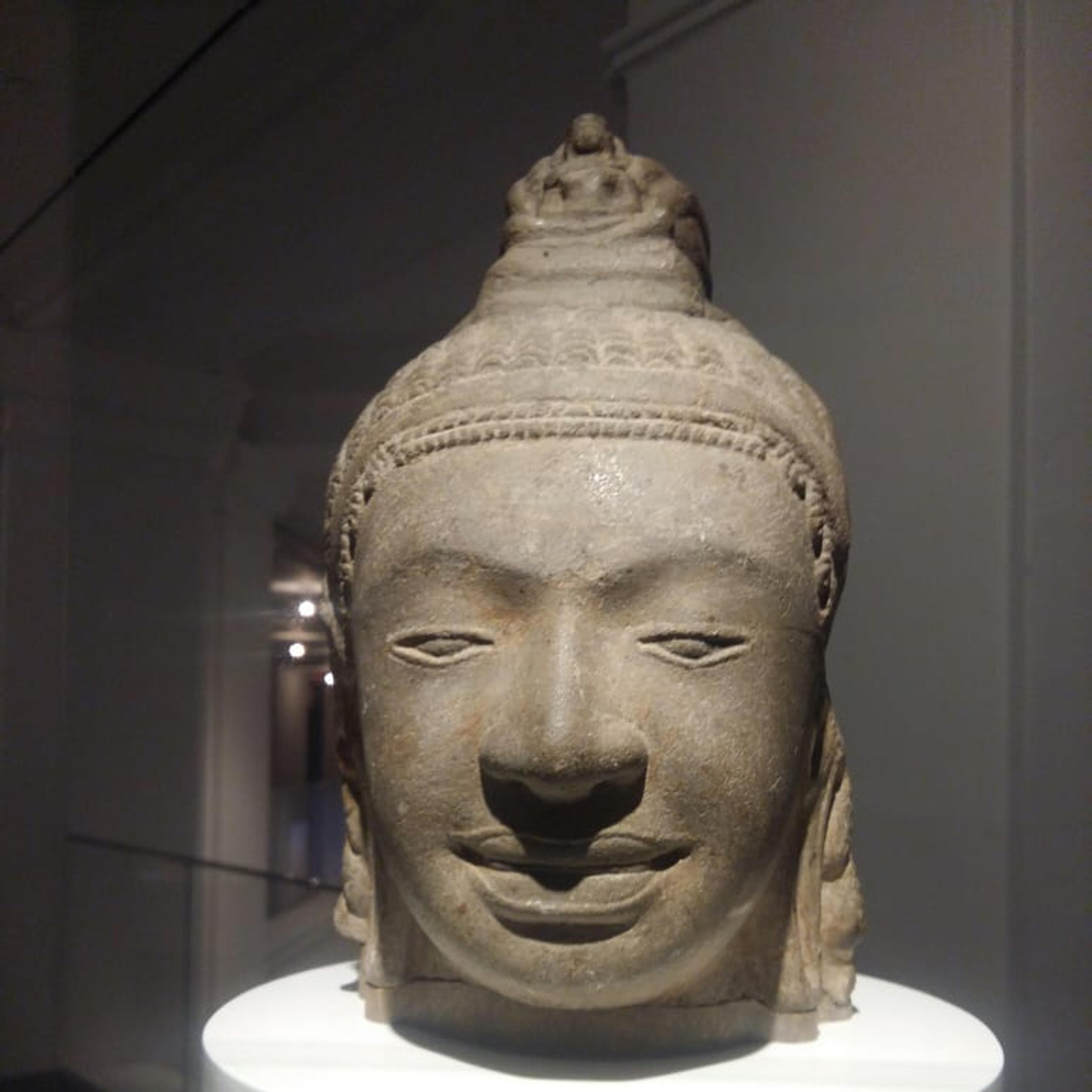 These two sculptures represent the different ways Buddhist divinities are represented in different cultures. The first is from Cambodia and the second from Japan.Notice the differences in facial proportions and headdresses. They're also made of different materials. The first is stone and the second is wood painted to look like bronze!
Tell me more.
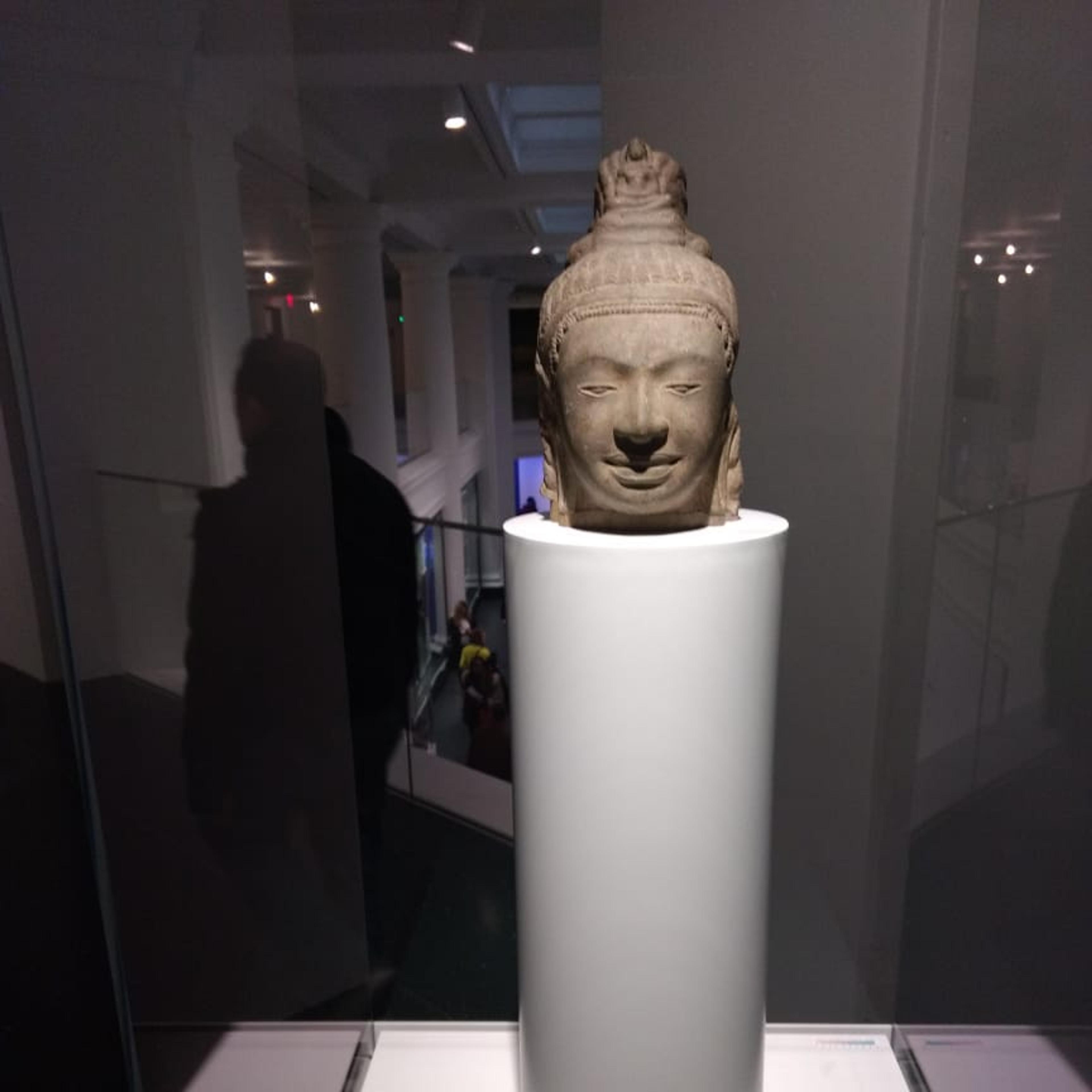 Starting in the early centuries of the first millennium, Brahmanical culture from South Asia began to impact Cambodia and neighboring regions of Southeast Asia, resulting in the adaptation and localization of Indic traditions.The identity of this image is actually unknown. You'll notice that there is a Buddha carved into his hair. This was added later to transform the deity into Avalokiteshvara, a bodhisattva. As belief in Hinduism waned in medieval Cambodia, images and sites were sometimes repurposed into a Buddhist context.
Have information?
Have information about an artwork? Contact us at