Bowl
12th century
Caption
Bowl, 12th century. Jun ware, stoneware with purplish blue glaze, 3 1/16 x 7 3/8 in. (7.8 x 18.7 cm). Brooklyn Museum, The Peggy N. and Roger G. Gerry Collection, 2004.28.40.
Gallery
Not on view
Collection
Gallery
Not on view
Collection
Frequent Art Questions
Can you tell me about this?
This bowl is an example of Jun ware, which was developed in northern China. It is characterized by it's stoneware body and opalescent blue-toned glaze.The blue tones were constructed using an optical illusion. Cobalt pigments weren't actually used to create the colors, like in other blue ceramics. Rather a combination of silica, alumina, and plant ash was fired to create a glaze made up of tiny glass spheres, which refract blue light in the same way as particles in the sky.Hi! What kind of process is used to make the glaze look like this?
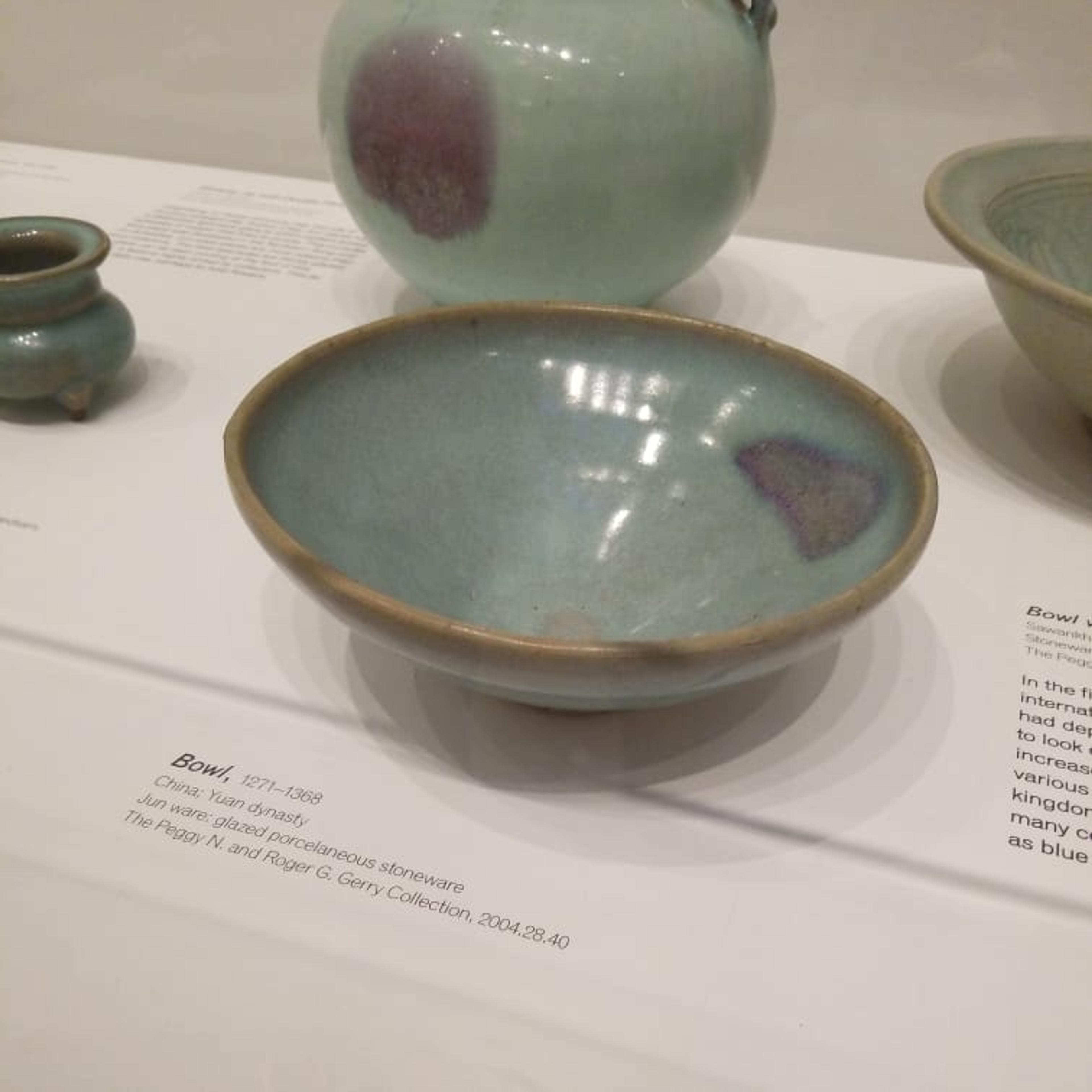 Basically, it has to do with variations in heat and oxygen level in the kiln. The glaze itself is all one color. Let me get some more details for you!So, the glaze used in Jun ware relies on chemical reactions between silica, alumina, and plant ash that take place in the high temperatures of the kiln to produce the mostly blue-green color that you see.Even higher temperatures transform the glaze into the red-purple splotches which were considered desirable. Ceramic artists carefully engineered their kilns to produce varying temperatures to this end.Cool thanks!
Have information?
Have information about an artwork? Contact us at