Prestige Raffia Panel
Kuba
Object Label
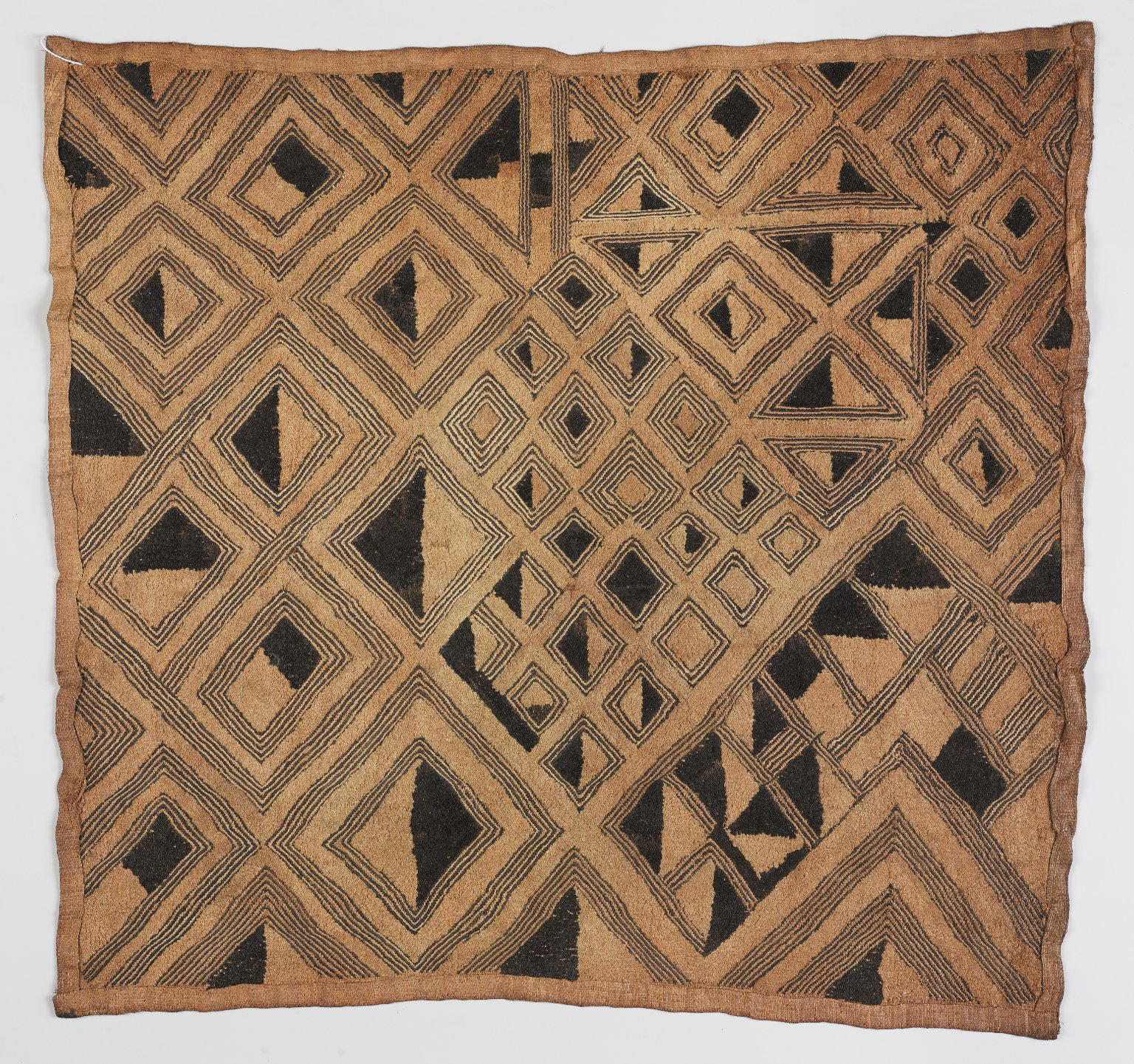
In the embroidered runner for Sojourner Truth (American, c. 1797–1883), Chicago and her collaborators intermingled Central African strip-weaving techniques with the symbolic quilt-making of African American artists such as Harriet Powers (American, 1839–1910), who, like Truth, was born into slavery. As a feminist artist, Chicago placed great weight on the liberating power of knowing one’s historical and aesthetic antecedents. In the Truth runner she used patterns akin to those from Kuba culture, thereby alluding to the knowledge of heritage denied to African Americans by white society. In early notes for the runner, Chicago considered using “homely fabrics” to convey Truth’s life circumstances, but elected instead to honor the rich textile traditions of black culture before the start of the Atlantic slave trade.
Caption
Kuba. Prestige Raffia Panel, 20th century. Raffia palm fiber, pigment, inks, 22 x 22 1/2 in. (55.9 x 57.2 cm). Brooklyn Museum, Transferred from The Metropolitan Museum of Art, The William B. Goldstein Collection, 2005.30.14.
Gallery
Not on view
Collection
Gallery
Not on view
Collection
Culture
Title
Prestige Raffia Panel
Date
20th century
Geography
Place made: Sankuru River region, Democratic Republic of the Congo
Medium
Raffia palm fiber, pigment, inks
Classification
Dimensions
22 x 22 1/2 in. (55.9 x 57.2 cm)
Credit Line
Transferred from The Metropolitan Museum of Art, The William B. Goldstein Collection
Accession Number
2005.30.14
Have information?
Have information about an artwork? Contact us at