Untitled (Vitrines)
Terence Koh
1 of 2
Object Label
Sol LeWitt, active from the 1960s, was a pioneer of Minimalism and Conceptual art. He often worked with simple geometric forms—particularly the cube—straight lines, and ninety-degree angles. Hanging Structure’s suspended three-dimensional grid, composed of identical, monochromatic units, is emblematic of this interest.
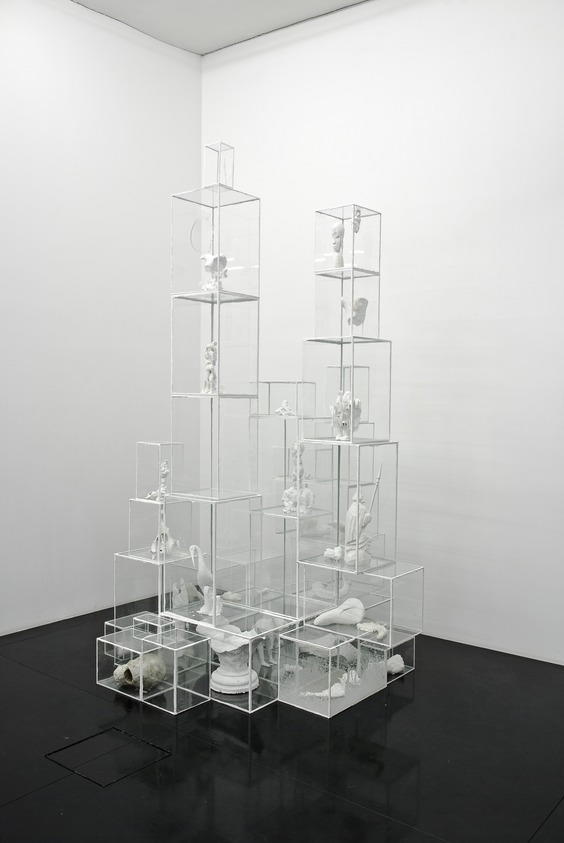
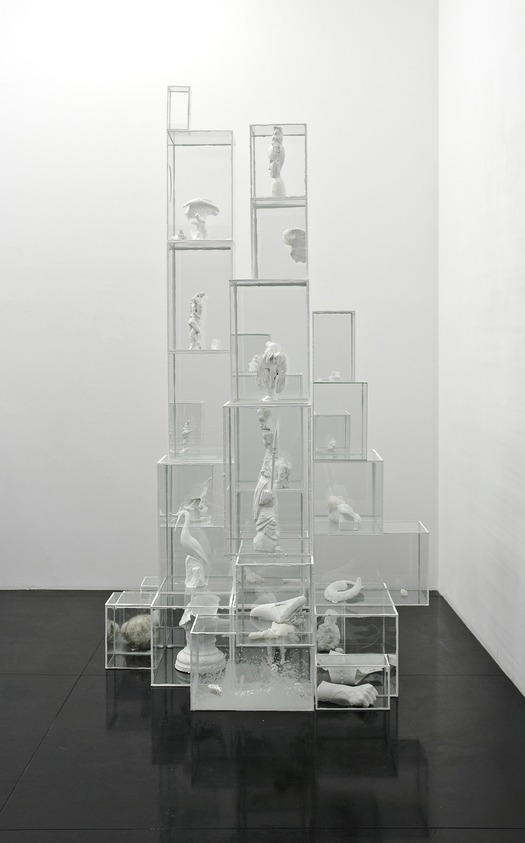
In contrast, Terence Koh, inspired by queer, punk, and DIY cultures, belongs to a 1990s generation whose work is more personally inflected. Embracing decay and ephemerality, Untitled (Vitrines) displays whitewashed objects collected from friends, lovers, Koh’s childhood, and flea markets, acting almost as a shrine preserving relics from his life. The sculpture departs significantly from LeWitt’s strict vision yet engages with the legacies of Minimalism and Conceptual art, exploring the possibilities of the grid and the monochrome and extending those formal considerations into the personal realm.
In contrast, Terence Koh, inspired by queer, punk, and DIY cultures, belongs to a 1990s generation whose work is more personally inflected. Embracing decay and ephemerality, Untitled (Vitrines) displays whitewashed objects collected from friends, lovers, Koh’s childhood, and flea markets, acting almost as a shrine preserving relics from his life. The sculpture departs significantly from LeWitt’s strict vision yet engages with the legacies of Minimalism and Conceptual art, exploring the possibilities of the grid and the monochrome and extending those formal considerations into the personal realm.
Caption
Terence Koh (Canadian, Shanghai, China, born 1977). Untitled (Vitrines), 2006. Mixed media, variable. Brooklyn Museum, Gift of Peres Projects, Inc., 2008.34. (Photo: Courtesy Peres Projects, Berlin Los Angeles. ? Lutz Bertram, Berlin)
Gallery
Not on view
Collection
Gallery
Not on view
Collection
Artist
Title
Untitled (Vitrines)
Date
2006
Medium
Mixed media
Classification
Dimensions
variable
Credit Line
Gift of Peres Projects, Inc.
Accession Number
2008.34
Frequent Art Questions
Why does this have a hole in it? Did the artist do this intentionally?
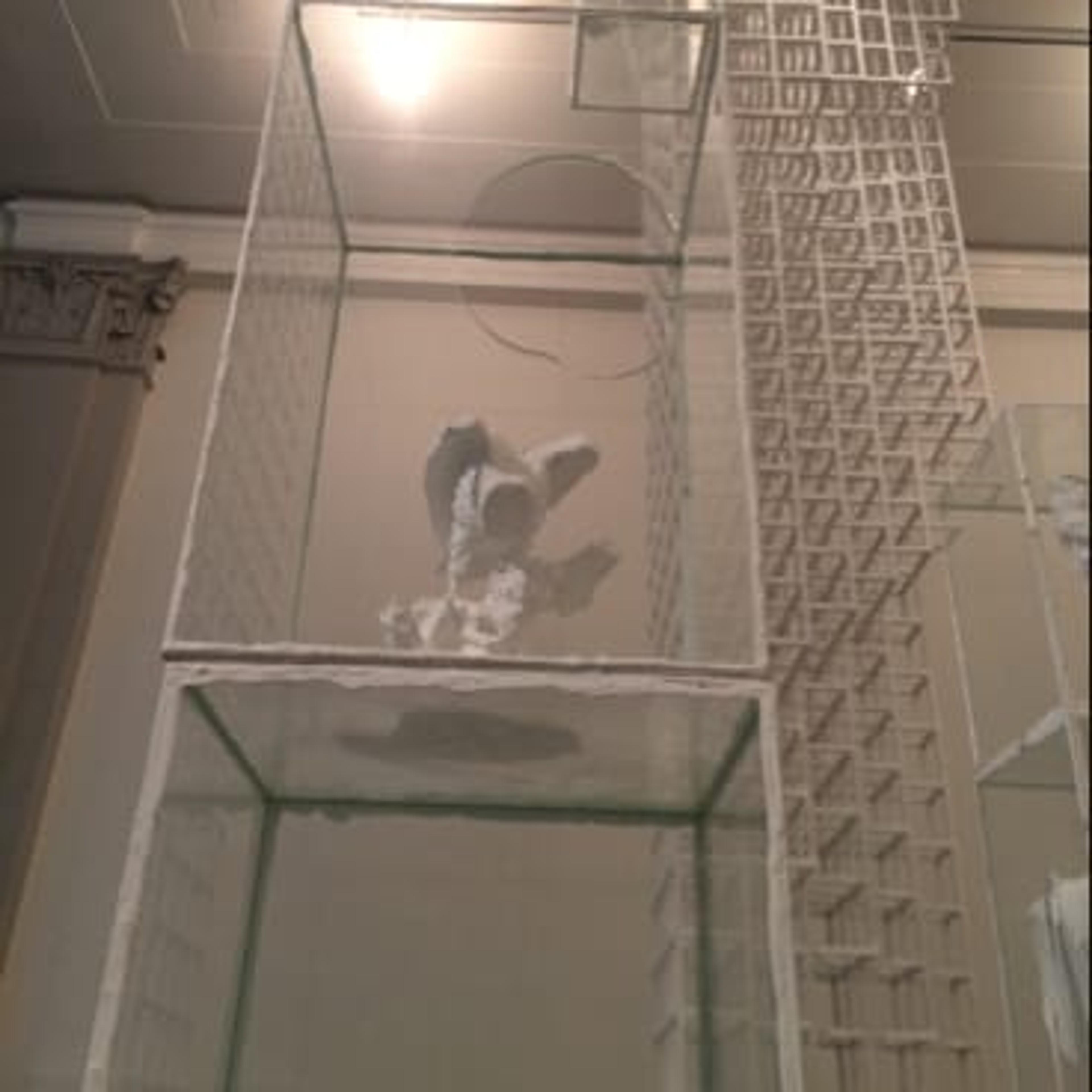 The hole is definitely a detail created by the artist, Terence Koh. He is interested in exploring ideas of ephemerality and decay. In this work Koh creates something like a shrine, with these items preserved as "relics." You could also think of it as an artistic take on the kind of display case you might see at a natural history, filled with objects of organic and inorganic materials.However, I am not certain why the artist felt compelled to make a hole in the vitrine. Contemporary artists often don't provide a lot of explanation about their work, in part to leave the meaning of the work open to interpretation. In my opinion the hole adds to this sense of decay, and I think it could also be read as an opportunity for escape.
Why are these paired?
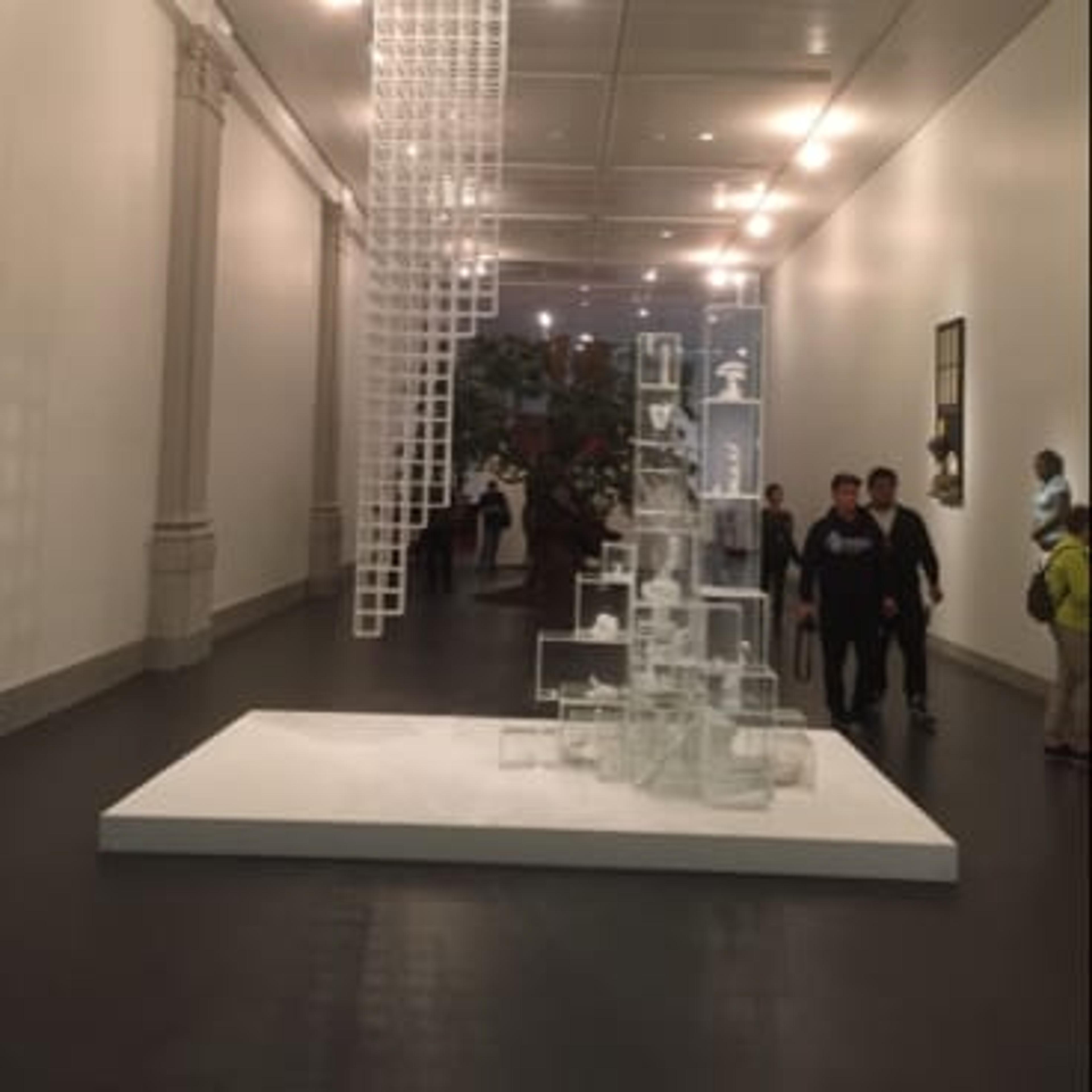 I love the juxtaposition of those two works. Both have grid-like formats but the Terence Koh is so individual and emotional, filled with objects that have personal meaning for him, while the Sol LeWitt is purely conceptual and makes us think about space and volume in an almost mathematical way.
Have information?
Have information about an artwork? Contact us at