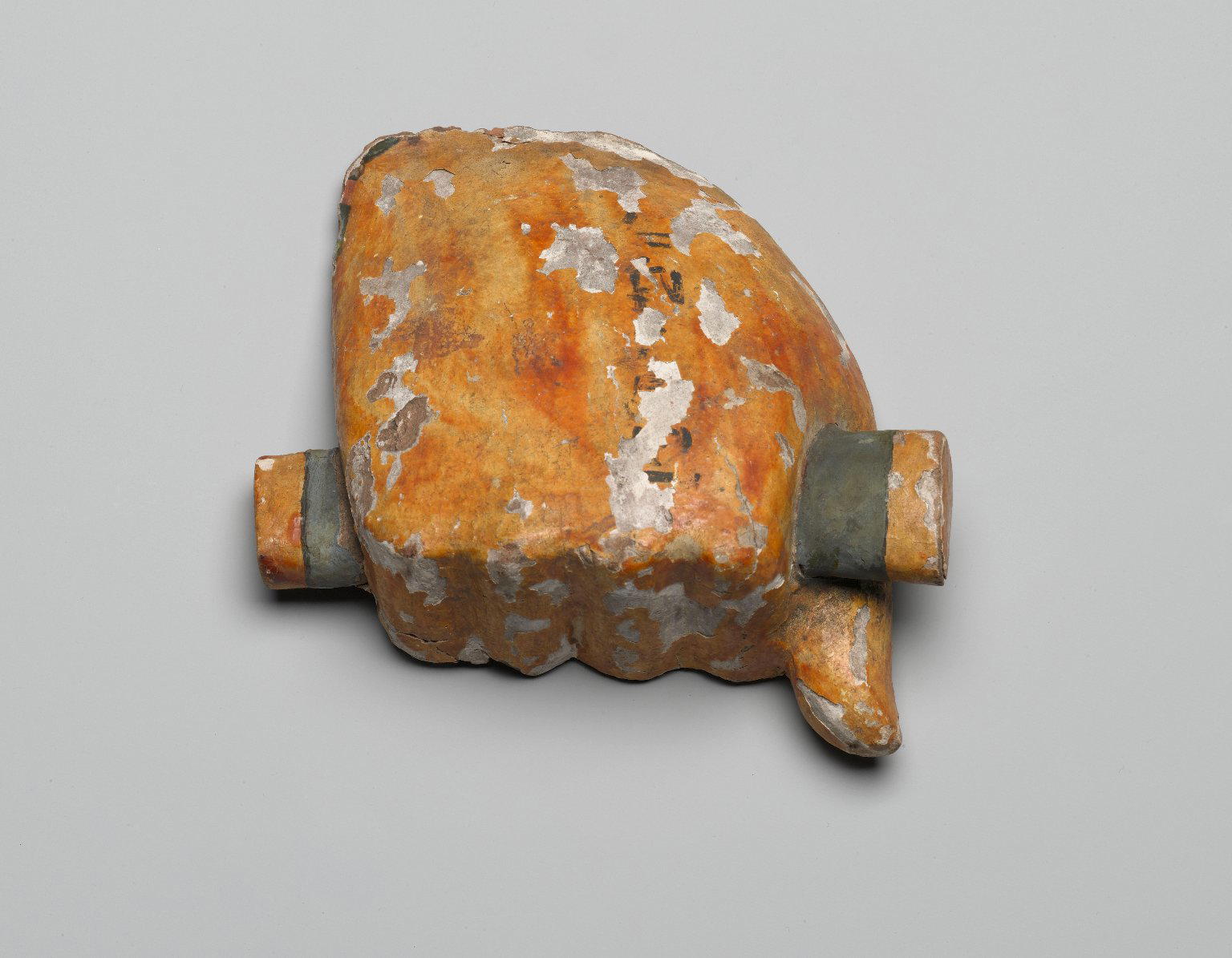
Right Fist Holding Folded Cloth
ca. 1075–656 B.C.E.




1 of 7
Object Label
Hands on wooden, anthropoid coffins were usually crossed over the chest to resemble depictions of the god Osiris. They were frequently modeled and attached separately by means of pegs, a hole for which is visible in the middle of the flat hand with rings (3).
The hand originally belonged to the coffin of a woman, while the clenched fist holding a short stave (4) is characteristic of men’s coffins. An unusual and damaged inscription on the fist, running from the knuckles to the wrist, appears to be the name of the deceased. The yellow hue of both hands evokes the Egyptian belief that gods, and thus the deceased associated with them, have golden skin.
The hand originally belonged to the coffin of a woman, while the clenched fist holding a short stave (4) is characteristic of men’s coffins. An unusual and damaged inscription on the fist, running from the knuckles to the wrist, appears to be the name of the deceased. The yellow hue of both hands evokes the Egyptian belief that gods, and thus the deceased associated with them, have golden skin.
Caption
Right Fist Holding Folded Cloth, ca. 1075–656 B.C.E.. Wood, gesso, pigment, resin, 5 9/16 x 2 1/16 x 5 7/8 in. (14.2 x 5.3 x 15 cm). Brooklyn Museum, Charles Edwin Wilbour Fund, 37.2041.13E. (Photo: Brooklyn Museum)
Gallery
Not on view
Gallery
Not on view
Have information?
Have information about an artwork? Contact us at