Twin-Spouted Vessel with Mountain Goat Handles


1 of 3
Object Label
These ceramics demonstrate ancient Iranian artists’ interest in creating containers and other ritual instruments in the shape of mammals or birds. This tradition was of incredible duration, stretching back to about 3000 B.C.E. of the Neolithic period and lasting as late as the sixth century C.E. These shapes relate Iranian art to the customs of neighboring regions of Mesopotamia, Greece, and Central Asia where animal art also played an integral role.
Caption
Twin-Spouted Vessel with Mountain Goat Handles, 250–100 B.C.E.. Clay, slip, height 13 1/16 x diam. 10 1/2 x width 8 1/16 in. (33.1 x 26.6 x 20.4 cm). Brooklyn Museum, Gift of the Arthur M. Sackler Foundation, NYC, in memory of James F. Romano, 2015.65.14. (Photo: Brooklyn Museum)
Gallery
Not on view
Gallery
Not on view
Title
Twin-Spouted Vessel with Mountain Goat Handles
Date
250–100 B.C.E.
Period
Early Parthian Period
Geography
Place made: Germi region, Eastern Azerbaijan, Azerbaijan
Medium
Clay, slip
Classification
Dimensions
height 13 1/16 x diam. 10 1/2 x width 8 1/16 in. (33.1 x 26.6 x 20.4 cm)
Credit Line
Gift of the Arthur M. Sackler Foundation, NYC, in memory of James F. Romano
Accession Number
2015.65.14
Frequent Art Questions
Could you tell me about this one please?
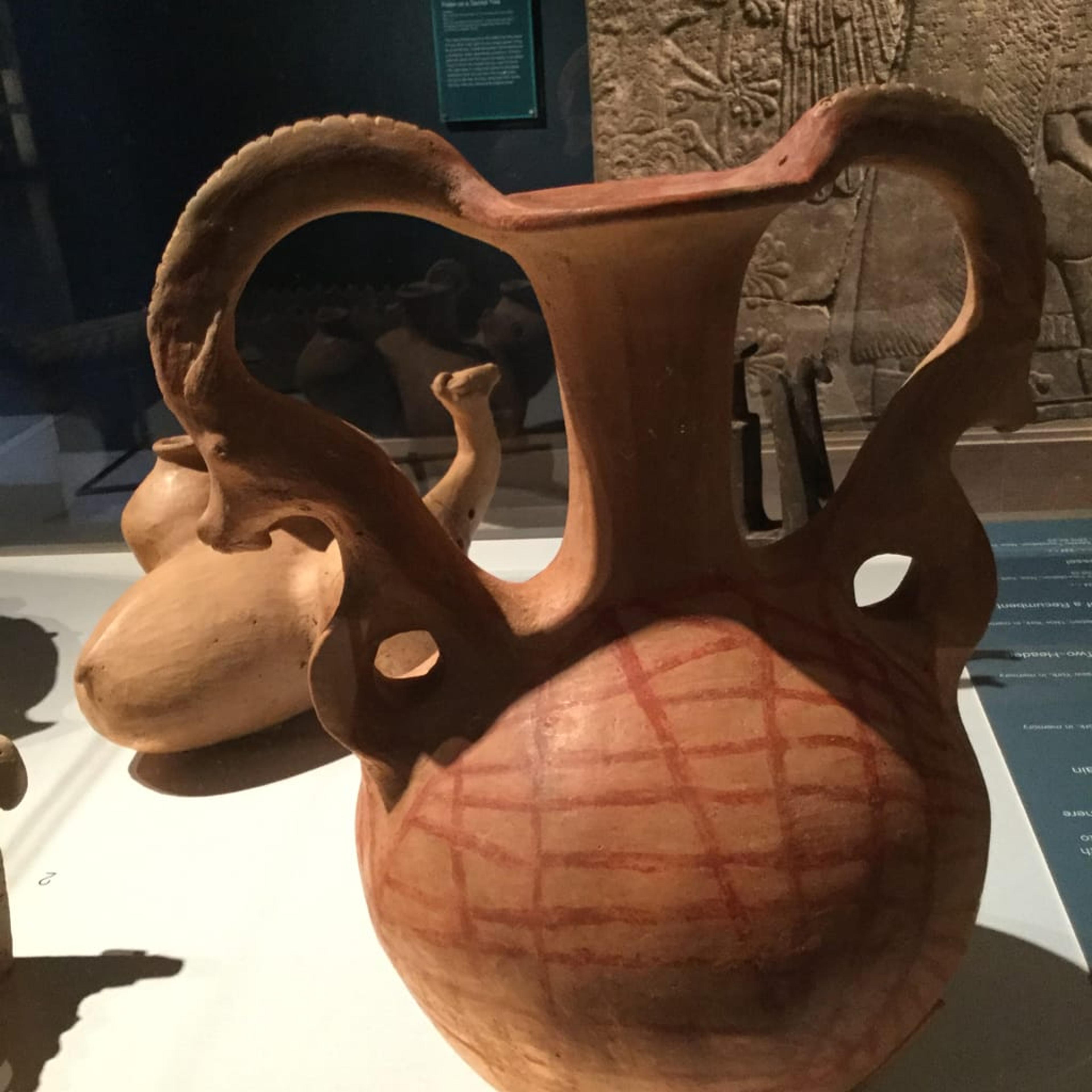 If you look you can see two tiny feet at the base of the jug. These are actually very small spouts. Through these spouts, two people would be able to drink from the vessel at once. This is possibly an item that would have been used to seal a bond, for instance a marriage or alliance. On the other hand, it is also possible it was an item used at social events for entertainment value.
This looks heavy. What type of clay is it made of, and do you know how it was made?
The clay would have been locally sourced iron-rich clay from the area that is now Western Iran or Eastern Azerbaijan, accounting for the red hue. The handles are hand formed and it is covered in cream slip and red paint. The body of the vessel is wheel-thrown.Hm, so the red is the true color? Do you know what was used to make the paint and slip?Yes, the red is the true color. If the artist wanted to achieve a darker surface, they would have altered the oxygen levels in the kiln during firing via a process called reduction firing.The slip would have been made of the same substance as the clay, while the red decoration was likely achieved using pigment made of iron oxide or red ochre.Ok, thank you.
Have information?
Have information about an artwork? Contact us at