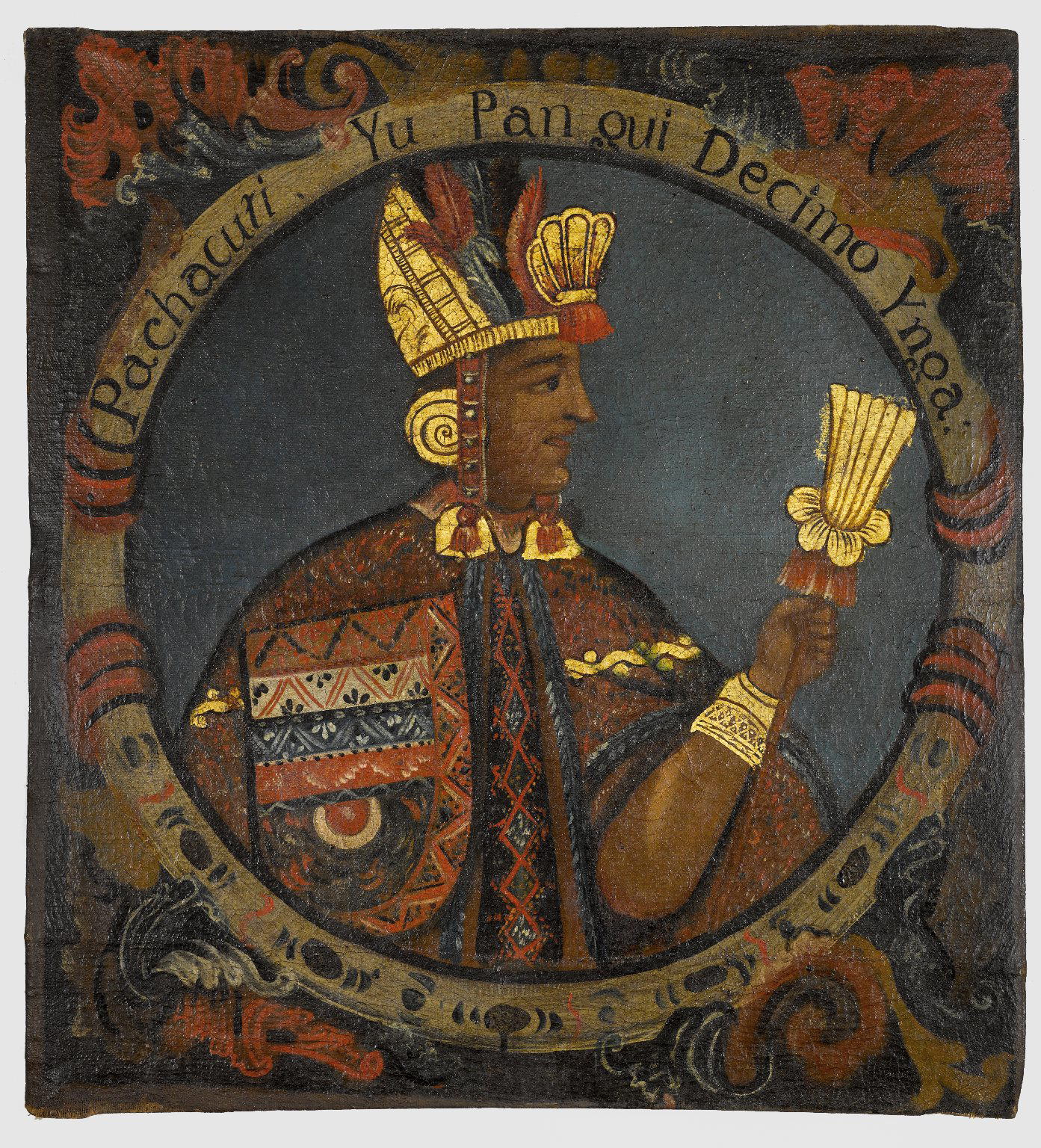
Pachacuti, Tenth Inca, 1 of 14 Portraits of Inca Kings
Brooklyn Museum photograph
Object Label
Throughout the embattled environment of the colonial Americas—above and below the equator—portraits served as potent symbols of political and social power. The Brooklyn Museum's strong holdings of Spanish colonial art afford an unusual opportunity to study American colonial portraiture on the broadest possible level. Portraits of the historical kings of the Inca dynasty of Peru—including this eighteenth-century example—were a type that originated in the context of the vying powers of native and Spanish rule in the city of Cuzco. Native artists in that city, the ancient highland center of Inca culture and a native stronghold throughout the colonial period, began producing the type about 1600 for Spanish patrons, adopting a European portrait mode but adding native facial characteristics and indigenous costumes for authenticity. Although these portraits were in a sense inventions—there were no actual historical likenesses on which they could have been based—they nevertheless served to "document" for the Spanish the powerful dynasty vanquished by the Conquest in 1541. At the same time, they were commissioned and prized by Cuzco's surviving Inca aristocracy, for whom they represented an illustrious and royal heritage. Because they reinforced the notion of Inca power, portraits of the native kings were banned and destroyed after the outbreak of Inca rebellions in the 1780s. After the demise of Spanish rule in 1824, surviving examples such as these became highly valued tourist souvenirs; the group of fourteen in the Museum's collection was collected by the Dutch-descended New Yorker Frederic de Peyster.
Caption
Unknown Artist; Peruvian. Pachacuti, Tenth Inca, 1 of 14 Portraits of Inca Kings, mid–18th century (probably). Oil on canvas, 23 9/16 x 21 9/16in. (59.8 x 54.8cm) frame: 29 1/8 x 27 5/16 x 2 13/16 in. (74 x 69.4 x 7.1 cm). Brooklyn Museum, Dick S. Ramsay Fund, Mary Smith Dorward Fund, Marie Bernice Bitzer Fund, Frank L. Babbott Fund, gift of The Roebling Society and the American Art Council, purchased with funds given by an anonymous donor, Maureen and Marshall Cogan, Karen B. Cohen, Georgia and Michael deHavenon, Harry Kahn, Alastair B. Martin, Ted and Connie Roosevelt, Frieda and Milton F. Rosenthal, Sol Schreiber in memory of Ann Schreiber, Joanne Witty and Eugene Keilin, Thomas L. Pulling, Roy J. Zuckerberg, Kitty and Herbert Glantz, Ellen and Leonard L. Milberg, Paul and Thérèse Bernbach, Emma and J. A. Lewis, Florence R. Kingdon, 1995.29.10. (Photo: Brooklyn Museum)
Gallery
Not on view
Collection
Gallery
Not on view
Collection
Artist
Culture
Title
Pachacuti, Tenth Inca, 1 of 14 Portraits of Inca Kings
Date
mid–18th century (probably)
Period
Colonial Period
Geography
Place made: Peru
Medium
Oil on canvas
Classification
Dimensions
23 9/16 x 21 9/16in. (59.8 x 54.8cm) frame: 29 1/8 x 27 5/16 x 2 13/16 in. (74 x 69.4 x 7.1 cm)
Inscriptions
On roundel: "Pachacuti Yu Pan qui Decimo Ynqa"
Credit Line
Dick S. Ramsay Fund, Mary Smith Dorward Fund, Marie Bernice Bitzer Fund, Frank L. Babbott Fund, gift of The Roebling Society and the American Art Council, purchased with funds given by an anonymous donor, Maureen and Marshall Cogan, Karen B. Cohen, Georgia and Michael deHavenon, Harry Kahn, Alastair B. Martin, Ted and Connie Roosevelt, Frieda and Milton F. Rosenthal, Sol Schreiber in memory of Ann Schreiber, Joanne Witty and Eugene Keilin, Thomas L. Pulling, Roy J. Zuckerberg, Kitty and Herbert Glantz, Ellen and Leonard L. Milberg, Paul and Thérèse Bernbach, Emma and J. A. Lewis, Florence R. Kingdon
Accession Number
1995.29.10
Frequent Art Questions
Who are they?
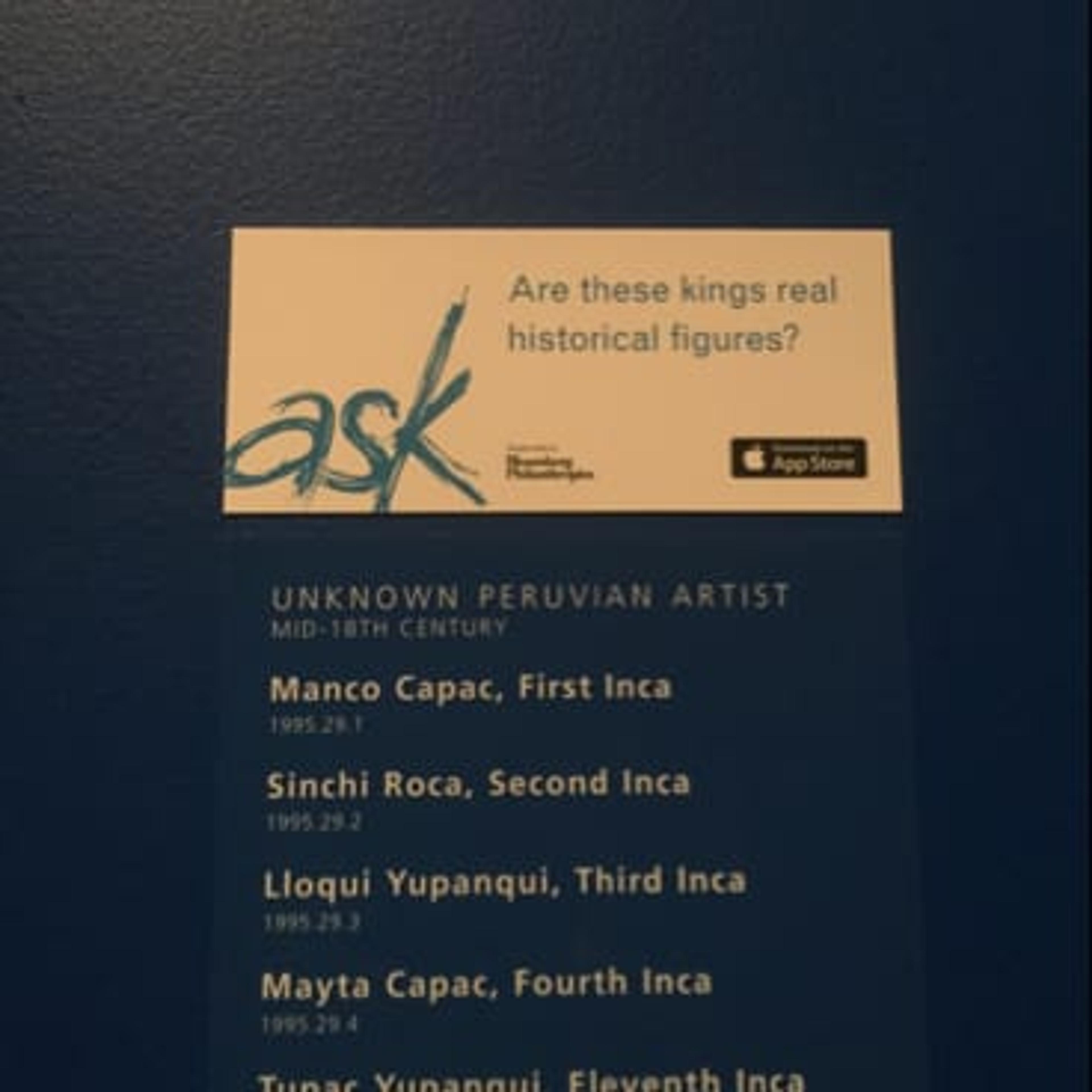 This series of 14 bust-length portraits represents historical Inca kings. Their names and positions in the line of royal succession are inscribed on the decorative roundels around each portrait.
I was wondering if these chiefs are real historical figures?
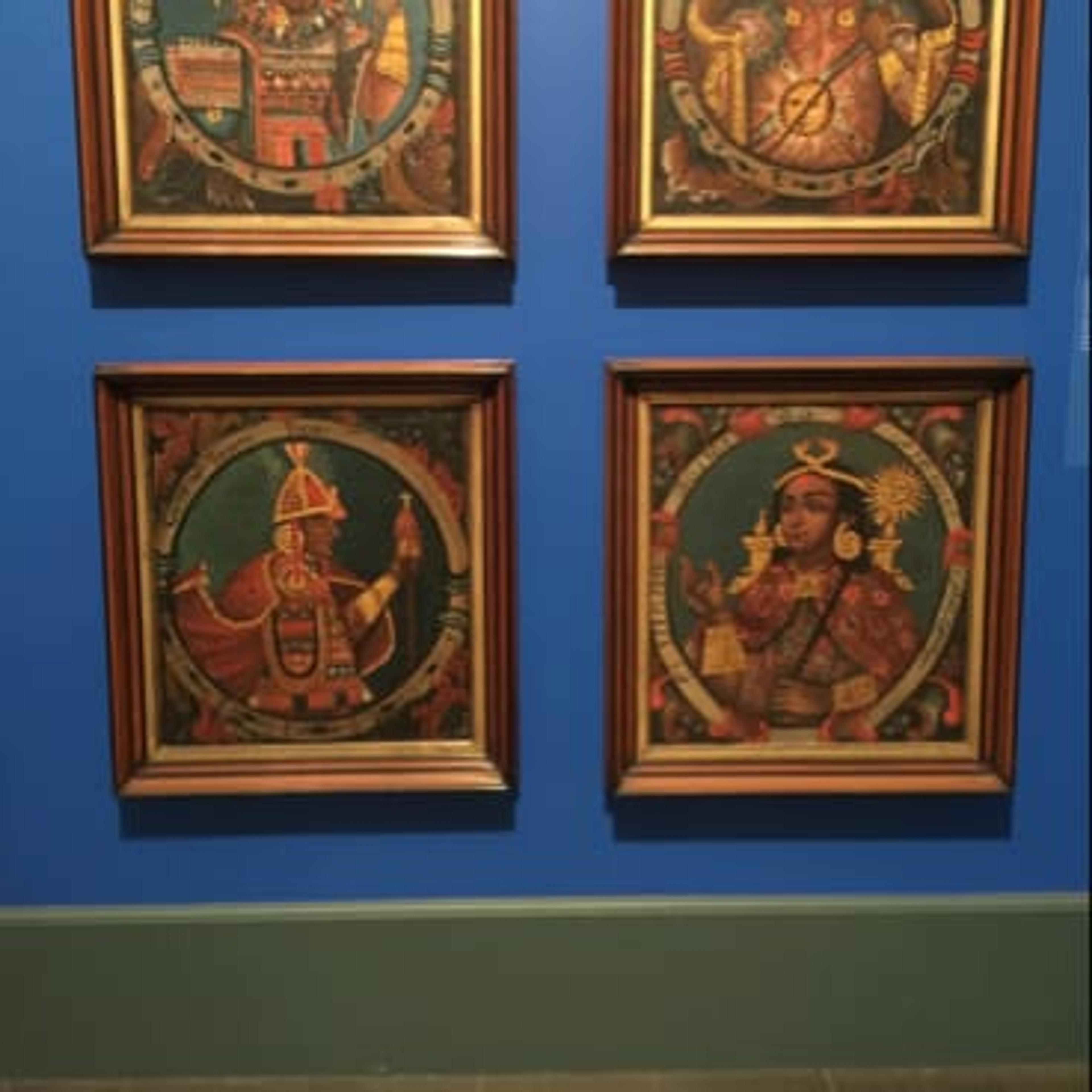 Yes, they are. This series of 14 bust-length portraits represents historical Inca kings.The earliest known Inca portraits were painted in Cuzco, the former capital of the Inca empire in the Peruvian Andes, as a kind of historical record. Painted for a local market, these portraits helped people to trace their lineage to the pre-Hispanic past. In Cuzco, they were visible manifestations, albeit in European form, of the ancestors who originally built the city. These portraits helped to maintain a historical identity of an idealized past existing prior to the Spanish Conquest.In order to legitimize claims to noble lineage in the viceroyalty of Peru, members of the Inca elite often conspicuously displayed in their homes Europeanized portraits of their ancestors, the fourteen ancient Andean rulers.Any idea if they're related or if they were elected by people? And also what time period did they rule?Yes, they were related. For example: Sinchi Roca, Second Inca King was the son and successor of Manco Cápac and the father of Lloque Yupanqui, the third Inca King. I do not believe they were elected by the people. The first Inca King, Manco Capac ruled from 1500-1545. They all ruled for an average of 30 years.
Were these painted before or after Emperor Pachacuti's rule?
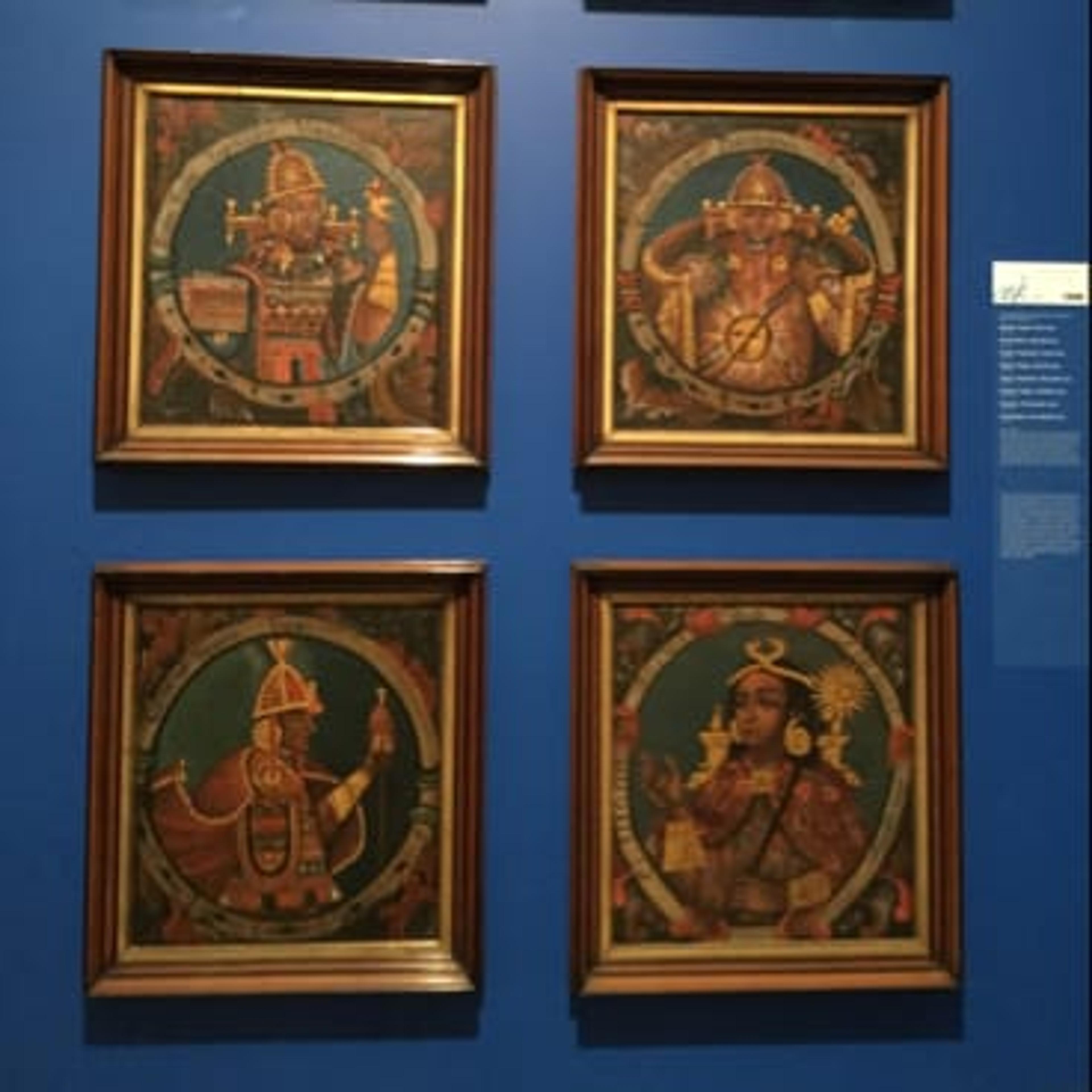 They are much later than the reign of Pachacuti. He lived during the 15th century and these were all painted in the 18th. And actually, one of the portraits is of Emperor Pachacuti.
Tell me more.
The tenth king of the Inca, Pachacuti, transformed the Kingdom of Cusco into the empire Tawantinsuyu or the Inca Empire. The famous site of Machu Picchu was very probably built as an estate for this king!Pachacuti means "he who shakes the earth,"a reference to how big an impact he had on his empire!What do these works convey about the Incas?
These paintings were meant to convey a sense of pride in Inca heritage. They were created in the Spanish colonial period in the city of Cuzco, which had been the capital of the Inca Empire. This set would have belonged to an indigenous elite family.The medium of oil painting, however, illustrates a blending of cultures in colonial Peru. The technique was something the Inca adopter from the European invaders, but that quickly became very popular.I’m ten years old and I’m wondering what these are! Do they represent months?
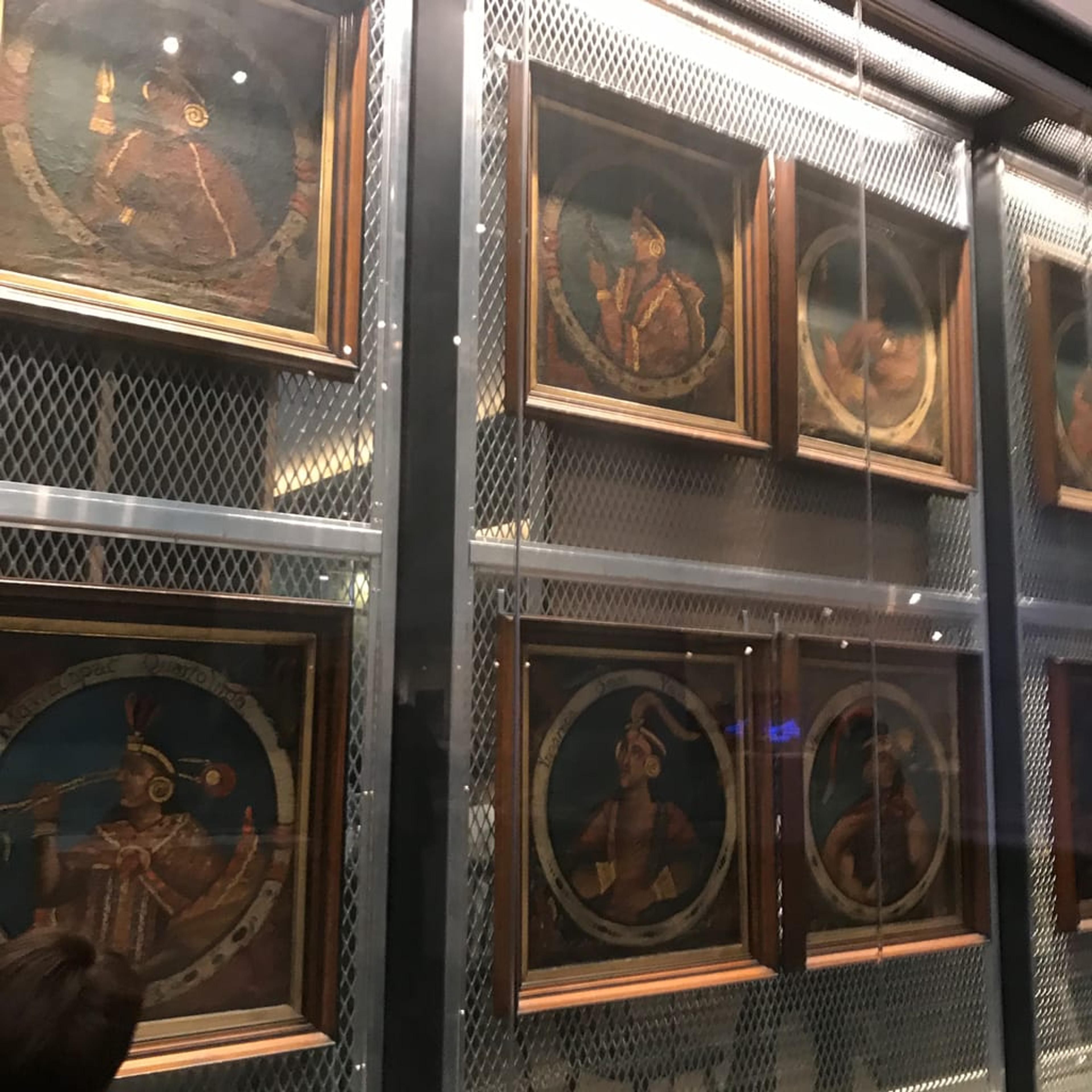 That is a really good guess but no, these are portraits of twelves of the fourteen historical Inca kings!Interesting!They would have been proudly displayed in the home of a wealthy indigenous family in colonial-era Cuzco.Some of the kings had been dead for hundreds of years by the time these portraits were made. Painting them was a way of honoring the family's cultural history.Thank you!
What do the words above the portraits mean? Are they describing an important date?
The writing above each portrait is the name and title for each individual.For example, one reads, "Aiarmanqo Capac Primer Rey. Del Cuzco." "Manco Capac" translates to "Powerful Ancestor."Thank you so much. This was very helpful and informative!So I read these were from Inca aristocracy from the 18th century. How much of that culture was left by then? Up in the mountains of the Andes?
These portraits were painted in Colonial Cuzco, the historical capital of the Inca Empire; they would have been proudly displayed in the home of an indigenous elite.Even at this time, around the mid 18th century, there was still an acknowledgment of the Incan past before colonization.These portraits would have been an important demonstration of royal genealogy for indigenous elite families in the new social order.
Have information?
Have information about an artwork? Contact us at