L'Odalisque
Henri Matisse
Brooklyn Museum photograph
Object Label
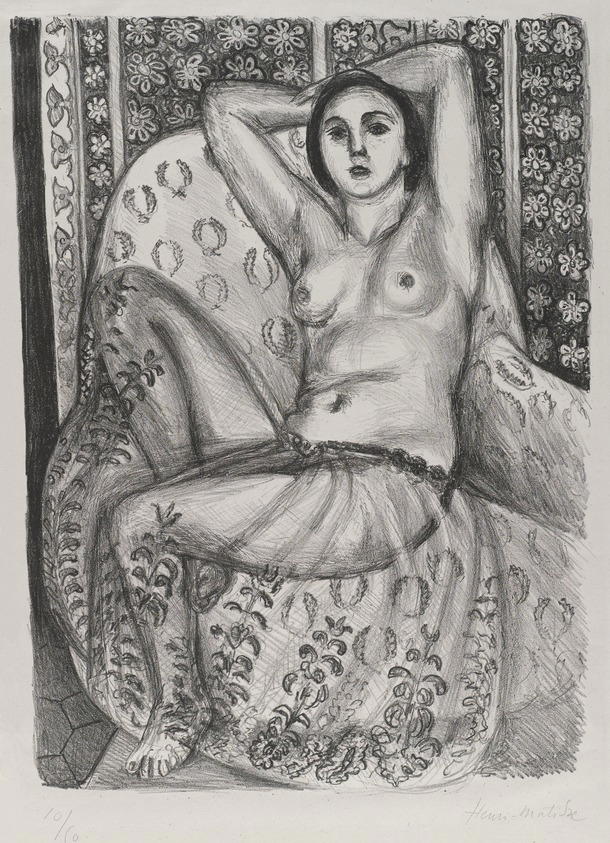
For Henri Matisse, printmaking was an extension of drawing. The 1920s marked a period of increased graphic output by the artist, including a series of lithographs depicting the model Henriette Darricarrère posing as an odalisque, the term for an enslaved woman in a harem. With the lithographic crayon Matisse achieved a charcoal-like effect, rendering in velvety tones the contours of her nude body, the texture of her transparent skirt, and the richly patterned studio background. In doing so, he also aestheticized sexual subjugation, like the many European artists before him who had trafficked in literary and pictorial fantasies and stereotypes of non-Western cultures.
In 1935 Odalisque was included in the first large-scale, monographic exhibition of prints by Matisse, held at the Brooklyn Museum. There its subject caused a stir, according to the Brooklyn Museum Quarterly: “The predominant subject throughout the prints was of course the female nude and the presentation of this subject was received rather noisily and with emotions as mingled as the visitors were varied.”
Titus Kaphar: I think [it] would be a really amazing performance . . . to bring these characters, these individuals, back to life—Matisse, Picasso, Gauguin—and to actually bring them into this space where their works are, to have them look at their space, enter and stand in front of these pieces and have them come in this moment where all the history we’ve experienced, we’ve seen, and force them to wrestle with it. Ultimately duct tape them, sit them in a chair, put them in a corner, and say, “We don’t want to hear anything you have to say. The one thing we are going to give you is you made beautiful pictures. That’s it. Now shut up and we are going to talk about this ourselves.” I think it’s a little too direct to be great art, but it would be fun to see. It would be really fun to see. I would go to that performance.
In 1935 Odalisque was included in the first large-scale, monographic exhibition of prints by Matisse, held at the Brooklyn Museum. There its subject caused a stir, according to the Brooklyn Museum Quarterly: “The predominant subject throughout the prints was of course the female nude and the presentation of this subject was received rather noisily and with emotions as mingled as the visitors were varied.”
Titus Kaphar: I think [it] would be a really amazing performance . . . to bring these characters, these individuals, back to life—Matisse, Picasso, Gauguin—and to actually bring them into this space where their works are, to have them look at their space, enter and stand in front of these pieces and have them come in this moment where all the history we’ve experienced, we’ve seen, and force them to wrestle with it. Ultimately duct tape them, sit them in a chair, put them in a corner, and say, “We don’t want to hear anything you have to say. The one thing we are going to give you is you made beautiful pictures. That’s it. Now shut up and we are going to talk about this ourselves.” I think it’s a little too direct to be great art, but it would be fun to see. It would be really fun to see. I would go to that performance.
Caption
Henri Matisse (Le Cateau–Cambrésis, France, 1869 – 1954, Nice, France). L'Odalisque, 1924. Lithograph on laid paper, Image: 14 3/8 x 10 3/8 in. (36.5 x 26.4 cm) Sheet: 20 1/4 x 14 3/4 in. (51.4 x 37.5 cm). Brooklyn Museum, Museum Collection Fund, 25.123. (Photo: Brooklyn Museum)
Gallery
Not on view
Gallery
Not on view
Artist
Have information?
Have information about an artwork? Contact us at