Tray-Top Table


1 of 2
Object Label
Mahogany sourced from estates in the Caribbean was sent to ports along the Atlantic seaboard, including Portsmouth, New Hampshire. There, cabinetmaking workshops owned by British-born or British-descended settlers such as Robert Harrold of Portsmouth copied fashionable designs from England to produce furniture for wealthy white merchants and landowners.
Caption
Attributed to Robert Harrold (American, born England, 18th century). Tray-Top Table, ca. 1770. Mahogany and mahogany veneer, 29 1/4 x 34 1/2 x 23 1/2in. (74.3 x 87.6 x 59.7cm). Brooklyn Museum, Matthew Scott Sloan Collection, Gift of Lidie Lane Sloan McBurney, 1997.150.16. (Photo: Brooklyn Museum)
Gallery
Not on view
Collection
Gallery
Not on view
Collection
Title
Tray-Top Table
Date
ca. 1770
Geography
Place made: Portsmouth, New Hampshire, United States
Medium
Mahogany and mahogany veneer
Classification
Dimensions
29 1/4 x 34 1/2 x 23 1/2in. (74.3 x 87.6 x 59.7cm)
Markings
Yellowed paper adhesive label with a red border declares the piece as property of Mr. M.S. Sloan. On the underside of the piece "456.R" is written in chalk. On the right side of the piece, inscribed in red paint are the numbers "14-1924-21".
Credit Line
Matthew Scott Sloan Collection, Gift of Lidie Lane Sloan McBurney
Accession Number
1997.150.16
Frequent Art Questions
What is this style called?
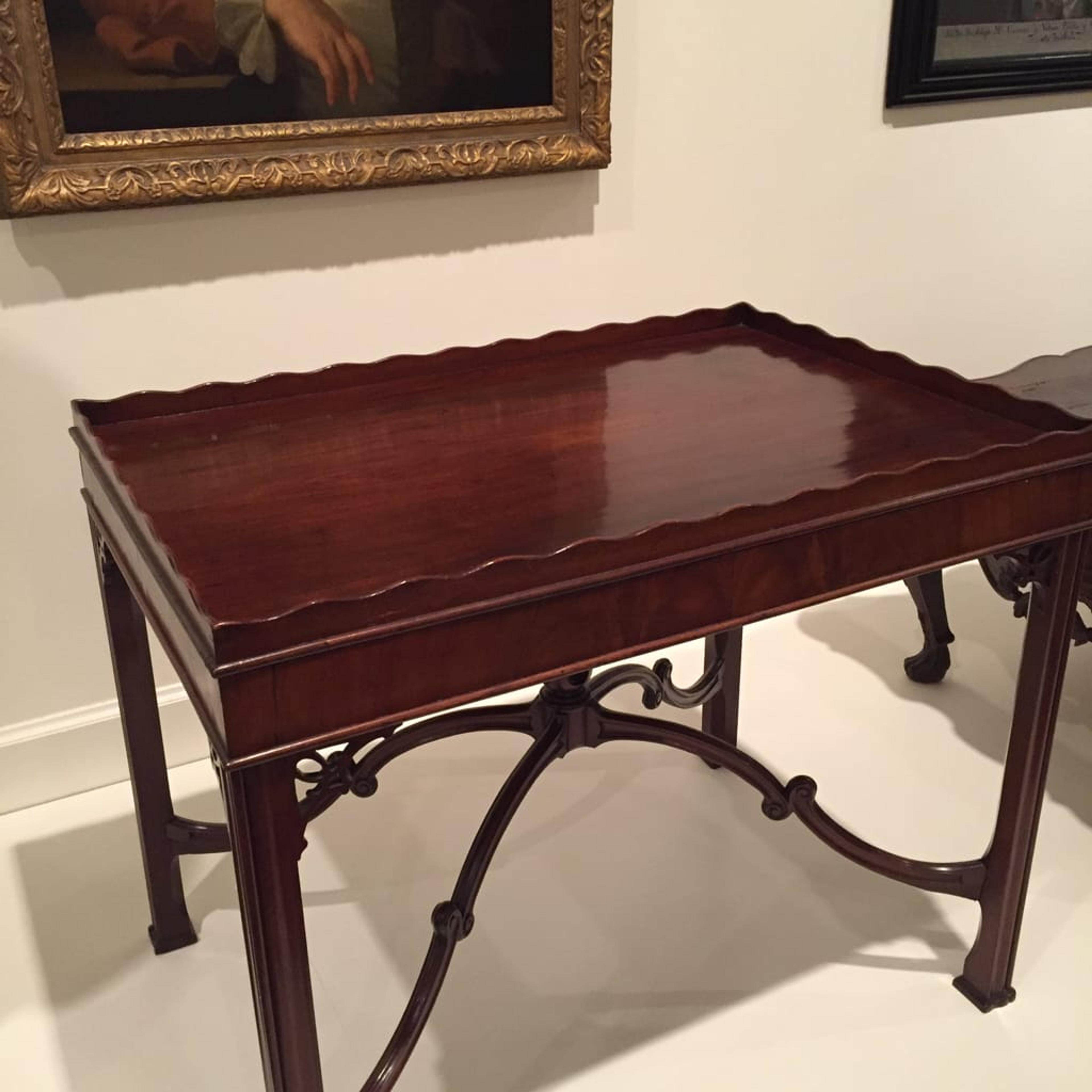 This tray-table is in the "Chippendale" style, after the London cabinetmaker Thomas Chippendale, whose published designs were copied by furniture makers living and working in Colonial America.Chippendale combined elements of various styles. The curved stretchers connecting the legs are in the Rococo style. But the legs themselves look like Gothic columns and the openwork carving in the corners is Gothic as well. Chippendale often incorporated Chinese motifs, although that is not seen in this particular piece.Is the top solid mahogany?The bottom is carved from solid mahogany and the tray top is veneered. If you look closely at the side of the tray, you will see "book match" veneering, where matching pieces of mahogany have been placed to create a mirrored pattern, like an open book.
Have information?
Have information about an artwork? Contact us at