Union Square
Julian Alden Weir
Brooklyn Museum photograph
Object Label
The Conservator's Eye
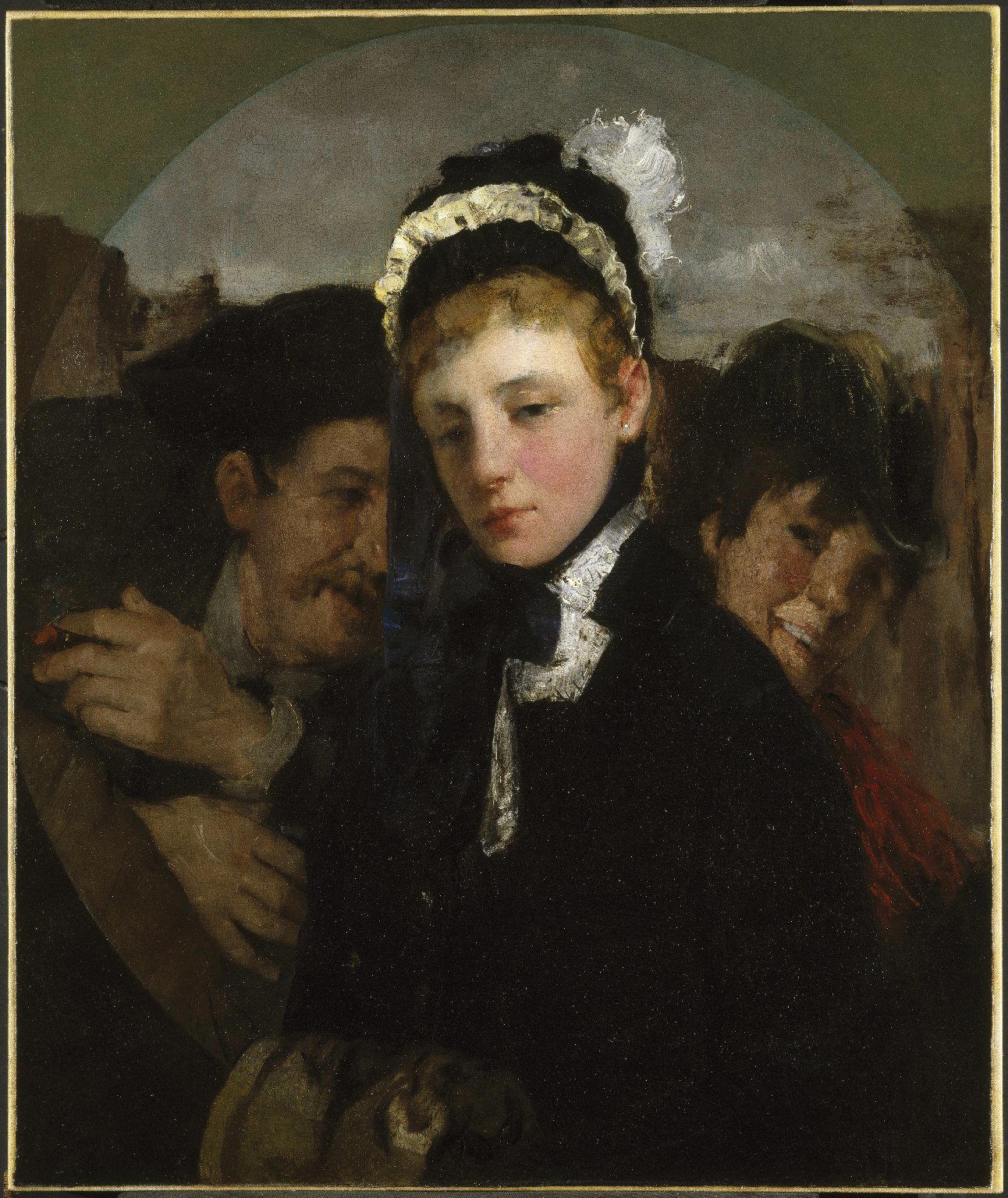
Set in Manhattan’s Union Square, this scene captures the urban street types and bohemian artists who populated the neighborhood.
Julian Alden Weir cut apart a larger composition titled In the Park sometime after it received harsh criticism at the 1879 Society of American Artists exhibition. One of three fragments, Union Square was cut in the shape of an oval and expanded into a rectangle through the addition of four spandrels, the triangular additions at the corners. Weir extended the composition onto the additions, filling in the sky and the bottom of the central figure’s fur muff. There is a tonal difference between the two generations of paint. This is because Weir matched the newer colors to a dirty varnish layer on the oval, which has since been cleaned away.
Set in Manhattan’s Union Square, this scene captures the urban street types and bohemian artists who populated the neighborhood.
Julian Alden Weir cut apart a larger composition titled In the Park sometime after it received harsh criticism at the 1879 Society of American Artists exhibition. One of three fragments, Union Square was cut in the shape of an oval and expanded into a rectangle through the addition of four spandrels, the triangular additions at the corners. Weir extended the composition onto the additions, filling in the sky and the bottom of the central figure’s fur muff. There is a tonal difference between the two generations of paint. This is because Weir matched the newer colors to a dirty varnish layer on the oval, which has since been cleaned away.
Caption
Julian Alden Weir (American, 1852–1919). Union Square, ca. 1879. Oil on canvas, 29 7/8 x 24 15/16 in. (75.9 x 63.4 cm) frame: 41 3/4 x 36 3/4 x 5 3/4 in. (106 x 93.3 x 14.6 cm). Brooklyn Museum, Museum Collection Fund, 26.410. (Photo: Brooklyn Museum)
Gallery
Not on view
Collection
Gallery
Not on view
Collection
Artist
Title
Union Square
Date
ca. 1879
Medium
Oil on canvas
Classification
Dimensions
29 7/8 x 24 15/16 in. (75.9 x 63.4 cm) frame: 41 3/4 x 36 3/4 x 5 3/4 in. (106 x 93.3 x 14.6 cm)
Signatures
Signed lower right: "J Alden Weir"
Credit Line
Museum Collection Fund
Accession Number
26.410
Frequent Art Questions
Why does there seem to be a halo around the figures?
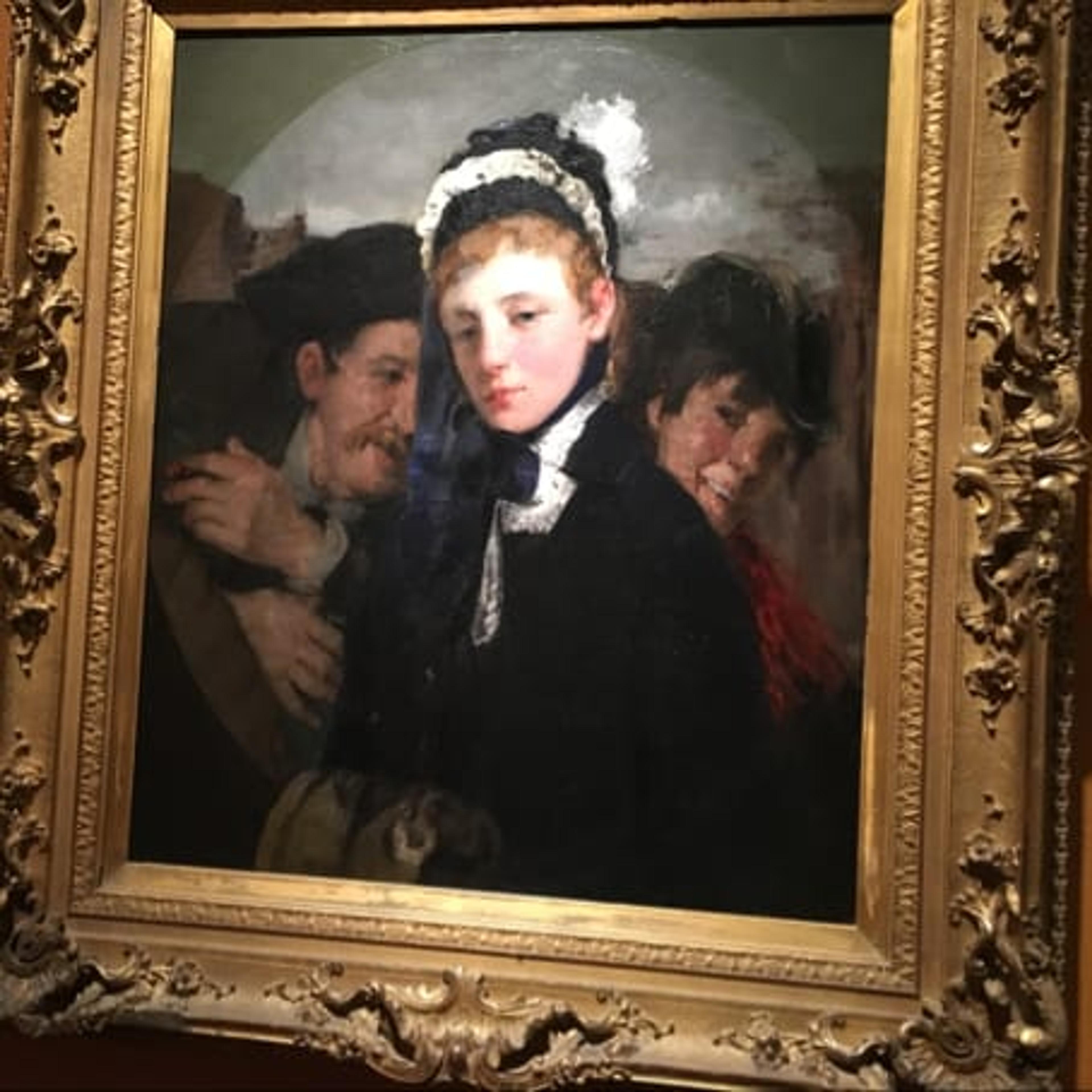 As the label might already explain, this is a fragment of a larger work originally titled "In the Park." After this piece was cut away from the original work, it was re-cut into an oval.Then those "spandrels" (triangular additions to the corners) were cut from another piece of canvas and added later. Weir painted them to fill out the composition into a rectangle again! He matched the colors on the spandrels to the colors resulting from the dark varnish that was on the original composition. Because the varnish was later removed, we're left with a lighter oval center. Complicated, right?Makes sense but yes, complicated!
Have information?
Have information about an artwork? Contact us at