Wadjet-Eyes and Papyrus Stalks
ca. 945–718 B.C.E. or later


1 of 5
Object Label
Living persons wore only one or a few amulets at a time, but mummies usually bear many amulets. The Ma’at amulet (no. 2) and heart scarabs (nos. 1, 3, 11), which occurred in many forms, guaranteed a successful judgment of the dead. The amulets of a hand (no. 8), lungs and a windpipe (no. 12), and wadjet-eyes (i.e., “healthy” eyes; no. 4) protected those parts of the body and also had connotations of resurrection and the unity or integrity of the mummy. The enigmatic aper amulet (no. 13) takes the form of the hieroglyph meaning “to be equipped,” perhaps in reference to the mummy’s preparation. The two crowns (nos. 5, 6) were symbols of power. The Heh insignia (no. 7), like the popular ankh-sign, denoted eternal life. Among the living, the frog (no. 9) and possibly also the hare (no. 10) suggested fertility. The amulets of the Four Sons of Horus (no. 15) perhaps served, as they did with canopic jars, to protect various organs of the body.
Caption
Wadjet-Eyes and Papyrus Stalks, ca. 945–718 B.C.E. or later. Faience, 2 1/4 × 1/2 × 2 3/8 in. (5.7 × 1.3 × 6.1 cm). Brooklyn Museum, Charles Edwin Wilbour Fund, 08.480.93. (Photo: Brooklyn Museum)
Gallery
Not on view
Gallery
Not on view
Frequent Art Questions
This color is beautiful! Can you tell me more about it?
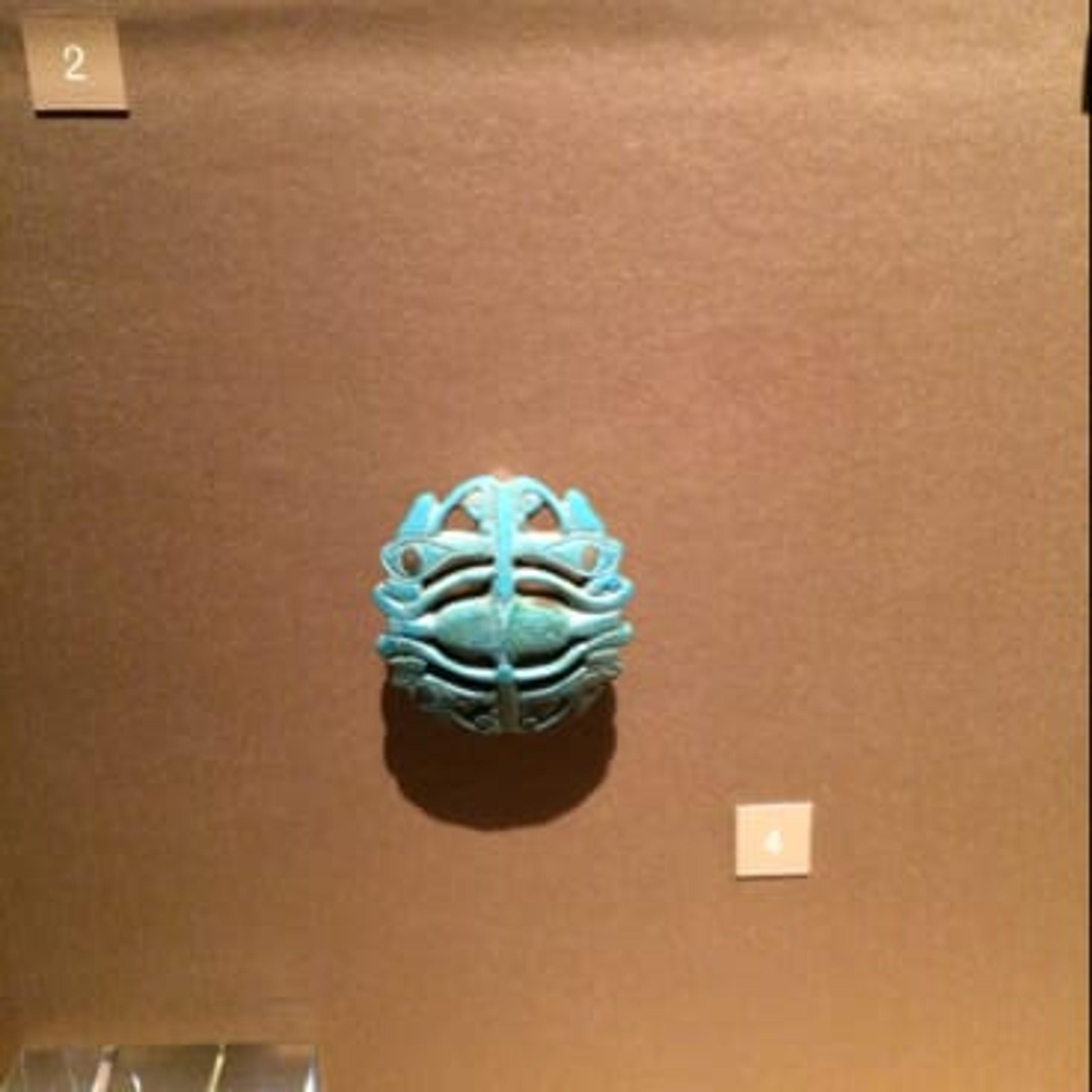 Thanks for trying our app in the Ancient Egyptian galleries today! That is a beautiful little object. For the Egyptians this lighter shade of blue was almost interchangeable with green, the color of the Nile, vegetation, and thus health and life. Faience (this kind of ceramic that was easy to color blue-green) was also a cheaper alternative to semiprecious stones like turquoise and lapis-lazuli.Thanks! It's neat to have that extra information.You're welcome! The color is a natural result of certain minerals (like copper) being added to the sand-based ceramic. They interact when the piece is fired at extremely high temperatures and that vibrant blue is a result. This piece combines imagery of lotus flowers with eyes known as "wedjat eyes." It would have been worn as an amulet for protection and strength.
Have information?
Have information about an artwork? Contact us at